A life almost entirely unknown
We know almost nothing about the life of Johannes Vermeer. Born in Delft in October 1632, he was baptised on the 31st in the Nieuwe Kerk. His father ran an inn and traded in paintings — the first connection with the art world. Vermeer married Catharina Bolnes in 1653, daughter of a wealthy Catholic woman, and probably converted to Catholicism for the marriage. They had fifteen children, eleven of whom survived.
He spent his entire life in Delft, seems never to have travelled, and produced at an extraordinarily slow pace — two or three paintings a year at most. His main income was not painting but the art trade he inherited from his father. He died in December 1675, deep in debt, leaving his family destitute. His widow attributed his death to the financial collapse caused by the war with France.
Vermeer's light: a silent revolution
What defines Vermeer is the light. Almost all his paintings show Dutch interiors — a kitchen, a parlour, a bedroom — traversed by lateral light entering through a window on the left. This light is not spectacular like Caravaggio's or Rembrandt's; it is soft, diffuse, enveloping. It models objects with photographic precision.
The milkmaid pouring her milk, the young woman reading a letter by a window, the lacemaker bent over her work: these ordinary, even banal scenes are transfigured by the quality of the light. Vermeer captures the moment when morning light enters a quiet room — and turns it into something eternal.
The camera obscura: was Vermeer cheating?
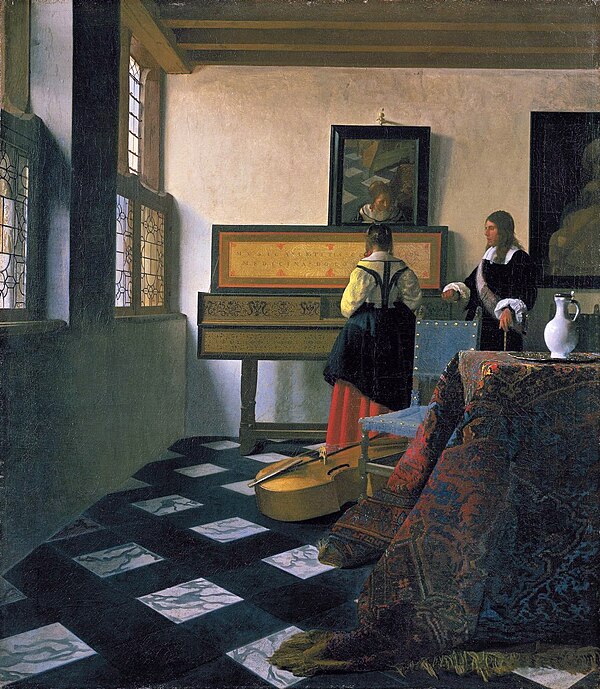
The optical perfection of Vermeer's paintings — impeccable perspectives, reflections on objects, depth-of-field blurring — led several researchers to propose that he used a camera obscura as a compositional aid. This instrument, which projects an inverted image of a scene onto a surface via an optical system, was known and used by artists of the period.
The filmmaker David Hockney and the physicist Charles Falco popularised this theory in the 2000s. Computer analyses of the perspectives and blur effects in certain Vermeer paintings appear to confirm the use of an optical device. But using an optical aid is not "cheating": it is understanding and mastering the tools available. The quality of the light and the subtlety of the tones remain purely pictorial achievements that no device can generate.
Vermeer forgotten, then rediscovered
After his death in 1675, Vermeer fell into almost complete obscurity for nearly two centuries. His paintings circulated under other names — Metsu, De Hooch, occasionally Rembrandt — and were undervalued. It was the art critic Théophile Thoré-Bürger who, in the 1860s, identified and assembled the Vermeer corpus, devoting resounding articles to him. The rediscovery was total and enthusiastic.
In the twentieth century, Vermeer's story took a novelistic turn with the Han van Meegeren affair: this Dutch forger produced several paintings "in the manner of Vermeer" in the 1930s and 1940s that fooled the most eminent experts. One was even sold to Field Marshal Göring for a colossal sum. Van Meegeren was unmasked only after the war, revealing the limits of connoisseurship when faced with a forger of genius.
Girl with a Pearl Earring: the Mona Lisa of the North
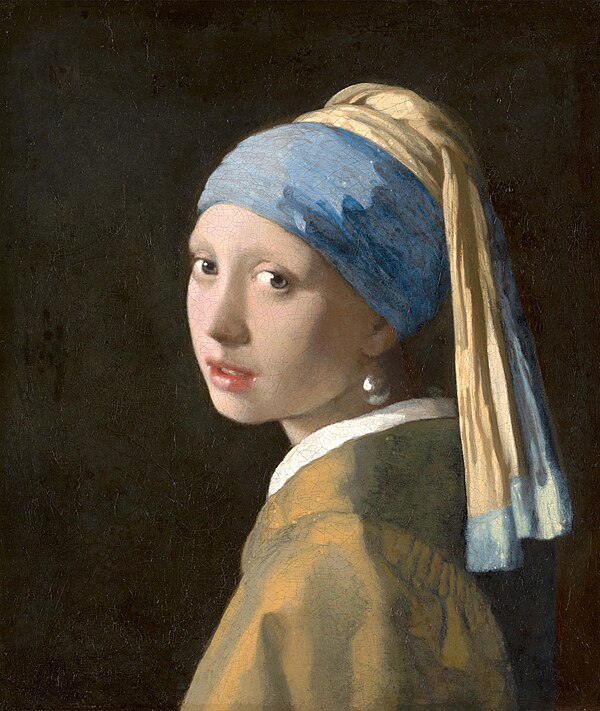
Among Vermeer's 35 paintings, Girl with a Pearl Earring (c. 1665) has become the most celebrated — popularised above all by the novel by Tracy Chevalier (1999) and the film adapted from it (2003, with Scarlett Johansson). The gaze of that face turned over the shoulder, the parted lips, the luminous pearl at the ear: these details exercise a fascination comparable to the Mona Lisa's smile.
The identity of the model is unknown. Some historians suggest a daughter of Vermeer; others see an ideal type rather than a real portrait. That very uncertainty is very Vermeer: in a body of work about which almost nothing is known, mystery is entirely at home.