A Provençal night painted from an asylum
In May 1888, after the famous episode in which he cut off part of his ear in Arles, Vincent van Gogh decided — voluntarily, against all expectation — to check himself into the Saint-Paul-de-Mausole asylum in Saint-Rémy-de-Provence. He had a room whose window looked onto an enclosed garden and, in the distance, the foothills of the Alpilles.
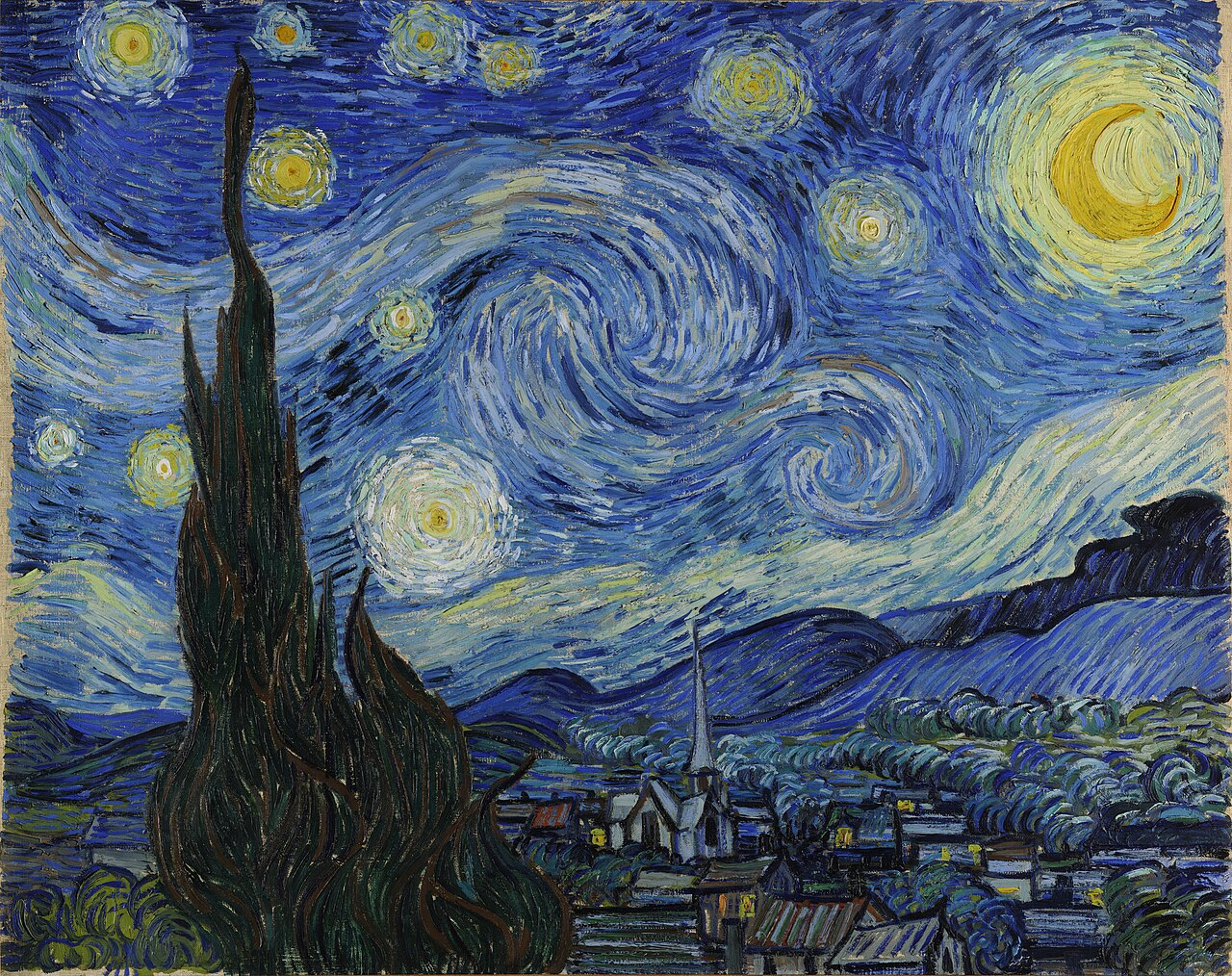
It was from that room — or rather from memory during the day, since patients were not allowed to paint at night — that Van Gogh composed The Starry Night in June 1889. He wrote to his brother Theo: "This morning before sunrise I stood at the window for a long time, looking at the countryside." The night he paints is not the one he observed exactly: it is a dreamed night, simplified, transfigured.
What the painting actually shows
The picture divides into three distinct zones. At the top, the night sky occupies two-thirds of the composition: a dark ground traversed by luminous swirls, bloated stars and a blazing crescent moon at the right. The movement is circular, almost hypnotic — as if the sky itself were breathing.
In the foreground on the left, a dark cypress tree rises to the top of the canvas, a sombre flame connecting earth and sky. In Provence, cypresses are traditionally associated with mourning and eternity. In the centre and right, a quiet village stretches across a valley — church spire, houses with lit windows, gentle hills — in an almost absolute calm that contrasts with the turbulent sky above.
The village: neither Saint-Rémy nor reality
The question comes up often: which village is it? Neither Saint-Rémy-de-Provence nor Arles matches what we see. The church, with its slender spire and pointed Gothic steeple, is far closer to Dutch churches than to the Romanesque bell towers of Provence. Most art historians now agree that it is an imaginary village built from memory — the villages of the Dutch Brabant where Van Gogh grew up, reconstituted as a mental image of home in a land of exile.
Van Gogh's technique: visible brushwork and pure colour
In The Starry Night, Van Gogh applied the paint in thick, visible strokes, oriented according to the movement he wished to create. The sky's swirls are made up of long, gestural sweeps of Prussian blue, cobalt and lead white, applied with confidence and speed. The stars and moon radiate as bright discs of cadmium yellow and pure white, thick enough to form a tactile relief.
This technique — associated with Post-Impressionism — fully embraces the materiality of paint. The picture does not pretend to be a window onto reality; it declares itself to be painting, constructed by a human gesture, bearing the traces of a presence.
Van Gogh's swirls and fluid dynamics
In 2006, a team of Mexican physicists published a widely noted study in the journal Physics of Fluids: the swirls in The Starry Night model Kolmogorov's equations of fluid turbulence with remarkable precision — a mathematical phenomenon that scientists would not formally describe until the twentieth century. Van Gogh, in his moments of acute suffering at Saint-Rémy, appears to have intuitively perceived and graphically represented what science would take decades to formalise.
This discovery gave the painting a new scientific aura, transforming its emotional swirls into a physical enigma. How did a painter without scientific training capture so precisely the mathematical structure of turbulence? The question remains open.
The painting's history after Van Gogh's death
Van Gogh himself had little regard for The Starry Night. He sent it to his brother Theo calling it a failure, preferring his own paintings of wheat fields or cypresses. The picture passed through several hands after Theo's death in 1891, was then acquired by the collector Johanna van Gogh-Bonger, and finally entered the collection of the Museum of Modern Art in New York in 1941, purchased from a Parisian gallery for $150,000.
Today it draws millions of visitors each year and has inspired countless derivative works — from Don McLean's song Vincent (1971) to animated film homages and shelves of merchandise. It remains the emblem of a beauty born of suffering, the legacy of a man who sold only one painting in his lifetime.