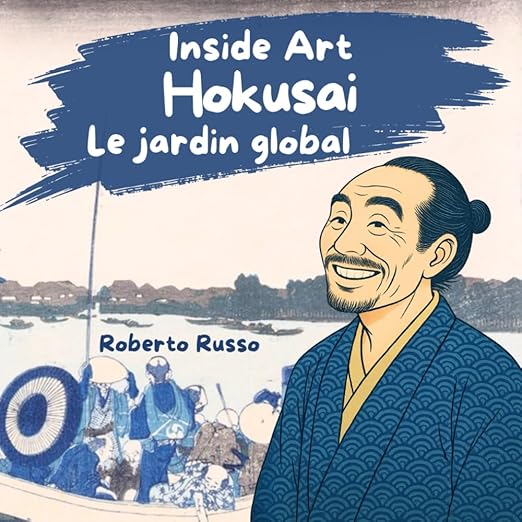
Hokusai, aged 72, at the height of his powers
Katsushika Hokusai (1760–1849) is one of the most singular figures in Japanese art. He changed his name more than thirty times over the course of his life — a Japanese tradition marking artistic breaks. He produced more than 30,000 works, taught until his death at 88, and painted The Great Wave at around 72, during his most creative period. He is also the man who, at 75, wrote in an autobiographical note: "Since the age of six, I have had a passion for copying the form of things; from about the age of fifty, I have made it a habit; and since the age of seventy-three, I have learned something about the true structure of nature."
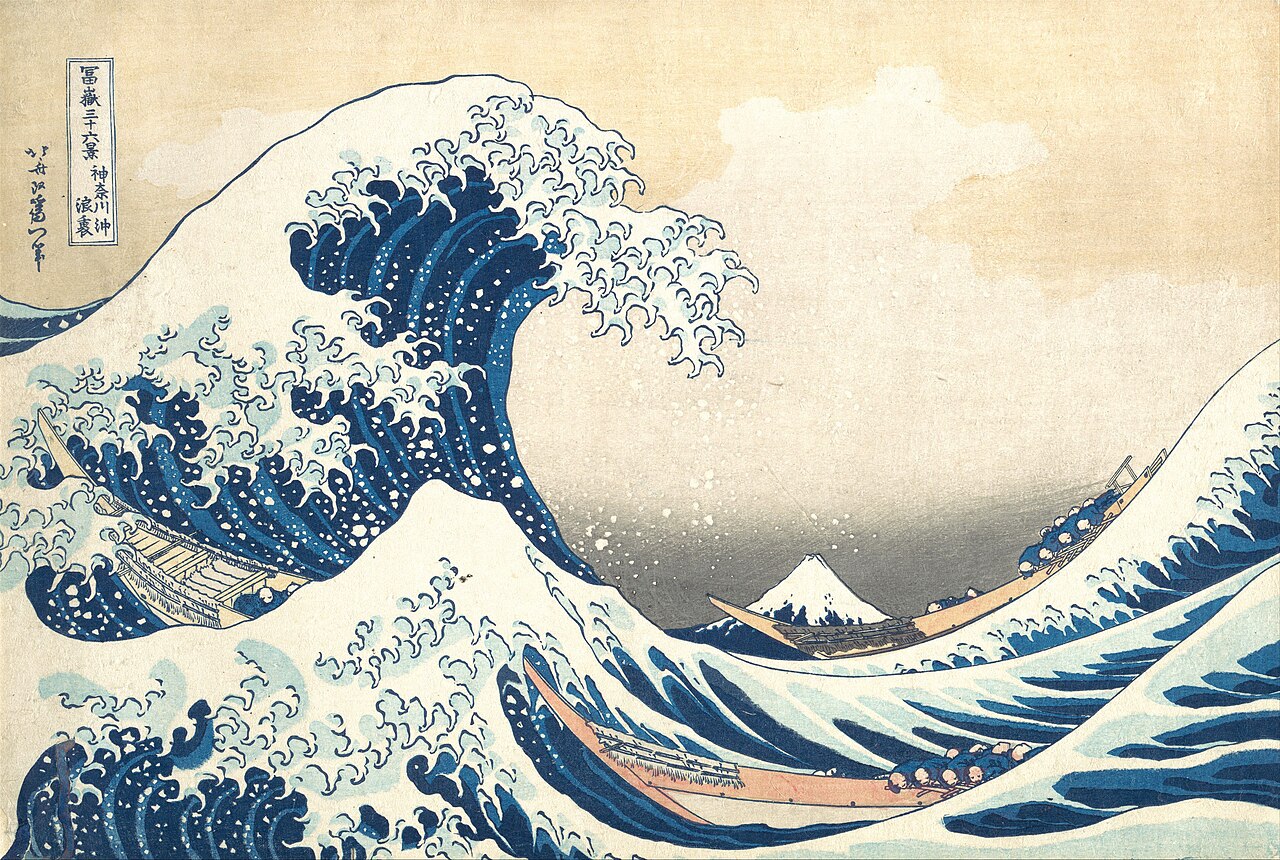
This late humility is vertiginous. The Great Wave belongs to the series Thirty-six Views of Mount Fuji (which actually contains forty-six prints), published between 1830 and 1832. It is the first print in the series and, by far, the most famous.
The ukiyo-e technique: the art of the carved block
The Great Wave is a woodblock print — ukiyo-e technique. The design is first drawn by Hokusai, then carved in relief by specialist craftsmen onto several cherry-wood blocks (one per colour). Each block is inked and pressed onto a sheet of washi paper in a precise sequence to achieve the overlapping colour layers.
The dominant blue is a revealing detail: it is Prussian blue (Bero-ai in Japanese), a synthetic pigment of European origin, available in Japan only since the 1820s. Hokusai immediately adopted this vivid, luminous blue, very different from the traditional Japanese natural blues. Without this imported European pigment, The Great Wave as we know it simply would not exist.
Composition analysis: the wave, Fuji and the boats
The composition is a remarkable achievement. The wave occupies two-thirds of the image and forms an arc that closes in on itself in foam claws at the crest. This dynamic shape — a closed curve that threatens without yet striking — creates maximum tension. The foam claws at the top are among the work's most admired details: Hokusai represents not foam but individual water droplets, frozen mid-fall.
In the background, tiny, Mount Fuji — snow-white, blue-white — formally echoes the wave: the same triangular shape, the same colours, but inverted in its symbolism. Fuji is immutable, eternal, stable; the wave is ephemeral, violent, changing. The small Fuji inside the jaws of the great wave embodies permanence in the face of chaos.
In the foreground, three transport boats (oshiokuri-bune) carrying fresh fish to Edo are in peril. The sailors crouch in the hulls, clinging to the sides. They are tiny against the natural force — human specks in a world of powers. This relationship between human beings and nature is a central theme of Japanese art.
Influence on the French Impressionists
The Great Wave reached Europe in the second half of the nineteenth century, during the wave (quite literally) of Japonisme that swept through Parisian artistic circles. Monet owned several hundred Japanese prints in his house at Giverny. Degas, Van Gogh, Toulouse-Lautrec and Gauguin studied these images from the other side of the world with passion.
Hokusai's influence is particularly visible in his work on the contour line — his pared-back curves, his simplification of natural forms into near-abstract motifs. These principles reinforced the formal freedom the Impressionists were already taking from academic representation. Debussy is reputed to have hung a reproduction of The Great Wave above his desk; one of his piano preludes, La Cathédrale engloutie, is often associated with the image.
An image that became a global sign
The Great Wave is today the most reproduced Japanese image in the world, present in every culture and medium. It was used to represent real tsunamis (in the wake of the 2011 earthquake in Japan, hundreds of media outlets ran it as an illustration), natural disasters in general, and the power of nature. It appears as an emoji, a tattoo motif, a logo. It has left the domain of art to become a universal pictogram of natural force.
Despite this popularity, high-quality early impressions remain highly sought-after. A fine example sold at Christie's New York in 2021 for $1.6 million — a record for a Japanese woodblock print at auction.