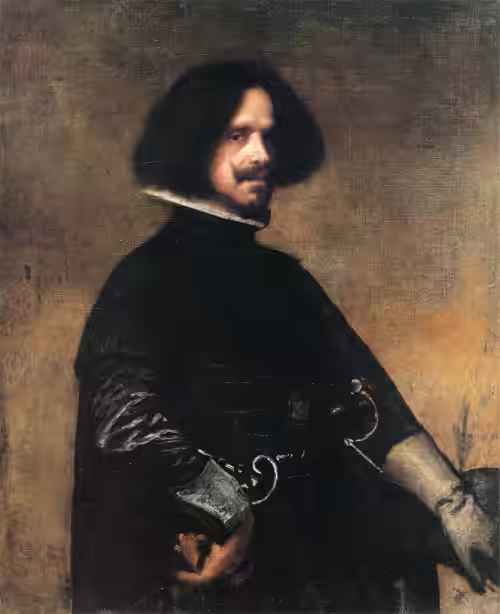
Diego Velázquez is the greatest Spanish painter of all time and one of the absolute masters of Western painting. First painter to the court of Philip IV, he spent his entire life in the service of the Spanish monarchy, painting with incomparable freedom and psychological depth the portraits of the king, his family and his court, as well as the dwarfs and jesters, the mythological figures and historical scenes. His major works — Las Meninas, The Surrender of Breda, The Spinners, The Rokeby Venus — defy the centuries and continue to astound with their modernity, their ambiguity and their capacity to interrogate the very nature of representation. Manet, Whistler, Francis Bacon, Picasso — all claimed him as a forefather. Velázquez is, in Manet's phrase, "the painter of painters."
A Sevillian Birth and an Early Formation
Diego Rodríguez de Silva y Velázquez was born on 6 June 1599 in Seville, a large cosmopolitan city and the home port of trade with the Americas. His father, Juan Rodríguez de Silva, was of Portuguese origin; his mother, Jerónima Velázquez, was Sevillian. Following Spanish custom, he took his mother's name.
At eleven he entered as an apprentice the workshop of Francisco Herrera the Elder, a painter of energetic touch and dark palette. He left quickly to enter the studio of Francisco Pacheco, a cultivated painter, art theorist and author of a fundamental treatise, The Art of Painting, who would become both his master and his father-in-law. In 1617 he was accepted into the Seville painters' guild after passing his examinations successfully. In 1618 he married Juana Pacheco, his master's daughter, with whom he had two daughters.
His early Sevillian works already reveal exceptional technical mastery and a taste for scenes of popular life — bodegones (kitchen and tavern scenes) — in which everyday objects are treated with a solidity and material presence that recalls Caravaggio, whose influence reached Spain through Neapolitan painters. Old Woman Frying Eggs (1618, National Gallery of Scotland, Edinburgh) and The Water Seller of Seville (c.1618–22, Apsley House, London) are among these precociously mature early works.
Madrid and the Court of Philip IV
In 1622, Velázquez went to Madrid hoping to gain access to the Court. His portrait of the poet Luis de Góngora (1622, Museum of Fine Arts, Boston) caught the attention of the Count-Duke of Olivares, the powerful valido (chief minister) of Philip IV, himself from Seville. In 1623, Velázquez was summoned to Madrid, painted the portrait of the young King Philip IV — who was immediately delighted with it — and was appointed official Court painter with a salary and lodgings in the palace. He was twenty-four. He would hold this post for the rest of his life.
The following years saw a progressive establishment and affirmation of his style. An Italian sojourn (1629–31), encouraged by Rubens, then visiting the Spanish Court in 1628–29, allowed him to study the Venetian masters — Titian above all, whose royal portraits had profoundly influenced the Spanish tradition — and the works of Raphael and Michelangelo in Rome. He returned with an enriched sense of colour and increased freedom of touch.
Court Portraits: Psychology and Freedom
Velázquez's portraits stand apart from all the official portraits of the period in their unique freedom and psychological depth. Where his contemporaries flattered their sitters or froze them in protocol poses, Velázquez captured something alive and true — a weariness in the king's gaze, a melancholy in the infanta's face, a troubling humanity in the jester's eyes.
His portraits of the court dwarfs and jesters — Pablo de Valladolid (c.1635, Prado), Don Sebastián de Morra (c.1644, Prado), El Primo (1644, Prado) — are perhaps the most revealing of his vision. These figures, whose social position was that of mere objects of entertainment for the nobility, are treated by Velázquez with a dignity and attention that raise them to the level of any other human being. Manet spent hours before these canvases during his stay in Madrid in 1865, and their influence on his work was direct and profound.
The Surrender of Breda (1634–35, Prado), also known as Las Lanzas (The Lances), is his most famous historical composition. It depicts the surrender of the Flemish city of Breda to Spanish troops in 1625, in a staging of remarkable generosity and humanity: the Spanish general Spinola prevents the defeated commander from kneeling and raises him courteously — a gesture that transforms military victory into an example of chivalric magnanimity.
Las Meninas: The Supreme Enigma
In 1656, Velázquez painted what is generally considered one of the most complex and fascinating canvases in the entire history of painting: Las Meninas (The Ladies-in-Waiting, Prado). The painting shows the Infanta Margarita Teresa surrounded by her ladies-in-waiting, two dwarfs and a large dog, in Velázquez's own studio in the Alcázar palace in Madrid. Velázquez himself appears on the left, brush and palette in hand, looking towards the viewer. In the background, a mirror reflects the blurred images of King Philip IV and the queen, who appear to occupy the very spot where the viewer stands.
This vertiginous composition plays with all the fundamental questions of representation: who is looking at whom? Who is the real subject of the painting? What is the spectator's place in the scene? The presence of the painter at work transforms the canvas into a meditation on the act of painting itself and on the relationships between the real, its representation and the gaze. Foucault, Picasso, Francis Bacon, Velickovic — the artists and thinkers who have engaged with this painting form an endless list.
The Second Italian Journey and Death
Between 1649 and 1651, Velázquez made a second journey to Italy, where he painted above all the Portrait of Innocent X (1650, Galleria Doria Pamphilj, Rome), universally considered one of the greatest portraits in the history of painting. Pope Pamphilj, depicted in his red and white vestments with dazzling pictorial richness and a gaze of striking intelligence and hardness, is said to have remarked on seeing his own likeness: "Troppo vero" — too true. Francis Bacon produced an obsessive series of variations on it.
Back in Madrid, Velázquez assumed increasing responsibilities at Court, culminating in his appointment in 1652 as aposentador mayor — palace chamberlain, responsible for organising royal ceremonies. It was in this role that he organised the lavish festivities on the Isle of Pheasants for the marriage of the Infanta Marie-Thérèse to Louis XIV in June 1660 — an exhausting effort from which he returned worn out. He died in Madrid on 6 August 1660, aged sixty-one. His wife Juana survived him by only eight days.
An Unparalleled Legacy
Velázquez was recognised during his lifetime by his peers — Rubens, during his stay at the Spanish Court, had called him the greatest painter in Europe — but exercised his full influence only from the nineteenth century onwards, when the opening of the Prado collections to the public (1819) and the visits of artists such as Manet, Whistler and Sargent to Madrid revealed to the whole world the extraordinary modernity of his touch and his vision. The Prado holds the most important and representative collection of his work, which remains one of the most sought-after destinations for painting lovers anywhere in the world.