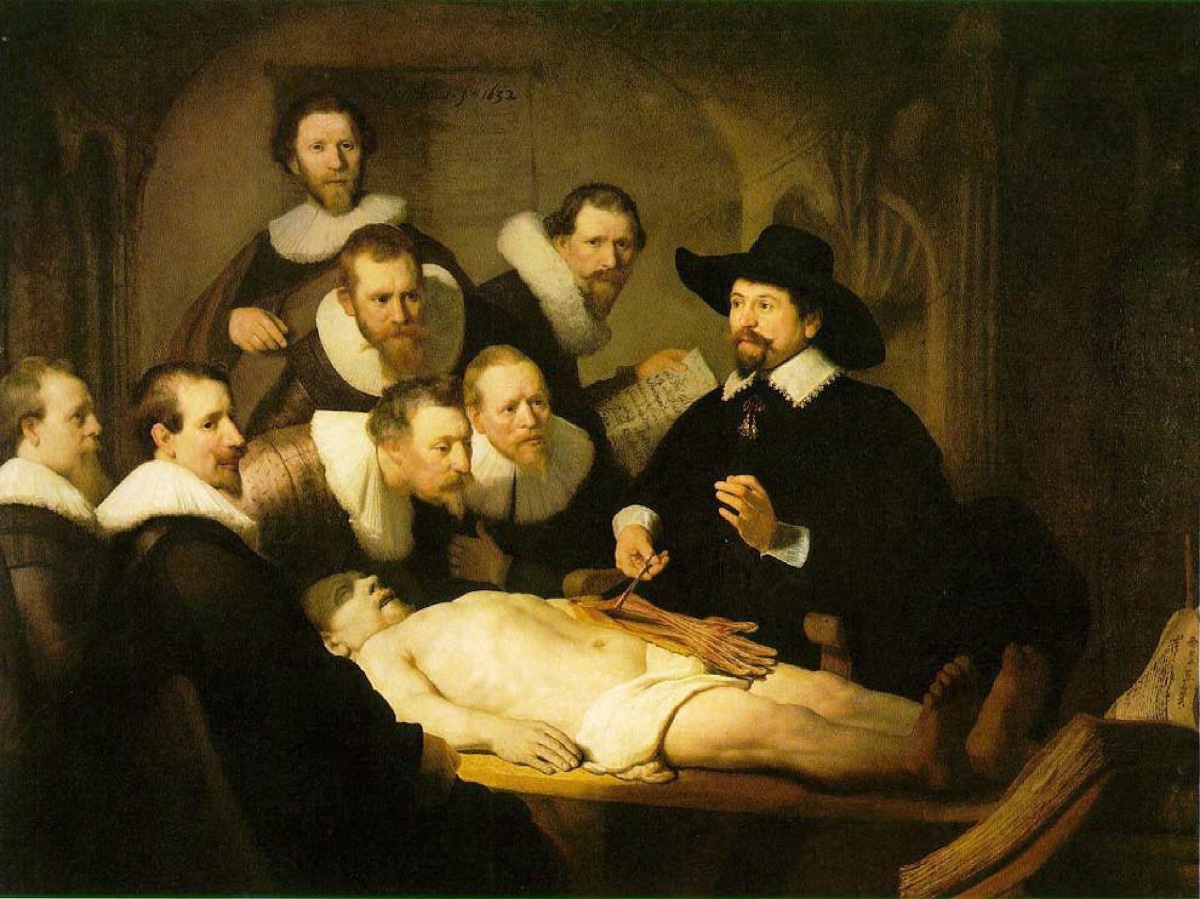
The Anatomy Lesson of Dr. Tulp
Artwork by Rembrandt • 1632
🖼️ Reproduce this artwork — 📗 Book on Rembrandt on Amazon
About this artwork - painting analysis
Commissioned in 1632 by the guild of surgeons in Amsterdam, Rembrandt's The Anatomy Lesson of Dr. Tulp marks a decisive turning point in the art of group portraiture in the Netherlands. This painting depicts the celebrated surgeon Nicolaes Tulp delivering a public anatomy demonstration before seven members of the guild, all dressed in black with the wide white collars characteristic of the era. The cadaver at the center, identified as that of criminal Aris Kindt, exposes his dissected left forearm, revealing muscles and tendons with remarkable precision. This captivating scene bears witness to the flourishing of medical sciences during the Dutch Golden Age, a period when Amsterdam established itself as a major intellectual center.
The pyramidal composition orchestrated by Rembrandt breaks with the rigid tradition of Dutch collective portraiture. Rather than arranging the figures in static alignment, the young painter – then only twenty-six years old – creates a narrative dynamic where every gaze converges toward the dissected arm or toward the viewer. Light, a central element of Rembrandt's genius, dramatically illuminates the pale body of the deceased and the concentrated face of Dr. Tulp, while the background remains shrouded in golden shadows. The pronounced contrasts between livid flesh, dark fabrics, and immaculate collars already reveal the mastery of chiaroscuro that would become the signature of the Dutch master.
This prestigious commission propelled Rembrandt to the rank of Amsterdam's most sought-after painters and established his reputation far beyond Dutch borders. The striking naturalism of the anatomy, the psychological intensity of the faces, and the controlled theatricality of the scene reflect the influence of Caravaggism while affirming a bold personal style. Housed at the Mauritshuis in The Hague, this canvas remains one of the absolute masterpieces of European Baroque portraiture, a fascinating testament to the convergence of art, science, and society in the seventeenth century, perfectly embodying the rationalist and humanist spirit that characterized the United Provinces during this flourishing era.
If you appreciate "The Anatomy Lesson of Dr. Tulp" and other paintings by Rembrandt, we offer you 10% off the purchase of an art poster from our partner europosters with the promo code GRANDSPEINTRES10.
Image license: faithful photographic reproduction of a two-dimensional public domain work of art.