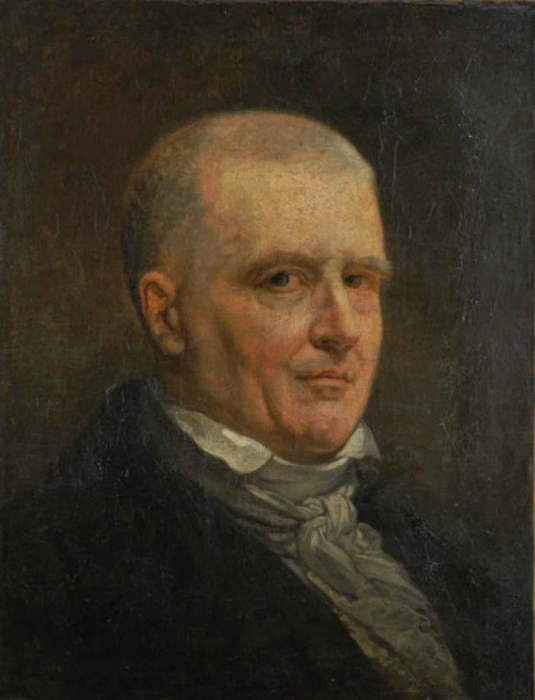
Jean-Honoré Fragonard is the Rococo painter par excellence — and that is both his glory and his tragedy. For he had the misfortune of being the most talented and most free representative of a style that collapsed precisely as he reached full maturity. The French Revolution of 1789 swept away the aristocracy that commissioned his fêtes galantes and mildly erotic scenes, replacing them brutally with the austere Neoclassicism of David and a conception of art as civic and moral act. Fragonard found himself on the wrong side of history — not through want of talent, but through excess of it. His dazzling touch, his palette of silk and gold, his way of catching a moment of happiness in all its fleetingness belonged to a world that the Revolution declared dead. He nearly died with it, surviving sixteen more years after 1789 in an obscurity that the scale of his talent made tragic.
Grasse and Paris: The Early Years
Jean-Honoré Fragonard was born on 5 April 1732 in Grasse, Provence, into a family of glove-makers. His father, François Fragonard, ran a shop but never prospered; the family decided to try their luck in Paris around 1738, when Honoré was six. He grew up in Paris in the modest milieu of small trade.
At fourteen, his father sent him to a notary as a clerk, but the young Fragonard thought only of drawing. His mother took him to François Boucher, the most fashionable painter in Paris and First Painter to Louis XV, whose pastoral scenes and rose-and-gold Venuses defined the aesthetics of the court. Boucher, pragmatic, advised him first to train under Chardin — a genre and still-life painter whose technical rigour would provide a better basic apprenticeship than his own studio. Fragonard spent a few months with Chardin, then returned to Boucher. In 1752, at twenty, he won the Prix de Rome.
Rome and Italian Light
From 1756 to 1761, Fragonard stayed in Rome at the French Academy, under the direction of Natoire. His Academy training was conventional — copies of antiques, drawings after Italian masters — but two experiences burst beyond this official framework.
The first was his friendship with the Abbé de Saint-Non, a cultivated French aristocrat travelling in Italy who took him to the gardens of the Villa d'Este at Tivoli, the Villa Farnese at Caprarola, and the parks of the great Roman villas. There Fragonard produced a series of drawings and painted studies of groves, fountains and cypress-lined alleys in the Italian summer light — works of a freedom and freshness that directly announce his mature style.
The second was his encounter with the paintings of Pietro da Cortona and Luca Giordano, whose decorative virtuosity and fluency of touch impressed him deeply. From Rome he brought back a way of painting rapidly, confidently, almost improvisationally that would become his hallmark.
Return, Success and The Swing
Back in Paris, Fragonard first achieved academic success with his canvas Coresus and Callirhoe (1765, Louvre), a large history-painting composition that the Académie received with enthusiasm. But very quickly he abandoned this official path for one that suited him better — galant scenes, amorous games, pastoral fêtes, mildly erotic intimacies — matching the tastes of the aristocratic and bourgeois clientele that enriched him.
In 1767, the Baron de Saint-Julien commissioned from him a canvas with a precise and charming subject: a young woman on a swing pushed by a bishop in the shadows, while a young man hidden in the bushes gazes up at her undergarments. Fragonard produced The Swing (Wallace Collection, London) — perhaps his most celebrated painting, an absolute masterpiece of the Rococo. The young woman in her pink dress on her swing, her shoe flying towards the sky in a gesture of joyful abandon, the summer light filtering through the canopy, the slightly libertine complicity of the scene: everything is perfect.
Touch and Speed
What technically distinguishes Fragonard from his contemporaries is a virtuosity and speed of execution that verge on the prodigious. He is said to have been capable of painting a portrait in an hour. His touch — broad, vibrant, applied with absolute confidence — creates effects of texture and light that seem caught on the spot, as if the canvas preserved the energy of the brushstroke. His flower still lifes, his fantasy portraits (such as The Reader, c.1776, National Gallery of Art, Washington), his domestic interior scenes have a freshness and spontaneity that have led some historians to say that he is, more than anyone, the direct precursor of the Impressionists.
His work also includes a series of erotic paintings — The Bolt (c.1777, Louvre), The Wardrobe (c.1778, Louvre) — of a frankness and sensuality that are never vulgar, because formal beauty and technical skill transcend them.
The Revolution and Oblivion
In 1789, everything collapsed. The aristocratic clientele fled or was guillotined. The new revolutionary taste demanded virtue and Roman heroes. Fragonard, who had always painted happiness and pleasure, had nothing to offer an age that required sacrifice. David — with whom he maintained ambiguous relations — tried to help him, giving him a post at the newly opened Louvre. But Fragonard scarcely painted any more.
He died in Paris on 22 August 1806, aged seventy-four, in near-total oblivion. His eldest son, Alexandre-Évariste Fragonard, also became a painter — a sign that talent ran in the family.
The rediscovery of his work in the second half of the nineteenth century, notably through the Goncourt brothers who devoted a passionate monograph to him in 1865, restored Fragonard to the place he deserves. His paintings are today among the most beloved at the Louvre, the Wallace Collection and the Frick in New York, and his capacity to paint the joy of living with sovereign lightness remains unique in the history of French painting.