A painting born from a camembert
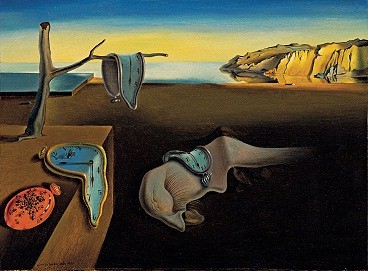
Dalí told the story of the painting's origin many times. One afternoon in 1931, at Cadaqués on the Costa Brava, he was alone in the house while Gala, his wife, had gone to the cinema. He lingered at the table over the remains of the meal — a camembert. The sight of the cheese softening in the sun triggered a mental image: melting watches. He fetched an already-started canvas — a landscape of Cap de Creus — and painted the soft watches directly onto that background in a matter of hours. When Gala returned, the painting was finished.
This story, told by Dalí himself with his habitual taste for the spectacular anecdote, perfectly illustrates the paranoiac-critical method he was developing at the time: provoking irrational image associations from the unconscious, then rendering them with hyper-realistic technical precision.
The melting watches: symbolism of subjective time
The three melting watches — one draped over a branch, another over a table, the third over the shapeless figure at the centre — represent the relativity of time in the dream state. In dreams, time does not obey the laws of objective chronology: it stretches, compresses, dissolves. A rigid watch is the archetypal symbol of mechanical, objective, inhuman time — the time of clocks, trains, work. To melt it is to free time from that rigidity.
The fourth watch, on the left, is covered in black ants. Ants are a recurring motif in Dalí's work since childhood — they represent putrefaction, decomposition, death. This watch is already dead, already consumed. The four watches thus present four states of time: time flowing (pocket watch), time deforming (melting), time dying (ants) and time vanished (closed, face down on the table).
The landscape and the figure: personal memory
The picture's background is a Costa Brava landscape — the cliffs of Cap de Creus that Dalí had known since childhood. This anchor in the real is characteristic of Dalí's Surrealist method: unlike other Surrealists who deliberately distanced themselves from any real referent, Dalí always grounds his visions in a precise and personal geography.
The shapeless figure at the centre, over which a watch is melting, is generally interpreted as a distorted self-portrait of Dalí — his profile, with his exaggeratedly long lashes visible. This boneless, skeletal figure is the dreamer's body: a body that loses its physical density in sleep, unable to rise or move, subject to gravity in a new way.
A miniature format, maximum impact
One fact consistently surprises MoMA visitors who encounter the painting in person: it measures 24.1 × 33 cm — barely larger than an A4 sheet of paper. This miniaturisation is deliberate. Dalí paints with watchmaker's precision, a care for detail that demands working at small scale. The hyper-realistic precision of the shadows, the reflections on the watches, the textures of the wood and rock is only achievable at this size.
Paradoxically, this tiny painting has become one of the most reproduced and most recognisable images in art history. Its ability to condense a complex idea — the relativity of subjective time — into an immediately readable image explains its universal reach.
The legacy of the painting
Acquired by MoMA in 1934, the work became the emblem of Surrealism in global popular culture. The melting watches became a universal visual cliché for representing time, memory and the unconscious — they appear in advertisements, films, video games, tattoos. This popularity should not obscure the philosophical and psychological density of the original work: Dalí did not paint a bizarrely decorative image; he represented a theory of inner time that Freud, Einstein and Bergson might have endorsed.