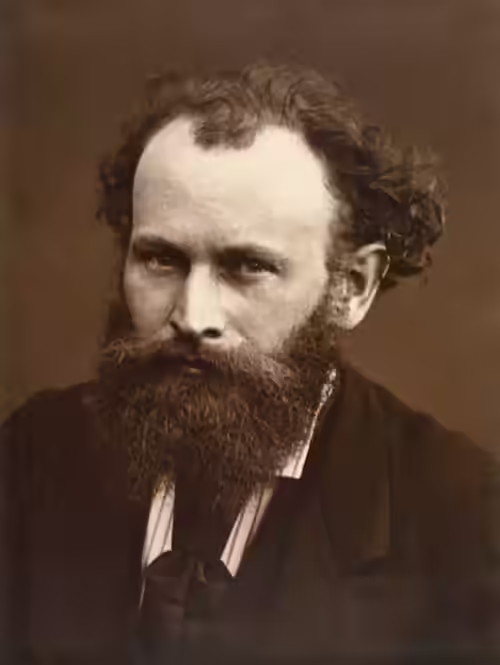
There is something deeply ironic in Édouard Manet's fate: he was the artist who most shocked and most divided the public and critics of his time, and he was also, at heart, the one who least wanted to cause a scandal. Manet was not a provocateur by temperament — he was a man of the world, elegant, cultivated, profoundly attached to official recognition. He saw himself as an heir of tradition, not a revolutionary. And yet each of his major canvases unleashed controversies of a violence that, in retrospect, seems incomprehensible, so beautiful and self-evident do his works appear to us today. This paradox — the conventional man with the radical work — is at the heart of the man.
Paris, the Bourgeoisie and a Refusal of the Law
Édouard Manet was born on 23 January 1832 in Paris, into a family of the upper Republican bourgeoisie. His father, Auguste Manet, was a senior civil servant at the Ministry of Justice, a severe and authoritarian man who had precise plans for Édouard: law studies, a career in the magistracy. His mother, Eugénie-Désirée Fournier, was a cultivated woman, daughter of the diplomat Joseph-Ennemond Fournier.
The young Édouard had no taste for the law. He drew; he was passionate about the old masters at the Louvre. Faced with his father's intransigence, he proposed a compromise: he would embark as a trainee pilot for a six-month voyage to Brazil — and if on his return he was not up to the standard for the Naval Academy, he could at last study painting. The voyage took place in 1848–49. He failed the naval examination. He entered the studio of the painter Thomas Couture, where he would remain six years — with growing hostility towards academic teaching.
These years of formation were above all years spent in museums. Manet copied at the Louvre — Titian, Velázquez, Rubens, Rembrandt, Goya — and made several journeys to Italy and Germany to study the masters directly. He forged an extraordinary visual culture, and above all a conviction: painting could look modern contemporary life straight in the face, using the same means as the great masters, without idealisation or historical disguise.
The Salon and the Refusal of Convention
In 1861, two of Manet's portraits were accepted at the official Salon and received an honourable mention. The artist was thirty, recognised by his peers, apparently on the right track. But in 1863, everything changed.
Le Déjeuner sur l'herbe was rejected by the Salon jury. Napoleon III, informed of the wave of refusals that year, created the Salon des Refusés to allow the public to judge for themselves. Manet's painting caused a sensation — in the negative sense. The composition showed two men dressed in contemporary suits and two women, one of them nude in the foreground, gathered in a forest. The scene was freely inspired by a group of figures from Raphael's Judgement of Paris, transposed into the Paris of 1863.
What shocked was not nudity per se — the Salon was full of academic nudes. It was that the nude woman in the foreground looked at the viewer. She was not asleep, not distracted, not turned away — she was there, present, conscious of being watched, and she looked back. This direct gaze transformed a conventional nude into something infinitely more disturbing: a confrontation. The public was not mistaken about this.
Two years later, in 1865, Olympia produced an even more violent response. The composition deliberately reprised Titian's Venus of Urbino — but the mythological Venus was here replaced by a contemporary woman reclining on a bed, manifestly a courtesan, whose gaze fixed the viewer with impassive frankness. The flower in her hair, the black velvet ribbon at her neck, the Black servant bringing a bouquet: everything signalled a contemporaneity that the aesthetics of the academic nude had always refused to admit. The critical response was of extraordinary violence.
The Painter of Painters
What Manet understood before his contemporaries — and before the Impressionism he would decisively influence without ever joining — was that painting could constitute itself as an autonomous visual system, independent of the illusionistic depth inherited from the Renaissance. Where his predecessors constructed space through perspective, modelled shadows and colour transitions, Manet deliberately flattened his compositions: figures placed against almost neutral backgrounds, without marked depth, as though the image had become conscious of itself as a painted surface rather than a window onto the world.
This "flatness" of Manet, which academic criticism accused him of as a deficiency in drawing, was in reality a conscious and fertile decision. It made him the absolute reference for the Impressionists — Monet, Degas and Berthe Morisot admired him unreservedly — and later for Cézanne, who saw in his work the model of a painting that fully assumed its two-dimensionality.
His palette also innovated profoundly. Manet juxtaposed contrasting tones without transitions, used black — banned by the Impressionists — as a noble colour, and created effects of light of striking modernity. His Portrait of Émile Zola (1868, Musée d'Orsay), his Berthe Morisot with a Bunch of Violets (1872, Musée d'Orsay) and above all The Fifer (1866, Musée d'Orsay) were brilliant demonstrations of this mastery.
Spain, Velázquez and the Gaze of Goya
Manet claimed two great masters: Velázquez and Goya. He travelled to Spain in 1865 and returned overwhelmed by his direct discovery of the Prado. The way Velázquez treated his figures — placed against almost empty backgrounds, caught in their material presence without theatricality — confirmed that he was on the right path. Velázquez's Pablo de Valladolid, with its figure silhouetted against a background of indeterminate light, could have been signed by Manet.
This dialogue with the Spanish masters surfaced in his great compositions on death and violence: The Execution of Emperor Maximilian (1868, Städtische Kunsthalle, Mannheim), which directly reprised the composition of Goya's Third of May, transposed a contemporary political subject into a history-painting format with a clinical coldness that heightened its force.
Old Age, Illness and A Bar at the Folies-Bergère
In the 1870s, Manet drew close to the Impressionists without ever exhibiting alongside them — he refused to cut himself off from the official Salon. He adopted their technique of the fragmented touch and clear palette, notably during stays in Argenteuil in 1874 alongside Monet. But he did not share their faith in pure outdoor painting: he remained essentially a studio painter.
His last great composition, A Bar at the Folies-Bergère (1882, Courtauld Gallery, London), was perhaps his masterpiece. A barmaid with an absent gaze stands behind her counter laden with bottles and fruit, before a large mirror reflecting the packed entertainment hall — but the reflection is geometrically impossible: the mirror shows what cannot be seen from that angle. This deliberate incoherence transforms the painting into a meditation on the gaze, on isolation in the crowd and on the very nature of representation.
Manet died in Paris on 30 April 1883, aged fifty-one, from locomotor ataxia that had been consuming him for several years. He had never received from the Salon the grand prize he had dreamed of. But he left a body of work that would transform European painting for the following hundred years — which he probably suspected, even if he was never able to verify it.
Friend of the Impressionists, Presiding Figure
What is remarkable about Manet's position is that he was simultaneously the spiritual father of Impressionism and someone who never exhibited with the group. Monet admired him deeply and awaited his approval as from a master. Berthe Morisot — who would become his sister-in-law by marrying his brother Eugène — was his most constant model and closest intellectual interlocutor. Degas shared with him a taste for modern subjects and a way of framing figures that seemed to emerge from photography.
And yet Manet refused to cut himself off from the Salon — that temple of academic values which he so effectively disrupted. He wanted to be recognised by the very institution he was transforming, to belong to the official history of French painting while rewriting it. This paradox says something essential about his personality: he was a revolutionary despite himself, a man of the world who produced subversive works almost by an accident of lucidity.
His place in the history of painting is today unquestionable: he is the bridge between the nineteenth and twentieth centuries, between tradition and modernity, between Velázquez and Cézanne. The Musée d'Orsay holds his most important works — Olympia, Le Déjeuner sur l'herbe, The Fifer, Berthe Morisot with a Bunch of Violets — which attract millions of visitors each year and continue to impose their presence with undiminished freshness.