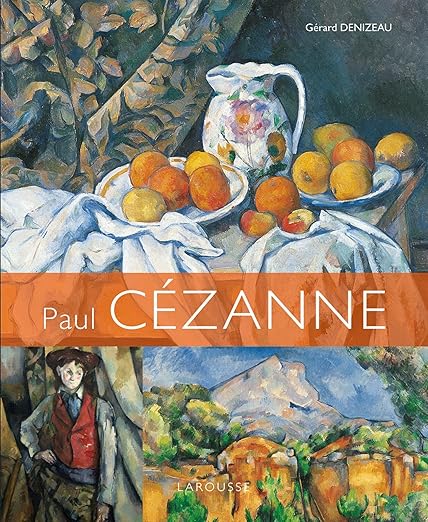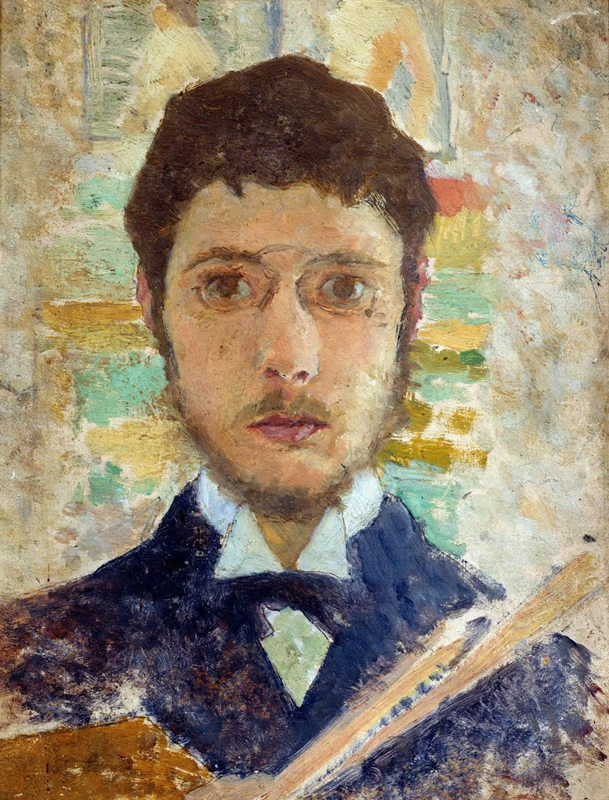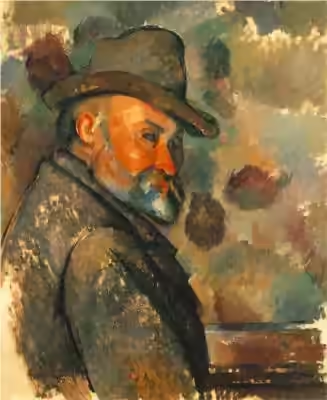
Paul Cézanne is one of the most important artists in the entire history of painting. Often called "the father of modern art," he developed in the solitude of his native Provence an entirely new pictorial language — founded on the construction of space and form through colour, rather than through drawing or linear perspective — that made possible Cubism, Abstract Expressionism and a large part of twentieth-century art. A solitary, uncompromising figure, misunderstood during his lifetime, he was finally recognised in his last years as the most important painter of his generation — a recognition he received with indifference mixed with bitterness, too sure of his convictions to need the judgement of others.
An Aix Childhood and Contradictory Ambitions
Paul Cézanne was born on 19 January 1839 in Aix-en-Provence, the natural son — later legitimised — of Louis-Auguste Cézanne, a hatter turned prosperous banker, and Anne-Élisabeth-Honorine Aubert. The family was comfortable and bourgeois, and his father had specific ambitions for his son: he destined him for the law and the eventual takeover of his business.
Paul grew up in Aix in an atmosphere of provincial respectability. A brilliant student, he formed a deep friendship at the Collège Bourbon with Émile Zola, the future novelist, who would be his closest friend and most faithful correspondent for twenty years. Together they dreamed of Paris, literary and artistic glory. Cézanne drew and wrote poetry; Zola wrote his first stories. This youthful friendship is one of the most celebrated in French literature and art.
In 1858, Cézanne entered the Aix School of Law, conforming to his father's wishes. But his vocation lay elsewhere. After difficult negotiations, Louis-Auguste finally accepted — not without persistent reluctance — that his son would leave for Paris in 1861 to try his luck as a painter. Paul frequented the Académie Suisse, where he met Pissarro who would become his mentor, and submitted his first canvases to the Salon, which regularly rejected them. Discouraged, he returned to Aix and entered his father's bank — before going back to Paris the following year, definitively convinced of his vocation.
The Years of Struggle in Paris
The years 1860–70 were for Cézanne a period of intense struggle and formation. His early works display an expressive violence and darkness that astonished his contemporaries: scenes of rape, murder and erotic fantasy, painted with thick impasto and dark colouring that has nothing in common with nascent Impressionism. These canvases testify to a tormented personality and a repressed sexuality that his later painting would sublimate into more balanced forms.
His encounter and collaboration with Camille Pissarro at Pontoise and Auvers-sur-Oise in the years 1872–74 constituted his genuine Impressionist apprenticeship. Pissarro taught him the patience of working from observation, luminous colour and divided touch. Cézanne, who would always say of Pissarro that he was "humble and colossal," absorbed the lessons but transformed them according to his own obsessions: where Monet sought instantaneity and the dissolution of form in light, Cézanne wanted to construct a lasting painting, "to make of Impressionism something solid and enduring, like the art of the museums."
Aix and the Mont Sainte-Victoire
From 1882, Cézanne settled progressively in Aix-en-Provence, which he would rarely leave until his death. His father's death in 1886 provided a comfortable inheritance that freed him from material constraints and allowed him to work in total independence. That same year, the publication of Zola's novel L'Œuvre — in which the failed painter Claude Lantier was a transparent allusion to Cézanne — permanently ruptured their friendship. Cézanne never forgave what he perceived as a betrayal.
In Aix, he painted the same motifs incessantly: the pines, the rocks of Bibémus, the Large Bathers, and above all the Mont Sainte-Victoire, which he depicted in some sixty oil paintings and watercolours, from different viewpoints and at different hours. These canvases — in which the mountain is decomposed into coloured planes that interlock and reconstruct themselves on the surface of the canvas, in a permanent tension between the depth of space and the flatness of the picture — are among the absolute masterpieces of modern painting.
His working method was characteristic and unique: he built form and space not through pencil outlines subsequently coloured in, but through coloured touches that accumulated on the canvas like crystals — each touch modifying and completing those before it in a constant, unstable equilibrium. This way of working was slowly and painfully elaborated, and Cézanne frequently abandoned his canvases and watercolours unfinished, unable to find the resolution he was seeking.
The Large Bathers and Belated Recognition
In the last years of his life, Cézanne worked on three large Bathers compositions — female nudes in a landscape — that constitute the most ambitious undertaking of his career. The Large Bathers (1894–1905, Philadelphia Museum of Art) is the most monumental: some twenty nude female figures arranged beneath an arch of trees, in a composition of architectural rigour and power that recalls the great compositions of Poussin or Titian, but entirely reformulated in Cézanne's coloured and constructive language.
These final years also saw recognition that, belated as it was, was real. In 1895 the dealer Ambroise Vollard devoted to him his first important Paris exhibition, which revealed his work to a new generation of artists. In 1904 a retrospective was held at the Salon d'Automne. In 1906 he exhibited ten canvases at the Salon, acclaimed by Matisse, Picasso, Braque, Léger and all the young painters who recognised in him their most important master.
Death
On 15 October 1906, caught by a storm outdoors while working on a motif near Aix, Cézanne was soaked through and fainted. Carried home, he died of pneumonia on 22 October 1906, aged sixty-seven. He had worked until the day before his collapse, with the quiet stubbornness that had characterised his entire life.
The Father of Modernity
Cézanne's legacy is immense and foundational. Picasso and Braque explicitly recognised in his work the starting point of Cubism: it was by studying his constructions in coloured planes that Braque produced, in 1908 at L'Estaque, the first Cubist canvases. Matisse recognised him as one of his essential masters in the organisation of the painted surface. Giacometti, Bacon, Balthus — all claimed him in various ways. Cézanne's phrase — "everything in nature is modelled on the sphere, the cone and the cylinder" — became one of the founding formulas of modern art. His works are today held in the greatest museums in the world, and the Sainte-Victoires are among the most recognisable — and most admired — paintings in all of French art.