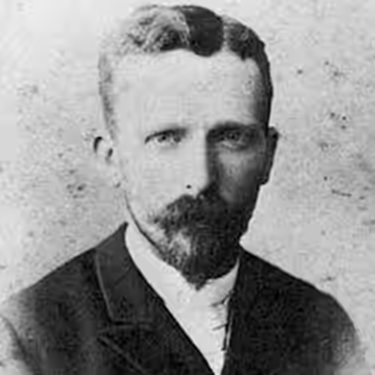
There is perhaps no story in art more famous and more misunderstood at the same time than that of Vincent van Gogh. We remember the severed ear, the madness, the poverty, the solitary death in a wheat field — and this Romantic legend of the misunderstood genius destroyed by the world has ended up eclipsing what matters most: that van Gogh was above all an artist of extraordinary intelligence and professional self-awareness, a man who had thought about painting with a rare depth and acuity, and who produced in ten years of activity — the last two years of which were the most productive — a body of work whose influence on all of twentieth-century art remains immense and direct.
Zundert, Theology and a Missed Vocation
Vincent Willem van Gogh was born on 30 March 1853 in Zundert, a Protestant village in the Dutch Brabant, the eldest son of Theodorus van Gogh, a Calvinist pastor, and Anna Cornelia Carbentus. The family was modest but cultivated. He had a younger brother, Theodorus — known as Theo — born in 1857, who would become the pillar of his entire life: their correspondence, several thousand letters, is one of the most moving and most important documents in the entire history of art.
A serious and solitary teenager, Vincent showed no particular artistic vocation. At sixteen, his uncle had him enter Goupil & Cie, a large firm dealing in paintings and prints. He worked in The Hague, London and then Paris — and these years spent in contact with works of art gave him a considerable visual culture. But his growing eccentricities, his religious outbursts and his refusal of commercial compromises eventually earned him dismissal in 1876.
Difficult years followed, apparently without direction. Van Gogh attempted to become a pastor, like his father — he studied theology in Amsterdam, failed the examinations — then went as a lay preacher to the Borinage, a mining region in southern Belgium, where he lived among the miners in total destitution, sharing their misery to the point that his superiors withdrew his mandate. This period, humiliating and painful, was nonetheless formative: it was there that his deep sympathy for the poor, for agricultural labourers, for all those society rejected was born — a sympathy that would structure all his painting.
The Early Works: Darkness and Humanity
Van Gogh began painting seriously around 1880, at twenty-seven — which was late. He settled in Nuenen in the Netherlands, where his father was pastor, and painted the local peasants and weavers with a darkness and intensity recalling Millet and the seventeenth-century Dutch masters. His major composition of this period, The Potato Eaters (1885, Van Gogh Museum, Amsterdam), showed peasants at a table of meagre food, lit by a single oil lamp. The touch was heavy, the colours dark and earthy, the faces tired. It was a painting seeking the moral truth of a laborious existence, not aesthetic grace — and that was intentional.
Paris, the Impressionists and the Discovery of Colour
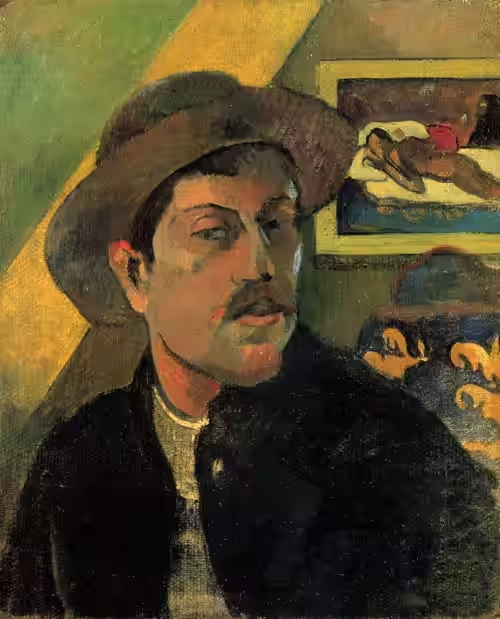
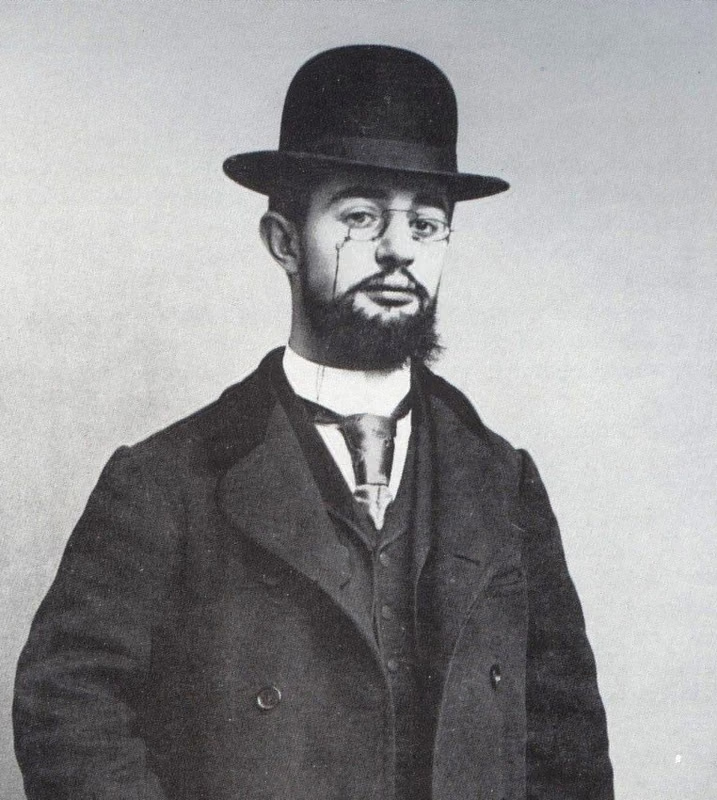
In 1886, van Gogh joined his brother Theo in Paris, where the latter was the director of a gallery. The encounter with the Impressionists and Post-Impressionists radically transformed his palette and vision. He discovered Monet, Pissarro, Seurat — and above all pure colour, freed from the browns and blacks of his Dutch period. He met Toulouse-Lautrec, Émile Bernard, Paul Gauguin, who would become his closest friend. He absorbed the principles of Divisionism, steeped himself in Japanese prints — which he was passionate about — and began to paint with a new speed and freedom.
Paris exhausted him in two years: the city, the noise, the alcohol, the endless café discussions left him at the end of his tether. In February 1888 he left for Arles, in the south, hoping to find the light and serenity he sought.
Arles, Gauguin and the Crisis
The Arles period (1888–89) was the most productive and most dramatic of his life. Van Gogh painted with a frenzy and intensity that bewildered: The Yellow House, the Sunflowers, The Bedroom, the portraits of the postman Roulin and his family, The Starry Night over the Rhône, The Night Café — all these iconic works were born within a few months. His touch had become a personal handwriting recognisable above all others: thick and swirling strokes that seemed to record the vital energy of forms rather than imitate them.
He persuaded Gauguin to join him and realise his dream of a "Studio of the South" — a community of artists working together. Gauguin arrived in October 1888. The cohabitation was a psychological disaster. The two men admired but could not endure each other. In December, during a violent quarrel, van Gogh cut off part of his left ear and brought it to a woman at a brothel. The exact nature of this incident — and Gauguin's role in it — remains debated.
Saint-Rémy and Auvers: The Final Masterpieces
In May 1889, van Gogh entered voluntarily the Saint-Paul-de-Mausole asylum at Saint-Rémy-de-Provence. Despite recurrent crises, he continued to paint — perhaps his most powerful works. The Starry Night (1889, MoMA, New York), with its swirling blues and whites in the night sky, the cypress like a black flame, the sleeping village: it was a painting that directly translated an inner state of almost hallucinatory intensity. The forms were not merely depicted — they vibrated, moved, breathed.
In May 1890, he settled in Auvers-sur-Oise, in the Val-d'Oise, under the benevolent supervision of Dr Paul Gachet, a physician and art lover. The seventy days he spent there were of stupefying productivity: seventy canvases in seventy days. The Church at Auvers, Dr Gachet, Wheatfield with Crows — this last canvas, with its stormy skies and the path that vanishes into the wheat, has often been read as a premonition of his end.
On 27 July 1890, van Gogh shot himself in the chest in a field. He walked back to the inn, went up to his room and died two days later, on 29 July, in Theo's arms. He was thirty-seven.
An Immense Legacy
Van Gogh's influence on twentieth-century painting was fundamental. German Expressionism — Die Brücke, Der Blaue Reiter — owed him the essential of its conception of colour as a vehicle for direct emotion. Fauvism inherited his chromatic liberation. The entire tradition of expressive arts — from street art to tattooing — was steeped in his formal legacy. His works, today among the most expensive in the world, attracted millions of visitors at the Van Gogh Museum in Amsterdam and elsewhere. What this popularity says is perhaps that van Gogh managed to put into his paintings something universal: the intensity of lived experience, painting as a desperate and magnificent act of affirming the beauty of the world.
The Letters to Theo: A Mind in Action
To understand van Gogh — to go beyond the Romantic myth and discover the artist — the letters he wrote to his brother Theo throughout his adult life are indispensable. This colossal correspondence, more than eight hundred letters between 1872 and 1890, was one of the most important documents in the entire history of art. One finds in them a man of extraordinary intelligence and sensibility, a voracious reader of Zola, Maupassant, the Bible and English novels, a serious thinker who reflected on painting with a depth and precision that those around him perhaps did not suspect.
Van Gogh described his paintings, explained his colour choices, analysed his influences, theorised his relationship with nature. He wrote, for instance, regarding the yellow in his paintings: "I try to express the terrible passions of humanity by means of red and green." These letters revealed that his formal choices — the swirling touch, arbitrary colours, distorted perspectives — were not the result of madness but of a very acute and very carefully considered artistic consciousness.
Theo, for his part, was far more than a brother: he was friend, confidant, financial support, faithful reader, first critic and first collector. Without Theo, there would be no van Gogh as we know him. He died six months after Vincent, in January 1891, aged thirty-three — as if his brother's death had broken something irreparable in him.
The life and work of van Gogh ultimately posed a simple and vertiginous question: what happens when a being of extreme sensitivity confronts the real world without any of the protections that most human beings progressively construct around themselves? Van Gogh had no such protections. He painted in the raw, literally. And that is perhaps why his paintings still touch us so directly, a century and a half after his death.