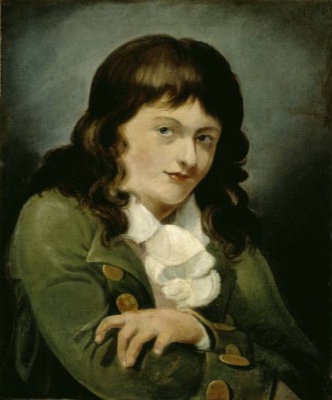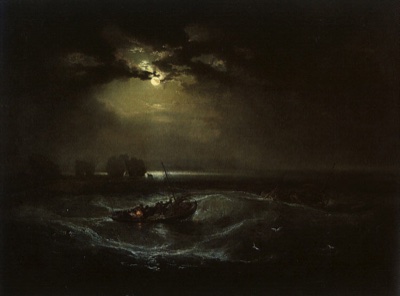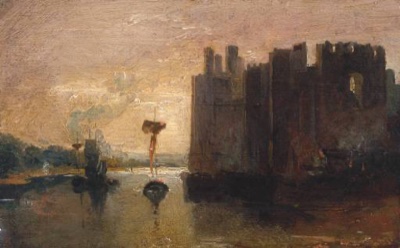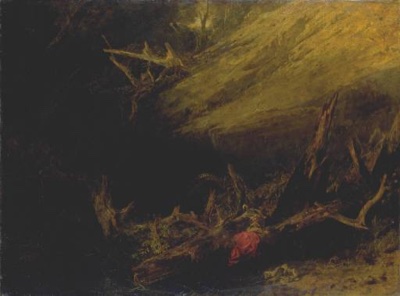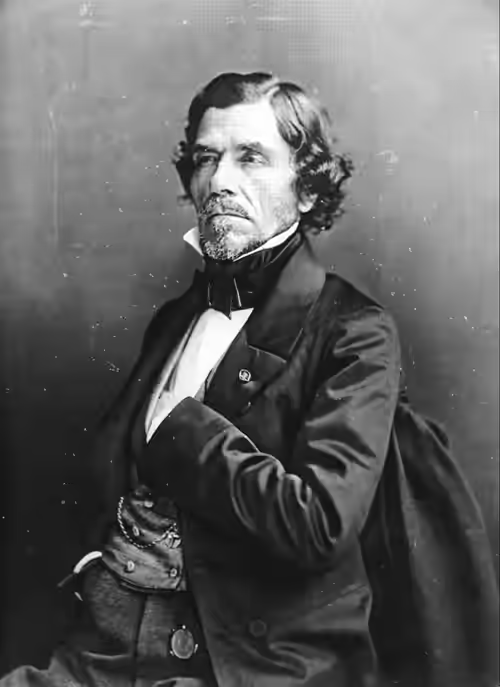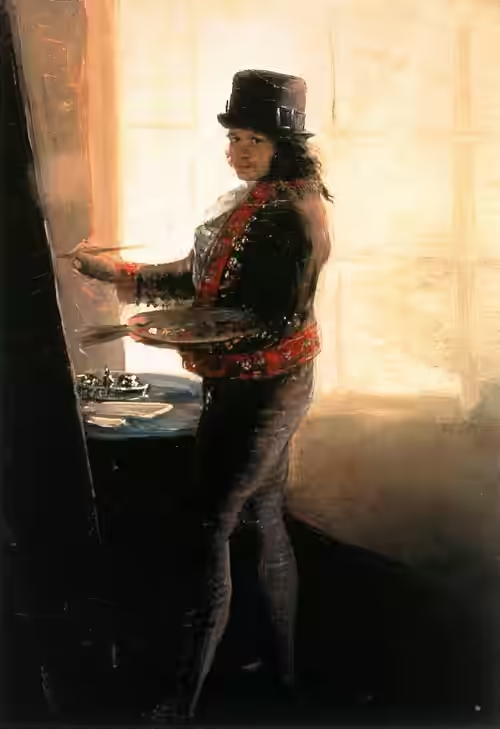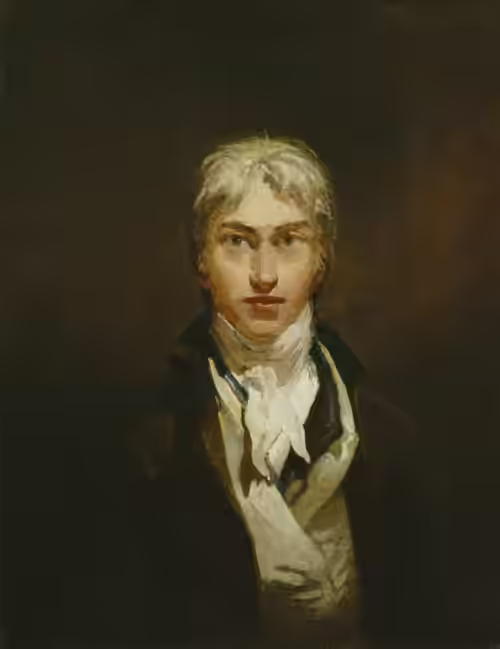
Joseph Mallord William Turner is the greatest British painter of all time and one of the most visionary artists in the history of Western painting. A landscape painter of unprecedented ambition and daring, he pushed the representation of light, water, mist and storm towards a dissolution of form that directly prefigures both Impressionism and the lyrical abstraction of the twentieth century. Admired by Monet, Ruskin and Hazlitt, misunderstood by much of his public, he devoted his entire life to the pursuit of pure light — first in the service of the Romantic sublime, then with increasing freedom, until his late canvases are composed of nothing but colour and luminosity. His solitary and eccentric life, his fierce possessiveness of his own work, his secret death under an assumed name — all of this makes Turner one of the most romantic figures in the history of art.
A London Childhood and the Earliest of Callings
Joseph Mallord William Turner was born on 23 April 1775 in Covent Garden, London, into a modest family. His father, William Turner, was a barber and wig-maker; his mother, Mary Marshall, suffered from mental illness that would eventually lead to her confinement at Bethlem (Bedlam) in 1800. Turner guarded his origins and his private life with absolute secrecy for the rest of his days.
His artistic vocation declared itself so early that his father was displaying his first drawings in the shop window by the time the boy was around ten, selling them to customers. In 1789, at fourteen, Turner was admitted to the Royal Academy of Arts in London — the most prestigious artistic institution in Britain. There he received a rigorous academic training in drawing and architecture that would always allow him to command perspective and formal construction even in his most liberated works.
His early topographical watercolours — views of cathedrals, castles, Welsh landscapes and the Lake District — already showed, in the 1790s, exceptional technical mastery and a particular sensitivity to atmospheric effects: morning mist on ruins, raking evening light on water, storms building behind mountains.
Mastery of Watercolour and Travels
Turner is one of the greatest watercolourists in history, and this technique — light, transparent, always on the verge of running away — remained fundamental to his practice throughout his life. He invented bold technical procedures: wetting the paper before laying down colour to obtain fusions and gradients, scraping the dry surface to draw out highlights, dropping wax reserves to protect certain zones.
An indefatigable traveller from the 1790s, he crisscrossed the British Isles in search of landscapes and monuments, filling hundreds of sketchbooks with pencil and watercolour. His European travels — France, Switzerland, Italy, Germany — began in 1802, when the Peace of Amiens allowed Channel crossings once again, and continued regularly into old age. Venice, which he first visited in 1819, became one of his most fertile sources of inspiration.
Academician and Marine Painter
In 1802, Turner was elected a full Royal Academician — at twenty-six, one of the youngest artists to receive that distinction. He taught at the Academy, initially perspective, and remained an active member of the institution until the end of his life. In 1807 he was appointed Professor of Perspective — a post he held until 1838, with variable attendance but genuine conviction in the importance of theoretical training for young artists.
His large oil paintings of the 1800s to 1830s are remarkable for their ambition and diversity: naval battles, storms at sea, mythological scenes, Alpine landscapes, Venetian views. In all of them, light is already the true subject. Hannibal and His Army Crossing the Alps (1812, Tate Britain, London) shows the Carthaginian army engulfed in a vortex of snow and wind that anticipates his most abstract late works. The Battle of Trafalgar (1824, National Maritime Museum, Greenwich) was his only large royal commission.
Dissolving Form: The Late Turner
From the 1830s, and especially during the 1840s, Turner pushed his pictorial language in directions that many contemporaries found incomprehensible or scandalous. His late canvases — Venetian vaporetti in the mist, conflagrations, tempests — are less and less recognisable as landscapes and more and more studies in pure light, where form melts into swirls of warm or cool colour.
Rain, Steam and Speed — The Great Western Railway (1844, National Gallery, London) shows a locomotive thundering across a viaduct in rain and mist, the train barely more than a dark smudge in a halo of yellow-grey light — the first painting of the industrial age in the history of great painting, and a direct anticipation of the Impressionist touch. Slave Ship (1840, Museum of Fine Arts, Boston) depicts a slave ship in a fiery sunset, with the bodies of enslaved people in the churning sea below — one of the most violently coloured and politically engaged works of his career.
The Fighting Temeraire (1839, National Gallery, London) may be his best-loved painting among British audiences: the old warship, a hero of Trafalgar, being towed to the breakers by a small, dark, smoky steam tug in a heartrending sunset. The melancholy of the scene — the majesty of the past yielding to the brutality of the industrial present — has moved generations of viewers.
A Secret Life and Death
Turner never married and guarded his private life with fierce jealousy. For years he lived with a widow, Mrs Sophia Booth, in Chelsea, under the name "Mr Booth." He accumulated works in his house on Queen Anne Street in conditions of disorder and neglect that distressed his friends — hundreds of canvases rolled or stacked in growing damp.
He died on 19 December 1851 in Chelsea, in Mrs Booth's house, in conditions of absolute discretion. His last words are said to have been: "The sun is God." He was buried in St Paul's Cathedral, London, alongside Reynolds and Lawrence.
He bequeathed to the British nation all the works still in his possession: more than three hundred paintings and nearly thirty thousand watercolours and drawings. This exceptional legacy forms the Turner Collection at Tate Britain in London — one of the most important and cohesive single-artist collections in the world.
A Visionary Legacy
Turner's influence on Impressionism is direct and acknowledged by Monet himself, who visited London's museums and recognised in Turner's paintings an anticipation of his own inquiry into light. But it may be the twentieth century that understood Turner best: Mark Rothko and his colour fields, the American Abstract Expressionists — all saw in his late works a direct precedent for their own practice. Turner remains one of the most visionary painters Britain has ever produced, and his final canvases — on the very edge between representation and abstraction — have lost none of their power to astonish.