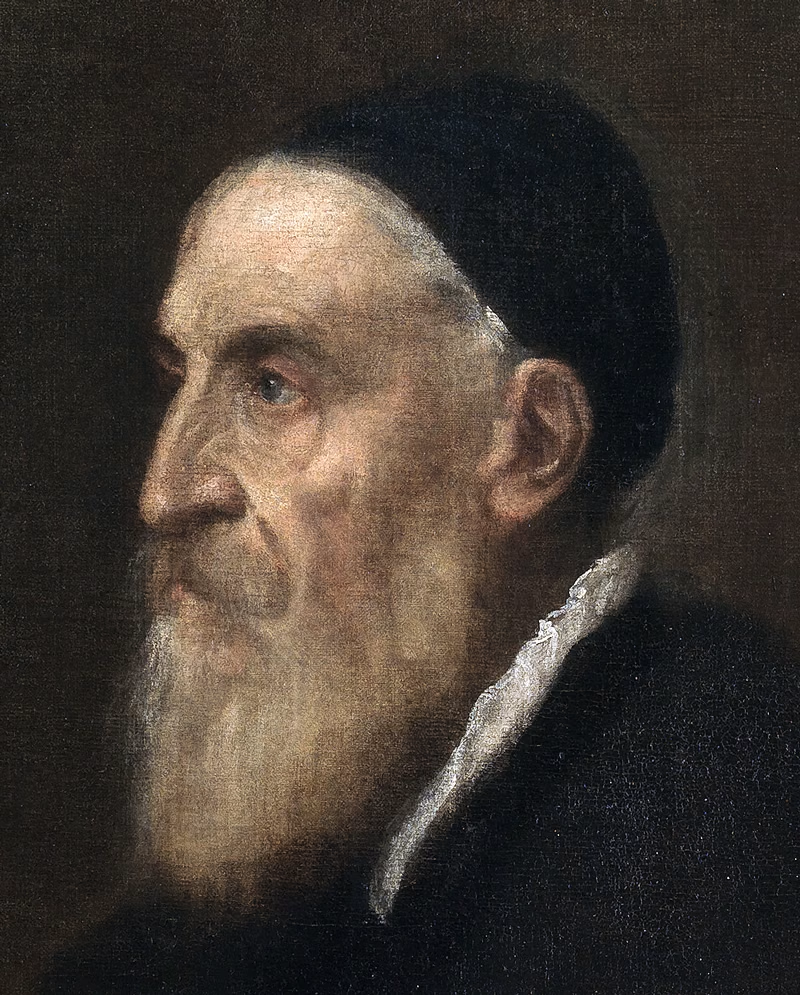
Titian is the most important painter of the Venetian school, one of the dominant figures of the entire Italian Renaissance, and the artist whose influence on European painting over the following two centuries was perhaps the deepest and most enduring. He practised his art for nearly seventy years of creative activity — from his earliest works at the beginning of the sixteenth century to his death in 1576, at an advanced age his biographers estimate at over ninety — without ever losing his power or his capacity to renew himself. His great mythological compositions, his portraits of sovereign psychological depth, his altarpieces of incomparable majesty and luminosity defined what painting can do with colour, and have fascinated generations of artists from Rubens to Manet.
Cadore and Venice: The Early Years
Tiziano Vecellio was born around 1488 in Pieve di Cadore, a small town in the Venetian Dolomites, into a family of local notaries. His exact birth date remains uncertain — sources vary considerably, and Titian himself was never very precise on this point. He joined Venice as a child, sent by his family to learn painting. He first entered the workshop of the mosaicist Zuccato, then that of Giovanni Bellini, the master of Venetian painting of the previous generation, and finally that of Giorgione, the painter who would exercise the most immediate and profound influence on him.
Giorgione (c.1477–1510) was the inventor of an atmospheric style — landscapes bathed in golden, mysterious light, melancholy figures in twilight moods — that marked the young Titian deeply. The two men collaborated closely, to the point that certain works were long disputed between them. Giorgione's death from plague in 1510 left Titian heir to his clientele and nascent reputation, which he would very quickly surpass.
Colour as Foundation
What fundamentally distinguishes Titian's painting — and Venetian painting in general — from Florentine or Roman painting of the same period is the place accorded to colour. In Florence and Rome, under the influence of Leonardo, Michelangelo and Raphael, drawing is the foundation of painting: one begins by constructing the composition and figures through drawing, then colouring them in. In Venice, the process is reversed: colour builds form and space directly, without preliminary drawing as the dominant structure. Titian is said to have painted with colour as poets write with words — directly, without intermediary.
This way of working produces entirely different visual effects: outlines are less sharp, forms more blended, atmosphere more present. Light in Titian's paintings is not a superimposed effect — it is constitutive of form itself. His Venetian reds, his twilight golds, his luminous and golden flesh tones are immediately identifiable and of a sensory beauty that has no equivalent in northern Italian painting.
His technique evolved considerably over the decades. In the works of his old age, the touches become broad, free, almost gestural — he sometimes painted with his fingers, Vasari tells us — producing surfaces of extraordinary texture and vibrancy that directly prefigure nineteenth-century painting and even certain twentieth-century Expressionisms.
The Major Works
Titian's output is immense — more than five hundred paintings are attributed to him — and covers all genres with equal mastery.
His altarpieces for the churches of Venice rank among the most powerful in the entire Catholic tradition. The Assumption of the Virgin (1516–18, Frari, Venice), in which the Virgin rises to heaven in an ascensional movement of extraordinary energy and colour, was immediately recognised as a masterpiece upon its installation. The Entombment (1520, Louvre) and The Martyrdom of Saint Lawrence (1559, Church of the Jesuits, Venice) demonstrate a mastery of dramatic chiaroscuro that recalls and anticipates the Baroque.
His great mythological compositions, painted principally for the Spanish court of Philip II in the years 1550–70, constitute perhaps his most ambitious and most personal undertaking. He called them himself poesie — visual poems — drawn from Ovid and ancient poetry: Danaë (various versions, Naples, Vienna, Madrid), Venus and Adonis (1554, Prado), Diana and Actaeon (1556–59, National Gallery, Edinburgh), The Fall of Icarus (lost). These paintings, of incomparable sensuality and formal freedom, in which nude bodies are treated with a tenderness and chromatic richness that make every painted surface an object of sensory pleasure, fascinated all the painters who saw them — Rubens copied them, Velázquez studied them, Poussin drew on them.
His portraits are among the most profound and most influential of the entire Renaissance. Man with a Glove (c.1520–23, Louvre) is one of the most psychologically intense portraits in the entire history of the genre. The Emperor Charles V on Horseback (1548, Prado) invented the official equestrian portrait that all of Baroque and Classical painting would repeat.
The Imperial Court and Glory
Titian was the most sought-after artist of his age. The Emperor Charles V received him in Augsburg in 1548 and 1550, granting him the titles of Count Palatine and Knight of the Golden Spur — extraordinary distinctions for an artist. His son Philip II of Spain remained faithful to him until Titian's death, commissioning works from him for decades from Madrid.
This unique position — first painter of the Empire — assured him a prosperity and creative freedom that few artists of his time enjoyed. He spent the end of his life in his villa in Venice, surrounded by pupils and assistants, receiving visitors and ambassadors like a prince.
He died on 27 August 1576 of plague, at an advanced age that remains disputed between eighty-eight and ninety-nine according to different sources. He was one of the very few Venetians to have been granted the right to be buried inside the Frari church — which also houses his Assumption — a final testimony to a glory that his entire life had built.