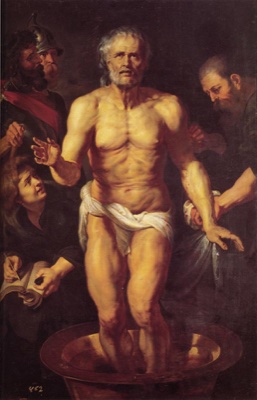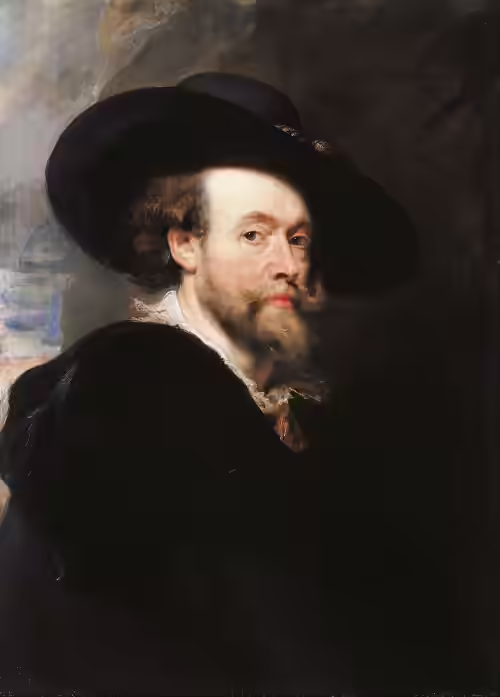
Peter Paul Rubens is the most important and influential painter of the Flemish Baroque, and one of the most prolific and admired artists in the entire history of European art. A painter of excess and fullness, he celebrated the human body, the Catholic faith, ancient mythology and the glory of princes with an energy and mastery that have no equal. His Antwerp studio, which employed dozens of assistants including Van Dyck and Jordaens, produced a prodigious quantity of work — monumental altarpieces, mythological cycles, state portraits, tapestry cartoons — that flooded the courts and churches of Europe. A diplomat as much as an artist, a scholar fluent in several languages, a man of the world possessed of natural elegance, Rubens embodies the humanist ideal of the complete artist at its highest degree.
A Youth Between Germany and Antwerp
Peter Paul Rubens was born on 28 June 1577 in Siegen, Westphalia (present-day Germany), where his family had taken refuge from Antwerp. His father, Jan Rubens, was a Calvinist lawyer who had fled the Spanish Netherlands to escape religious persecution — he had been imprisoned for an affair with Anne of Saxony, wife of William of Orange, and had been released only through the determined intervention of his wife, Maria Pypelincx. Jan Rubens died in 1587. Maria brought her children back to Antwerp, where the family rediscovered its roots and where Peter Paul was raised in the Catholic faith — a conversion that would prove permanent and sincere.
In Antwerp, Peter Paul received a thorough humanist education at the Jesuit colleges. He learned Latin, Greek, French, Spanish and Italian, and read the ancient authors with a passion that would nourish his iconographic repertoire for the rest of his life. In 1591 he entered service as a page to a noblewoman — the customary route for young men of his station — before devoting himself entirely to painting. He trained successively under three Antwerp painters: Tobias Verhaecht, Adam van Noort, and above all Otto van Veen (Vaenius), a cultivated humanist whose studio was one of the most respected in Antwerp. In 1598 he was received as a master in the painters' guild of Saint Luke.
Italy: The Revelation
In 1600, Rubens left for Italy — a journey that would last eight years and constitute his decisive formation. He entered the service of Vincenzo Gonzaga, Duke of Mantua, whose court was one of the richest and most cultivated in Italy. This position allowed him to travel freely and study the greatest art collections on the peninsula.
In Venice, he discovered Titian, Veronese and Tintoretto — the Venetian colourists whose chromatic richness and freedom dazzled him and whose lessons he absorbed with exceptional intelligence and speed. In Rome, he studied Michelangelo and the Antique, copied Greek sculptures and Roman reliefs, and confronted Raphael's frescoes in the Vatican. In Genoa, Mantua and Madrid — where he accompanied a ducal embassy in 1603 — he painted portraits, altarpieces and commissioned works that already reveal a mastery fully formed.
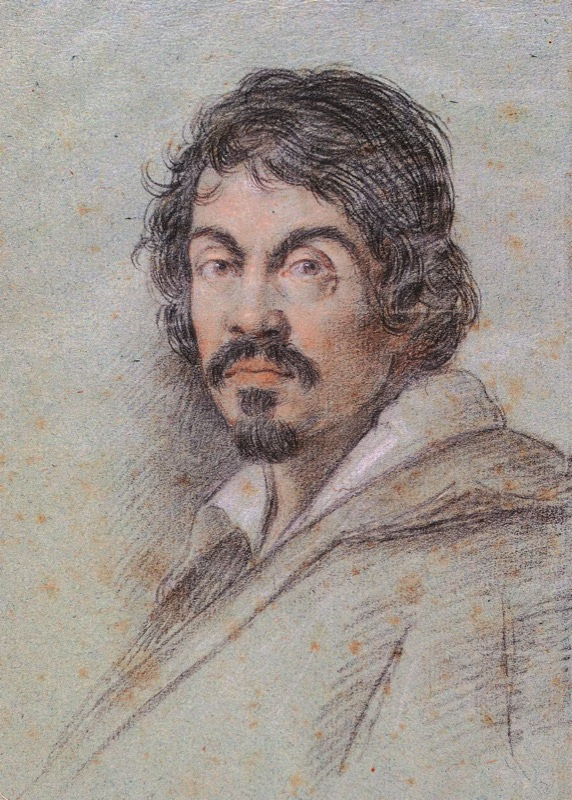
In Italy he also encountered the Caravaggist current, whose impact on his handling of chiaroscuro and dramatic lighting was real — though he transformed that influence according to his own vision: where Caravaggio sinks into shadow, Rubens bathes in light.
Antwerp, the Studio and Fame
His mother's death in 1608 called him back to Antwerp, which he would leave thereafter only for diplomatic missions. He settled there, married Isabella Brant in 1609, daughter of an Antwerp humanist, and gradually built one of the largest and most active studios in Europe. His house — today the Rubens House museum in Antwerp — was a veritable princely residence, with an Italian-style courtyard, a gallery of antique sculpture, a vast library and workshops where dozens of assistants and pupils worked simultaneously.
His working method in the studio is well documented: Rubens conceived the compositions, executed the essential parts himself — the faces, hands and most important passages of light — and entrusted the backgrounds, draperies, secondary figures and still-life elements to his collaborators. This industrial organisation allowed him to meet enormous demand while maintaining high quality. His principal collaborators — Jan Brueghel the Elder for flowers and landscapes, Frans Snyders for animals, Van Dyck for portraits — were themselves first-rate artists.
The Great Cycles and Masterpieces
The list of monumental commissions Rubens completed between 1610 and 1640 is nothing short of staggering. For Antwerp Cathedral he painted The Elevation of the Cross (1610–11) and The Descent from the Cross (1611–14), two monumental triptychs of dramatic power and formal mastery that immediately established themselves as the masterpieces of Flemish Baroque. The Descent from the Cross in particular — its dead Christ lowered in a diagonal movement of incomparable elegance and expressive force — is one of the most perfect religious compositions in the entire Christian tradition.
For Marie de' Medici, Queen Mother of France, he painted between 1622 and 1625 a cycle of twenty-four canvases commemorating her life and reign, intended for the Luxembourg Palace and today housed in the Louvre. This allegorical-historical cycle, of extraordinary fantasy and iconographic invention, is one of the most ambitious decorative programmes of the European Baroque.
The Diplomat and a Happy Old Age
Rubens conducted an active diplomatic career alongside his artistic one, largely on behalf of the Spanish Habsburgs of the Netherlands. Between 1622 and 1630 he undertook several missions to Paris, Madrid, London and The Hague, participating in peace negotiations between the great European powers. In 1629–30 he spent nine months in London as an ambassador, painted numerous canvases there, was knighted by Charles I, and received an honorary doctorate from the University of Cambridge.
Isabella Brant died in 1626. In 1630, at the age of fifty-three, Rubens married for a second time: Hélène Fourment, a sixteen-year-old girl from an Antwerp merchant family, whose radiant, full-bodied beauty inspired a series of portraits of a tenderness and freedom that rank among the finest paintings of private life in the entire history of art. The Little Fur (c.1636–38, Kunsthistorisches Museum, Vienna) — Hélène wrapped in a fur coat, her nude body shown with absolute tenderness and sensuality — is his testament on feminine beauty.
In his final years Rubens retreated more and more frequently to his château at Steen in Brabant, where he painted landscapes of a new serenity and luminosity, discovering at sixty an intimate vein of landscape painting he had never before explored. Gout increasingly immobilised him. He died in Antwerp on 30 May 1640, aged sixty-two.
An Immense Legacy
Rubens's influence on seventeenth- and eighteenth-century European painting is colossal. Rembrandt knew his work and deliberately distinguished himself from it. Van Dyck, his most gifted pupil, carried his portraiture legacy to England. Watteau, Fragonard and the entire French eighteenth century owed him the exuberance of colour and freedom of touch. Delacroix, in the nineteenth century, claimed him as the master of living painting against neoclassical rigidity. The Prado in Madrid, the Kunsthistorisches Museum in Vienna, the Louvre and Antwerp Cathedral hold the most important works of this incomparable artist.