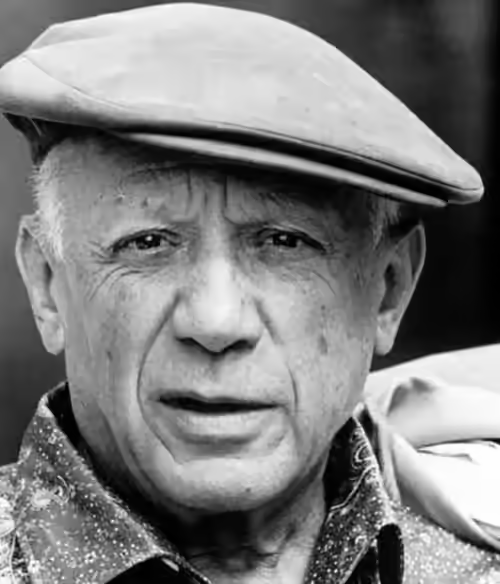
Pablo Picasso is the most famous and influential artist of the twentieth century. Painter, sculptor, printmaker, ceramicist and poet, he worked across nine decades with an energy and inventiveness that have no equal in the history of art. Co-founder of Cubism alongside Georges Braque, he shattered the representational conventions inherited from the Renaissance and opened paths that modern art went on to explore in every direction. His major works — Les Demoiselles d'Avignon, Guernica, the series of portraits of his companions — have become universal icons. A brilliant, seductive and domineering character, he embodied all by himself the modern idea of the artist as absolute creator and force of nature.
An Andalusian Childhood and an Overwhelming Vocation
Pablo Diego José Francisco de Paula Juan Nepomuceno Crispín Crispiniano María de los Remedios de la Santísima Trinidad Ruiz Picasso was born on 25 October 1881 in Málaga, Andalusia, into a cultivated middle-class family. His father, José Ruiz Blasco, was a painter and drawing teacher who specialised in still lifes of pigeons and game — a subject Picasso himself would later remark he had learned to paint before he could write. His mother, María Picasso López, came from a family in Majorca.
Pablo's talent revealed itself so early and so unmistakably that his father, according to legend, handed the boy his brushes at the age of thirteen, declaring he could never paint as well as his son. In 1891 the family moved to La Coruña, then in 1895 to Barcelona, where his father took up a teaching post at the School of Fine Arts. Pablo sat the entrance examination — normally requiring a month's preparation — in a single day, at the age of fourteen.
In 1897 he enrolled at the Royal Academy of San Fernando in Madrid, which he quickly abandoned to spend his days in the Prado copying Velázquez, Goya and El Greco. Back in Barcelona in 1899, he became a regular at Els Quatre Gats, an artistic and intellectual café where Catalan bohemians nourished on Symbolism and Art Nouveau gathered. He held his first exhibition there in 1900.
Paris: the Blue and Rose Periods
In 1900, Picasso made his first trip to Paris, which would gradually become his adopted city. He settled there for good in 1904, at the Bateau-Lavoir, a ramshackle Montmartre building turned artist's hive, where he lived in poverty and intellectual excitement alongside Max Jacob, Guillaume Apollinaire, Fernande Olivier — his first significant Parisian companion — and before long Gertrude and Leo Stein, the American collectors who would be among his earliest supporters.
The so-called Blue Period (1901–04) is dominated by canvases in cold blue monochrome depicting figures from society's margins — beggars, prostitutes, the blind, acrobats — in an atmosphere of melancholy and destitution that reflected his own poverty and the shock of his friend Carlos Casagemas's suicide in 1901. La Vie (1903, Cleveland Museum of Art) and The Old Guitarist (1903–04, Art Institute of Chicago) are the most representative works of this phase.
The Rose Period (1904–06) brought new warmth and lightness, with saltimbanques, clowns and harlequins painted in ochres and pinks. Family of Saltimbanques (1905, National Gallery of Art, Washington) illustrates the shift towards a more tender and less despairing register.
Les Demoiselles d'Avignon and the Birth of Cubism
In 1907, Picasso produced a canvas that would overturn twentieth-century art: Les Demoiselles d'Avignon (MoMA, New York). This large composition of five nude women in frontal, fractured poses was the outcome of a long and difficult gestation — the preparatory sketchbooks show dozens of revisions — fed by the discovery of African and Iberian masks at the Trocadéro and by deep study of Cézanne, particularly his Large Bathers. The faces of the two women on the right, shattered and deformed like ritual masks, broke with every convention of beauty or coherent spatial representation.
In an intense collaboration with Georges Braque between 1908 and 1914, Picasso developed Cubism — first Analytic, breaking objects into multiple facets seen simultaneously from different angles and rendering them in a reduced palette of greys and ochres; then Synthetic, reintroducing colour and pasted papers (collage) into more decorative compositions. This formal revolution called into question the very foundations of representation as inherited from the Renaissance over five centuries.
Maturity: From Neoclassicism to Surrealism
Picasso's creative richness also lay in his refusal to follow any straight line. After the Cubist years he practised different styles simultaneously or in succession, in constant dialogue with the history of art and contemporary movements. In the 1920s he developed a neoclassical manner — large, serene, monumental women rendered with the purity and solidity of Ingres — while remaining Cubist in other works. After his encounter with the Surrealists, whose circles he moved in without ever becoming a full member, his figures deformed according to a new psychological and dreamlike logic.
His romantic life, as turbulent as his art, fed directly into his painting. His successive companions — Fernande Olivier, Olga Khokhlova (a Ballets Russes dancer he married in 1918), Marie-Thérèse Walter (his secret mistress from 1927), Dora Maar, Françoise Gilot, Jacqueline Roque (whom he married in 1961) — pass through his work as so many muses and victims. Each new relationship brought with it a stylistic renewal, and the portraits of these women rank among the most inventive and psychologically intense works in his entire output.
Guernica: Art Against Barbarism
On 26 April 1937, aircraft of the Nazi Condor Legion and the Italian Fascist Aviazione Legionaria bombed the Basque town of Guernica, a symbol of Basque identity. Picasso, living in Paris and close to the Communist Party since the 1940s, responded with startling speed. In a matter of weeks he painted Guernica (1937, Museo Reina Sofía, Madrid), a monumental canvas in black, white and grey depicting the chaos and terror of the bombing — a dying horse, an impassive bull, screaming women, a dismembered soldier, a lamp throwing harsh light on the scene. Shown at the Spanish Pavilion of the Paris International Exposition, it immediately became the most powerful symbol of art's resistance to political barbarism in the twentieth century.
Final Decades and Death
After the Liberation, Picasso moved progressively to the south of France — Antibes, Vallauris (where he threw himself into ceramics), Cannes, Mougins — while maintaining a strong symbolic presence in Paris. He continued painting with a frenzy that commands admiration: in his final decades he produced hundreds of canvases, sculptures and prints, exploring new series of variations on the old masters — Velázquez, Manet, Delacroix, Rembrandt — with a freedom and irreverence that defied his age.
He died at Mougins on 8 April 1973, at the age of ninety-one, leaving behind a body of work estimated at more than twenty thousand paintings, sculptures, prints and ceramics. No artist in history has ever produced a body of work so vast and so varied. The Musée Picasso in Paris and the Museu Picasso in Barcelona hold the most important collections of his work.
An Immeasurable Legacy
It is hard to measure Picasso's influence on twentieth-century art, so total and multiform is it. Cubism freed painting from Renaissance perspective and opened the door to every form of abstraction. His easy, uninhibited relationship with the history of art — the capacity to digest, transform and reinvent Velázquez, Ingres or Delacroix — defined an artistic stance that postmodernism fully inherited. And his conviction that art can and must be a political act, embodied in Guernica, remains one of the most powerful affirmations of the artist's responsibility in the face of history.