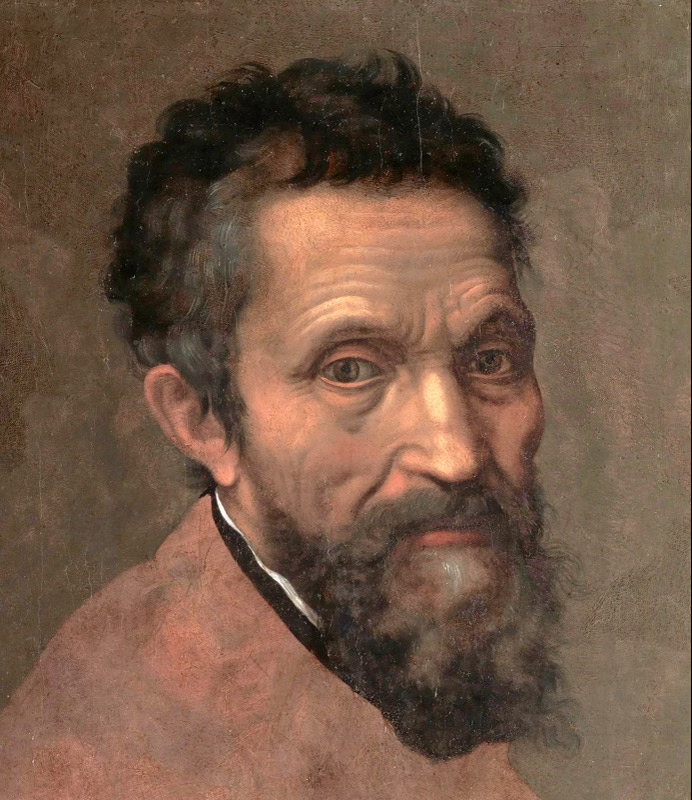
Michelangelo di Lodovico Buonarroti Simoni is one of the most prodigious figures in the entire history of Western art. Sculptor, painter, architect and poet, he dominated the Italian artistic scene for nearly seven decades, spanning the High Renaissance and laying the foundations of Mannerism. A contemporary of Leonardo da Vinci and Raphael, he distinguished himself from both through a formal power and spiritual intensity without equal. His works — the David, the Pietà, the Sistine Chapel ceiling, St Peter's Basilica — have become universal symbols of human greatness and Christian faith. More than any other artist, Michelangelo embodied the ideal of the uomo universale, the universal man capable of excellence in every domain.
A Florentine Childhood and an Early Vocation
Michelangelo Buonarroti was born on 6 March 1475 in Caprese, a small Tuscan borough whose podestà (magistrate) his father, Lodovico di Leonardo Buonarroti Simoni, happened to be for a few months. The family returned soon to Florence, where Michelangelo spent his entire childhood. His mother, Francesca di Neri, died in 1481 when he was only six. Entrusted to a wet-nurse whose husband was a stonecutter in the region of Settignano, the young Michelangelo grew up in contact with quarrymen and sculptors, and would joke later in life that he had "sucked the chisel and the hammer with my nurse's milk."
His father, from a family of impoverished Florentine minor nobility, had ambitions for him in letters or law. But Michelangelo had eyes only for art. At thirteen, in 1488, despite his father's reluctance, he entered as an apprentice the workshop of the painter Domenico Ghirlandaio, one of the most active studios in Florence, then working on the decoration of the Tornabuoni chapel in Santa Maria Novella. Ghirlandaio immediately perceived his pupil's exceptional maturity.
Under the Medici: The Garden of San Marco
As early as 1489, after barely a year in Ghirlandaio's studio, Michelangelo was noticed by Lorenzo de' Medici, the Magnificent, ruler of Florence and the greatest patron of his age. Lorenzo invited him to join the informal academy he had founded in his garden of San Marco, where young artists studied the collection of antique Greek and Roman sculptures under the guidance of the sculptor Bertoldo di Giovanni, himself a pupil of Donatello.
Michelangelo lived for two years in the Medici palazzo as a member of the household, dining at Lorenzo's table, rubbing shoulders with the philosophers, poets and humanists who gravitates around the master of Florence. This immersion in Neoplatonic culture — notably the thought of Marsilio Ficino and Pico della Mirandola on beauty as a reflection of the divine — would profoundly mark his vision of art and the human soul. It was in this garden that he produced his first sculptures, including the Battle of the Centaurs (c.1492), which already reveals a stupefying mastery of figures in movement.
Lorenzo de' Medici's death in 1492 deprived Michelangelo of his patron. In the years that followed, Florence was shaken by Savonarola's preaching and political turbulence. Michelangelo left the city, stayed in Bologna, then went to Rome in 1496.
Rome and the Pietà: Consecration
In Rome, Michelangelo produced between 1498 and 1499, at the request of Cardinal Jean de Bilhères, the Pietà now in St Peter's Basilica in the Vatican. This white Carrara marble sculpture shows the Virgin Mary cradling the dead body of Christ on her knees. The work astonished contemporaries with the perfection of its execution: the softness of the faces, the fineness of the drapery, the anatomical truth of the bodies, and above all the contained emotion that emanates from the whole. Michelangelo was just twenty-three when he completed it. The Pietà is the only work he ever signed — his name is carved in capital letters on the Virgin's shoulder strap, an act of pride he would regret and never repeat.
Florence and the David: The Ideal of Man
Back in Florence in 1501, Michelangelo received from the wool guild (Opera del Duomo) a commission for a colossal statue intended to ornament the cathedral. The available marble block, more than four metres tall, had already been clumsily roughed out by another sculptor forty years earlier and was considered unusable. Michelangelo accepted the challenge.
Between 1501 and 1504, he carved from this ungainly block the David, a 5.17-metre statue depicting the biblical hero before his combat with Goliath, in a state of absolute concentration and inner tension. The result was so perfect that a committee of Florentine artists — including Leonardo da Vinci — decided the work was too beautiful to be placed high on the cathedral: it was installed before the Palazzo della Signoria, at the heart of the city, as a symbol of Florence's republican freedom. The David is today held at the Galleria dell'Accademia in Florence.
The Sistine Chapel: A Superhuman Challenge
In 1508, Pope Julius II — an authoritarian and ambitious figure whom Michelangelo both respected and feared — commissioned him to decorate the ceiling of the Sistine Chapel in the Vatican. Michelangelo protested: he considered himself first and foremost a sculptor, not a painter. He accepted nonetheless, and radically transformed the original project.
Working on a scaffold, his body reversed or contorted over four years (1508–12), Michelangelo painted alone — progressively dismissing his assistants, whom he found insufficiently skilled — a surface of more than 500 square metres. The ceiling deploys an iconographic programme of extraordinary breadth: nine scenes from Genesis in its centre, including the celebrated Creation of Adam in which the hand of God extends a finger towards Adam, framed by prophets, sibyls, ancestors of Christ and monumental figures known as Ignudi.
The work was unveiled on 31 October 1512, on the eve of All Saints' Day, and caused immediate astonishment. Raphael, who visited the chapel secretly before its official opening, was so overwhelmed that he modified one of his own paintings in progress to incorporate the lesson of Michelangelo.
Twenty-three years later, in 1536, Michelangelo returned to the Sistine Chapel at the commission of Pope Paul III to paint the altar wall: the Last Judgement, completed in 1541. This monumental fresco, peopled with hundreds of swirling nude figures around the judging Christ, expressed a dark and terrifying vision of human destiny, far removed from the Olympian serenity of the ceiling. It reflected the anxieties of the Protestant Reformation and the spiritual crisis then gripping the Catholic Church.
Sculptor, Architect and Poet
Though the Sistine Chapel is his most celebrated painted work, Michelangelo always regarded himself as a sculptor above all. His output in that domain was immense: besides the Pietà and the David, he produced the tomb of Pope Julius II — a colossal project that occupied him for decades and of which he completed only a part, including the monumental Moses (c.1513–15), held at San Pietro in Vincoli in Rome. He also carved the Slaves or Prisoners, series of human figures appearing to struggle free from the marble, whose deliberate incompleteness (non finito) prefigures aesthetic questions that would run through art long after the Renaissance.
As an architect, he designed in Florence the New Sacristy of San Lorenzo and the Laurentian Library, both commissioned by the Medici. In Rome, from 1546, he took over the construction of St Peter's Basilica, rethinking its plan and designing the famous dome — which he would not live to see completed, but which remained faithful to his plans.
Michelangelo was also the author of a poetic oeuvre of some three hundred sonnets and madrigals, in which he expressed his spiritual torments, his love of beauty, and his meditations on death and faith. His poems addressed to Tommaso de' Cavalieri, a young Roman aristocrat he met in 1532, and to Vittoria Colonna, a poet of high nobility who became his dearest friend in his final years, testify to an inner life of remarkable depth and complexity.
Final Years and Death
Michelangelo aged in growing solitude, increasingly absorbed by religious and existential preoccupations. The death of Vittoria Colonna in 1547 plunged him into deep grief. He devoted himself to increasingly intimate and anguished works: the Rondanini Pietà (1552–64), which he worked on until the last days of his life and left unfinished, is the antithesis of the marmoreal perfection of his youth — the bodies seem to dissolve into the material, as if form itself were seeking liberation from the weight of flesh.
He died on 18 February 1564 in Rome, aged eighty-eight, having dictated his will in three sentences: "I give my soul to God, my body to the earth, my goods to my nearest relatives." His funeral was held in Rome, but his remains were secretly transported to Florence by his nephew Lionardo, as he had wished. He rests in the Basilica of Santa Croce, alongside Dante and Galileo.
A Legacy Without Measure
Michelangelo exercised an influence so vast and so deep on Western art that it is difficult to assess fully. The generations of painters and sculptors that followed — from the Florentine Mannerists to Baroque painters such as Caravaggio and Rubens, to the nineteenth-century Romantics — all had to confront his legacy, admire it, surpass it or free themselves from it. Rodin, in the nineteenth century, acknowledged him as his absolute master.
More than his works themselves — though they are among the most visited and most reproduced in the world — it is perhaps the very idea of artistic genius that Michelangelo bequeathed to posterity: the conviction that art can reach the divine, that beauty is a path to truth, and that creative suffering is the price to be paid for touching the absolute.