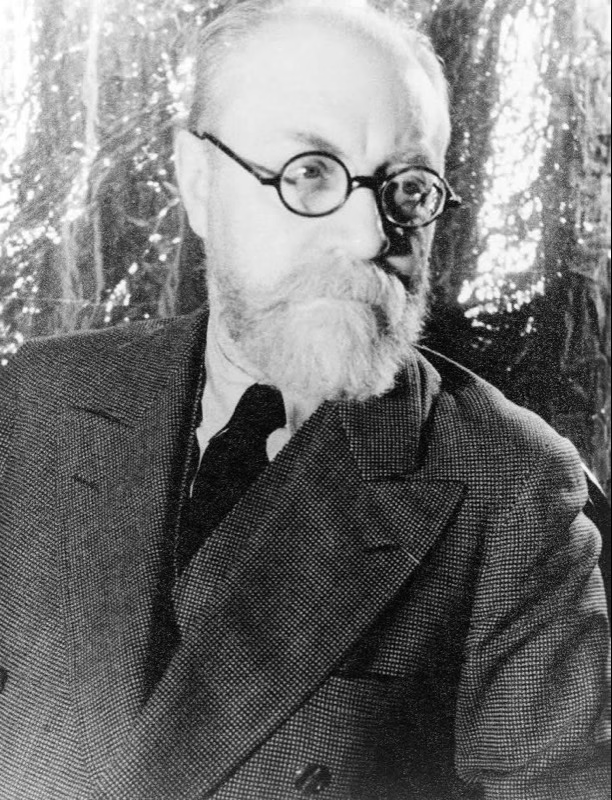
Henri Matisse is one of the most important painters of modern art. The presiding figure of Fauvism and great rival of Pablo Picasso, he devoted his entire life to a single quest: finding in colour and line an equilibrium capable of expressing fullness and the joy of living. From his early dark canvases inherited from the nineteenth century to the blazing cut-outs of his final years, his work traces a creative arc of exceptional coherence and richness. Matisse never ceased to reinvent himself, turning every constraint — including illness — into a starting point for new artistic freedom.
A Late Vocation, Born by Chance
Henri Émile Benoît Matisse was born on 31 December 1869 in Le Cateau-Cambrésis, in northern France, into a family of grain merchants and weavers. His father, Émile Matisse, was a shopkeeper; his mother, Anna Gérard, painted decorations on porcelain in her spare time — the young Henri's first discreet but real contact with the world of art.
Following family expectations, Matisse studied law in Paris and obtained his diploma in 1888. He returned to Saint-Quentin to work as a solicitor's clerk, leading an undistinguished life. It was in 1889, during a long convalescence after an attack of appendicitis, that his mother brought him a box of paints to pass the time. The revelation was immediate and total. He described this experience later as a liberation: "I felt free, alone, at peace."
At twenty, he decided to abandon everything for painting. His father, deeply disappointed, nevertheless granted him a meagre allowance. In 1891, Matisse moved to Paris and entered the Académie Julian before joining the École des Beaux-Arts in 1895 in the studio of the Symbolist painter Gustave Moreau. Moreau, an exceptional teacher, encouraged his students to copy the masters at the Louvre and to find their own language. "Colour must be thought, dreamed, imagined," he taught them. Among his fellow students were Georges Rouault and Albert Marquet, who would become close friends.
Years of Apprenticeship and Early Influences
Matisse's first canvases, produced in the 1890s, belonged to an academic and sombre tradition. But several encounters and discoveries gradually drew him towards light and colour. In 1896 and 1897, he stayed in Brittany and discovered the clear painting of the Impressionists. Seeing canvases by Monet and Pissarro revealed to him the possibilities of luminous colour applied directly to the canvas.
In 1898, he married Amélie Parayre, with whom he had three children — two sons, Jean and Pierre, and a daughter, Marguerite, born of a previous relationship and adopted by Amélie. That same summer, on Pissarro's advice, he spent his honeymoon in Corsica and London, where the luminous seascapes of J. M. W. Turner left him speechless.
In 1899, he purchased at considerable financial sacrifice a small Bather by Cézanne, which would stand in his studio until the end of his life. Cézanne's influence on his way of constructing space and laying down colour would be decisive. He also engaged with the work of Paul Signac, whose Divisionism — placing colour in small separate touches — attracted him for a time before he moved beyond it.
Fauvism: Colour Unleashed
The summer of 1904 was a turning point. Matisse stayed in Saint-Tropez with Signac and produced Luxe, Calme et Volupté (1904–05), a large Neo-Impressionist composition that announced his imminent transformation. The following year, the summer of 1905 spent in Collioure with André Derain was the true trigger. The two painters worked side by side in intense Mediterranean light and produced canvases in which colour, stripped of all descriptive function, exploded into pure, violent flat areas.
In the autumn of 1905, these works were shown at the Paris Salon d'Automne. The public and critics were stunned. The critic Louis Vauxcelles, observing these raw-coloured canvases hung around a Renaissance-style sculpture, exclaimed: "Donatello among the wild beasts!" The term stuck, and Fauvism was born. Matisse was its figurehead. His painting Woman with a Hat (1905), depicting Amélie in an apparently uncontrolled state of colour, was purchased by the American collectors Leo and Gertrude Stein — the beginning of an important relationship with the American art world.
The Joy of Life (1905–06), a large Arcadian composition peopled with nude figures dancing and resting in a landscape, summed up Matisse's ambition: to create an art of fullness, "an art of balance, of purity and serenity, devoid of troubling or preoccupying subject matter."
Maturity: From Colour to Form
In the years that followed, Matisse deepened his search for the essential. He travelled to Italy in 1907, Germany in 1908, and made two decisive trips to Morocco in 1912 and 1913. The light and colours of Tangier, the interiors adorned with zellige tiles and lattice screens, the slowness and serenity of local life nourished a series of luminous, contemplative canvases that rank among his finest achievements.
In 1909, the Russian collector Sergei Shchukin commissioned two large decorative panels for his Moscow residence: The Dance and Music (1909–10), works of striking formal power, reduced to three colours — the blue of the sky, the green of the ground, the red of the bodies — and forms of an almost primitive simplicity. These two masterpieces are now held at the Hermitage Museum in St Petersburg.
Matisse settled in Nice in 1917, drawn by the Mediterranean light. He would paint there for nearly three decades — series of Odalisques, windows open onto the sea, sumptuous interiors in which fabrics, faience tiles and tropical plants composed worlds of visual pleasure. Though some critics charged him with a certain decorative hedonism, these canvases testify to an absolute mastery of composition and colour.
Picasso, the Other Giant
The relationship between Matisse and Pablo Picasso is one of the most celebrated and most fruitful in the history of art. The two men met in 1906 at Gertrude Stein's and thereafter maintained an intense friendship-rivalry, compounded of mutual admiration, emulation and deep aesthetic disagreement. Where Picasso deconstructed and fractured form, Matisse sought harmony and fullness. Where one worked in anguish, the other aspired to serenity. Together they embodied the two great directions of twentieth-century artistic modernity, and each recognised in the other an irreplaceable interlocutor.
The Cut-Outs: A Final Revolution
In 1941, Matisse underwent a serious operation for duodenal cancer. The surgery left him with significant aftereffects and confined him to lengthy periods in bed or in a wheelchair. It was in these conditions of physical frailty that he invented a new technique: the papiers découpés (cut-outs). He had large sheets of paper painted in vivid colours by his assistants, then cut directly into them with scissors, composing plant, animal or abstract forms that he assembled into large mural compositions.
Far from being a substitute technique, the cut-outs constituted a genuine aesthetic revolution. "Cutting directly into vivid colour reminds me of the sculptor's direct carving," he said. Among the major works of this period are the Jazz series (1947), The Swimming Pool (1952) and the compositions produced for the Chapelle du Rosaire in Vence (1948–51), a total architectural and decorative project — stained glass windows, ceramic tiles, liturgical ornaments — that Matisse considered his own masterpiece.
Death and Legacy
Henri Matisse died on 3 November 1954 in Nice, aged eighty-four, of a heart attack. He left behind an immense body of work: paintings, drawings, sculptures, prints, cut-outs, as well as decorative artworks, ballet costumes and sets for Sergei Diaghilev's Ballets Russes in the 1920s.
His influence on twentieth-century art is considerable and multiform. From American Abstract Expressionism — Mark Rothko's colour fields owe much to Matisse — to contemporary graphic design, through Minimalist art, his legacy irrigates vast tracts of modern creation. The Matisse Museum in Le Cateau-Cambrésis, his birthplace, and the Matisse Museum in Nice hold the most important collections of his works.
Throughout his life, Matisse sought to create an art capable of bringing comfort and joy, "something like a comfortable armchair," in his own words — not out of naivety or superficiality, but from the deep conviction that beauty is a form of intelligence about the world.


