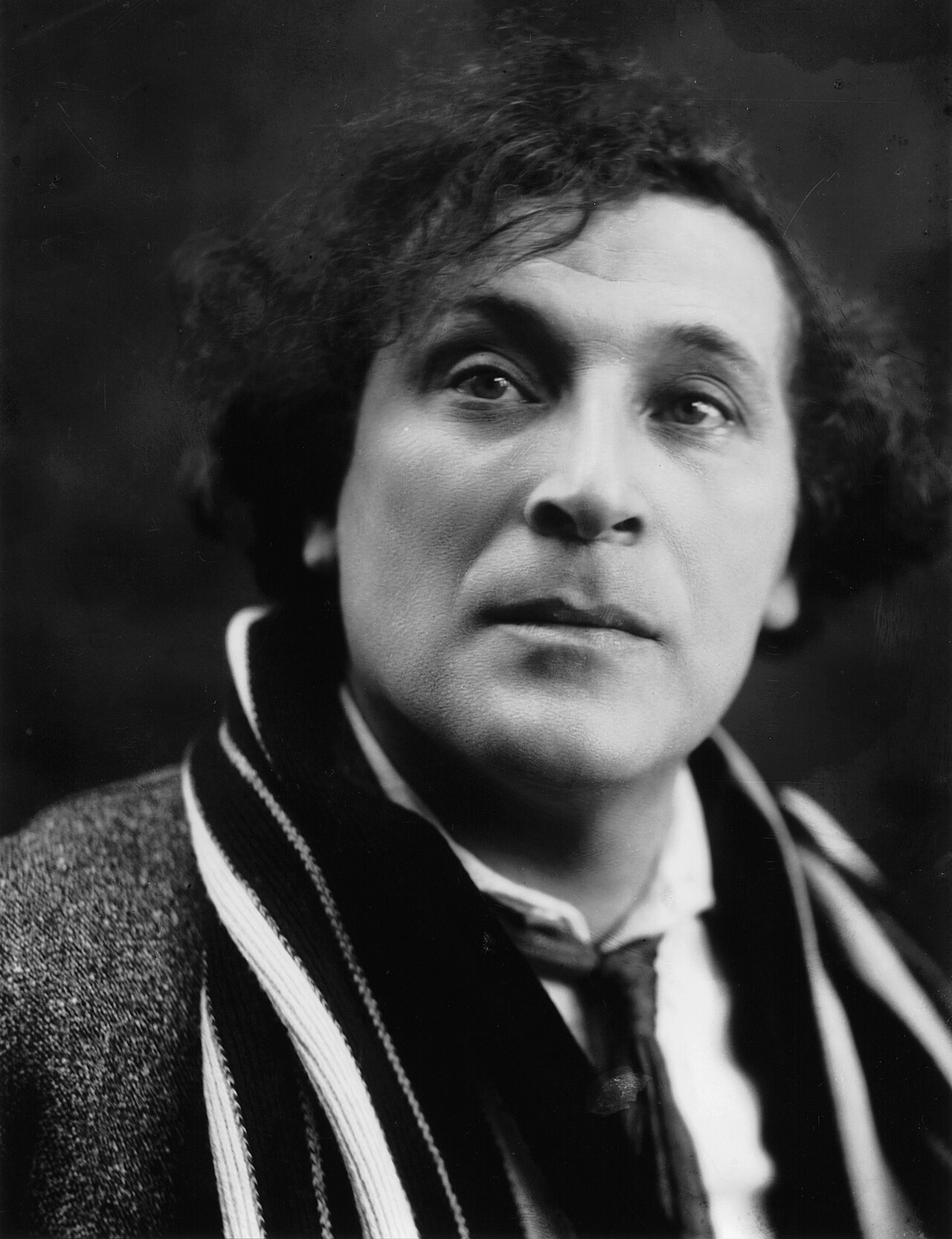
There is something profoundly singular about Marc Chagall's work: a way of fusing the memory of a childhood in a shtetl of the Russian Empire, the feverish skies of Belle Époque Paris, the tenderness of bodies entwined in mid-air, and above all colour — colour applied with a freedom and joy that seem to defy all sadness. Chagall was not an Impressionist, nor a Cubist, nor an Expressionist, nor really a Surrealist, though André Breton claimed him as one of their own. He is simply Chagall — a visual world like no other, where violinists play on rooftops, lovers fly above snow-covered villages, and faith, love and nostalgia blend in a visual poetry of rare generosity.
Vitebsk: The Roots of a World
Marc Chagall was born on 7 July 1887 in Vitebsk, a city in the Russian Empire (present-day Belarus), into a modest Jewish family. His father, Zahar Chagall, was a herring warehouse worker; his mother, Feïga-Ita Rosenfeld, ran a small grocery and looked after her nine children with energetic dedication. Marc was the eldest. The family was poor, deeply rooted in Jewish culture and religion — the Hebrew calendar festivals, the stories of the Tanakh, klezmer music and the shtetl community formed the emotional and symbolic humus that Chagall would carry with him throughout his life, to France, to America and as far as his mosaics for the Paris Opéra.
He discovered painting almost by chance, seeing a classmate draw. The revelation was immediate and total. His mother, a pragmatic woman who wanted the best for her son, eventually paid for drawing lessons with Jehuda Pen, a local academically trained painter. But Vitebsk soon felt too small. In 1907, at twenty, Chagall persuaded his mother to advance him the train fare to Saint Petersburg, the Empire's artistic capital. There he entered the school of the Imperial Society for the Encouragement of the Arts, then the studio of Léon Bakst — the designer of the Ballets Russes — who recognised his originality and encouraged him to go to Paris.
Paris and La Ruche: The Explosion
Chagall arrived in Paris in 1910 and moved into La Ruche, an artists' residence on the rue Dantzig in Montparnasse, where Modigliani, Léger and Soutine also lived. The impact was thunderous. In Paris he discovered Cézanne, the Fauves and nascent Cubism. He absorbed their lessons with voracious curiosity, but without ever dissolving his own vision in them. From Cubism he retained the simultaneity of planes and the decomposition of space; from the Fauves, the freedom and power of colour. But he added something that neither possessed: dream, memory, feeling.
The canvases painted between 1911 and 1914 are among his most revolutionary. I and the Village (1911, MoMA, New York) juxtaposes the memory of a cow, a peasant, a flowering tree and a village scene in a circular composition of formal freedom that owes as much to Russian icons as to Cubism. To Russia, Asses and Others (1911, Centre Pompidou, Paris) accumulates images from his childhood in a dreamlike space where the logic of cause and effect has simply disappeared — a woman separates her head from her body to water a cow, a man runs upside down. This is not Surrealism: it is affective memory, operating through free association rather than narrative logic.
Bella, the War and the Return to Russia
In 1914, on the eve of the First World War, Chagall returned to Vitebsk for what was meant to be a brief visit. The war kept him there until 1922. There he found again Bella Rosenfeld, daughter of a local jeweller he had met in 1909 and been in love with ever since. They married in 1915. Bella — intelligent, cultivated, beautiful — would be Chagall's absolute muse and companion for thirty years, until her death in 1944. She runs through his work as a luminous, recurring presence: it is she, eyes closed, dark-haired, flying above cities in dozens of canvases.
The Bolshevik Revolution of 1917 initially opened new prospects: he was appointed Commissar for the Arts of the city of Vitebsk and founded an arts school there in 1918. But quarrels with Malevich, who took control of the school and imposed Suprematism at the expense of figuration, disgusted him. He left Vitebsk for Moscow, where he produced monumental decorations for Alexei Granovsky's Jewish Chamber Theatre — colourful and inventive frescoes covering the walls and ceilings of the hall. In 1922 he left Russia permanently for Berlin, then returned to Paris in 1923.
Paris, the Holocaust and American Exile
Back in Paris, Chagall entered a period of growing productivity and recognition. The dealer Ambroise Vollard commissioned illustrations from him for the Fables of La Fontaine and for the Bible — a project that occupied him for years and took him to Palestine in 1931. These illustrations, engraved in etching with consummate mastery, are among his finest works.
But the 1930s progressively darkened his world. The rise of Nazism, pogroms in Eastern Europe and the persecution of Jews shook him profoundly. His paintings of this period — notably the White Crucifixion series (1938) — show a Jewish Christ crucified against a background of burning shtetls and fleeing refugees. The figure of Christ, for Chagall, was not a Christian figure but the universal symbol of all innocent victims.
In 1941, at the invitation of the Museum of Modern Art in New York, Chagall emigrated to the United States with Bella. In 1944, Bella died suddenly of a viral infection. Chagall was devastated. Months passed before he picked up his brush again.
Consecration and the Major Decorations
After the war, Chagall settled permanently in France — first in Paris, then in Vence in the Midi, and finally in Saint-Paul-de-Vence, where he lived until his death in 1985. He rebuilt his life with Valentina Brodsky (known as Vava), whom he married in 1952, and recovered his creative serenity.
The final decades of his life were those of the major official commissions: the ceilings of the Paris Opéra (1964), the stained glass windows of Metz Cathedral (1958–68) and the Hadassah synagogue in Jerusalem (1962), the mosaics and tapestries of the Israeli Parliament, the murals of the Metropolitan Opera in New York (1966). These large works, bathed in blue light and spiritual jubilation, crowned a lifetime devoted to making colour a language of love and memory.
Marc Chagall died on 28 March 1985 in Saint-Paul-de-Vence, aged ninety-seven. The Musée National Marc Chagall in Nice, inaugurated in 1973 during his lifetime, is one of the rare museums in the world created for a living artist — testimony to a recognition that, for once, had not waited for death.