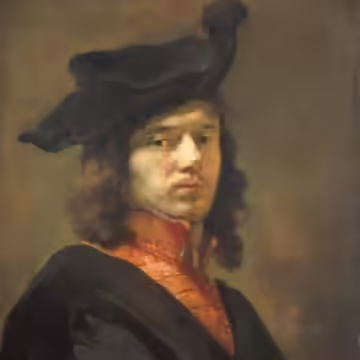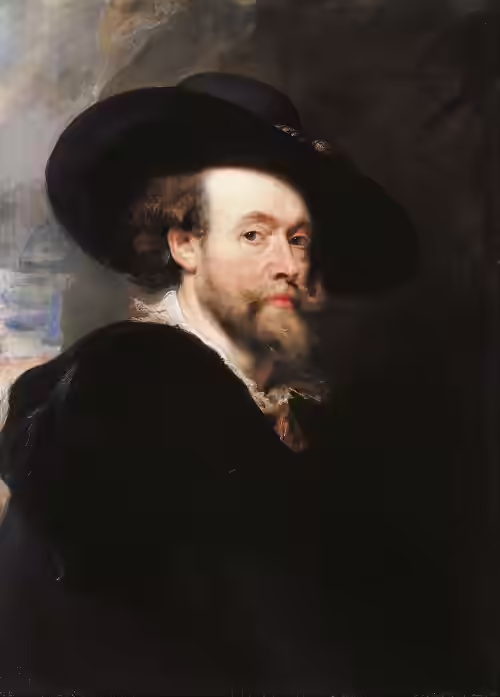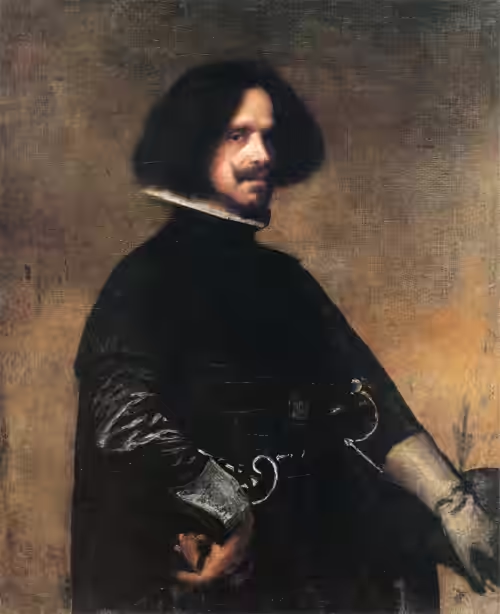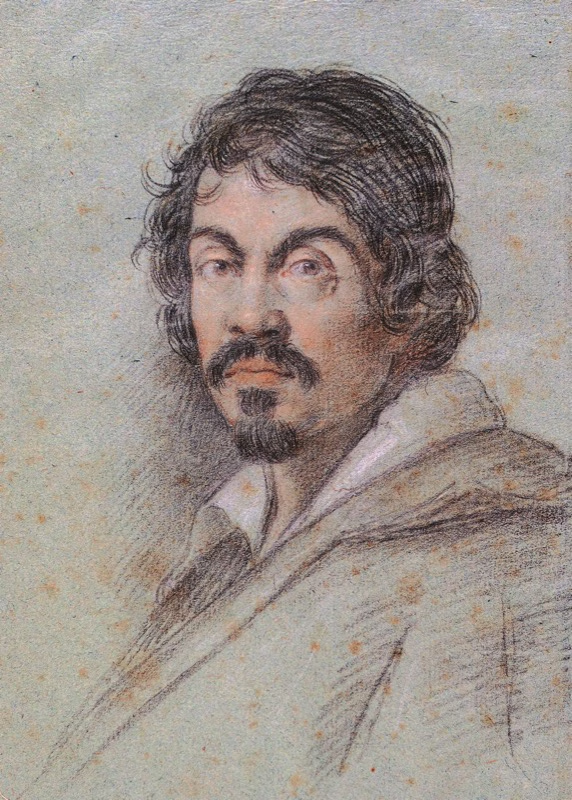
Michelangelo Merisi, known as Caravaggio, is one of the most revolutionary and most enigmatic painters in the entire history of art. In barely two decades of active career, this Lombard artist settled in Rome overturned the conventions of Western painting by inventing a radically new visual language, founded on the brutal contrast between light and shadow — the famous chiaroscuro or tenebrismo — and on a representation of religious scenes of previously unprecedented realism. Admired by some, scandalised by others, hunted by the law, dead at thirty-eight in obscure circumstances, Caravaggio led a life as violent and troubled as his work is powerful. His influence on the generations that followed — Rubens, Rembrandt, Velázquez, Georges de La Tour — was considerable and enduring.
A Lombard Origin and a Milanese Formation
Michelangelo Merisi was born on 29 September 1571 in Milan, most likely, though some old documents suggested the town of Caravaggio in Lombardy, from which his nickname derived. His father, Fermo Merisi, was a master builder and steward in the service of the Marquis Francesco Sforza di Caravaggio. His mother, Lucia Aratori, came from a family of craftsmen. In 1576, a plague epidemic ravaged the region and carried off Michelangelo's father, grandfather and an uncle. The family took refuge in Caravaggio, where the child grew up.
In 1584, at thirteen, Michelangelo was placed as an apprentice in the Milanese studio of the painter Simone Peterzano, a pupil of Titian, under whom he trained for four years. This classical training gave him mastery of drawing, knowledge of pictorial techniques and familiarity with the great works of the Lombard Renaissance — Leonardo had worked in Milan, and his influence on local painting, particularly in the treatment of light and half-tones, was still palpable. The young Michelangelo was also exposed to works by Giorgione and Titian, whose use of colour and atmosphere marked him profoundly.
Arrival in Rome and Difficult Beginnings
Around 1592, after the death of his mother and the liquidation of the family inheritance, Michelangelo Merisi arrived in Rome, then the artistic capital of the Western world, in full ferment under Pope Clement VIII. He was in his early twenties, with little money and no connections. His first years in the city were precarious: he worked in the studios of minor painters, including the Cavalier d'Arpino (Giuseppe Cesari), and produced flower and fruit paintings — a decorative genre of little esteem at the time, but one in which he already manifested an extraordinary visual acuity.
His situation changed thanks to the patronage of Cardinal Francesco Maria Del Monte, a cultivated man and art lover who took him into his palazzo around 1595 and gave him the freedom to work. For Del Monte, Caravaggio painted a series of cabinet pictures of troubling sensuality, depicting young musicians or mythological figures with ambiguous features: The Concert (c.1595), The Lute Player (c.1596), Bacchus (c.1596). These works displayed a sharp eye for observation — the fruit in Bacchus shows realistic imperfections, the draperies are crumpled, the fingernails of the figures slightly dirty — and a physical presence of subjects that broke with the still-dominant Mannerist idealisation.
The Revolution of Realism and Chiaroscuro
Consecration came with the major public commissions of 1597–1601. Cardinal Del Monte recommended Caravaggio for the decoration of the Contarelli chapel in the church of San Luigi dei Francesi in Rome. The artist produced three monumental canvases devoted to Saint Matthew: The Calling of Saint Matthew, Saint Matthew and the Angel and The Martyrdom of Saint Matthew (1599–1600).
These works sent a shockwave through the Roman art world. In The Calling of Saint Matthew, Christ and Saint Peter enter a dark tavern where dice-players are seated at a table — contemporary figures, dressed in sixteenth-century fashion, lit by a shaft of light that cuts through the shadow like a divine finger. No haloes, no opening sky, no angels: divine grace operates in the most trivial everyday setting, with a suddenness and luminous violence that stuns the eye.
This technique, which would be called tenebrismo or Caravaggist chiaroscuro, involved plunging almost the entire painting in deep darkness, from which figures were drawn out by directed, intense beams of light. It was not an absolute invention of Caravaggio — Leonardo and Giorgione had already explored sfumato and half-tones — but he pushed it to a radical extreme never before reached, making the contrast itself the principal vehicle of dramatic emotion.
Shortly afterwards, for the Cerasi chapel in Santa Maria del Popolo, he painted The Conversion of Saint Paul and The Crucifixion of Saint Peter (1600–01), two compositions of striking sobriety and power. In The Conversion of Saint Paul, the future apostle lies thrown from his horse, arms spread in the darkness, while a groom attends to the animal, indifferent to the miracle unfolding around him. The essential is suggested, not shown — and it is precisely this restraint that makes the scene so overwhelming.
Scandal and Violence
Alongside his mounting fame, Caravaggio led a life of disorder and violence that earned him numerous run-ins with Roman justice. The court records of the period preserve traces of multiple incidents: brawls, inflicted wounds, insults, assaults. He carried a sword at all times and used it readily. In 1600 he wounded a certain Girolamo Stampa. In 1601 he was involved in another brawl. In 1603 he was sued for defamation by the painter Giovanni Baglione.
28 May 1606 was the point of no return: during a dispute whose exact causes remain obscure — perhaps a disagreement over a ball game, perhaps a quarrel over a woman — Caravaggio killed Ranuccio Tomassoni with a sword thrust in Rome. Condemned to death in absentia, he had to flee the city immediately and could never return.
Exile: Naples, Malta, Sicily
The last four years of Caravaggio's life were those of a fugitive genius, drifting from city to city across the Mediterranean, painting with growing intensity and darkness while attempting to obtain the papal pardon that would allow him to return to Rome.
In Naples, where he arrived in the autumn of 1606, he painted The Seven Works of Mercy (1606–07), a large composition for the church of the Pio Monte della Misericordia, which synthesises in a single canvas of intertwined figures all the works of Christian charity. The work was immediately recognised as a masterpiece.
In 1607, he sailed to Malta, hoping to secure the protection of the Knights of St John of Jerusalem. He received the title of Knight of Grace there and painted for the cathedral of Valletta The Beheading of Saint John the Baptist (1608), his largest painting, signed — according to legend — with his own blood. In reality, his signature is traced in the blood flowing from the neck of the decapitated saint, the only known signature in his work after his early period. But his demons caught up with him: imprisoned after another assault, he escaped and fled to Sicily.
In Syracuse, Messina and Palermo (1608–09), he painted canvases of dark, visionary intensity: The Burial of Saint Lucy, The Raising of Lazarus, The Adoration of the Shepherds. The figures are more stripped-down than ever, the settings reduced to their essentials, the light even more brutally concentrated on flesh and faces. These works of exile are among the most moving of his entire output.
Back in Naples in 1609, he was the victim of a violent assault — a probable murder attempt, most likely commissioned by enemies — which partially disfigured him. He continued to paint feverishly, awaiting the papal pardon that seemed finally on the point of being granted.
An Obscure Death
In July 1610, Caravaggio boarded a felucca headed for Rome, carrying with him several paintings intended as gifts in exchange for his pardon. At Porto Ercole on the Tuscan coast, he disembarked for unknown reasons and was briefly arrested then released. He died on 18 July 1610 at Porto Ercole, aged thirty-eight. The cause of his death remains uncertain: fever, heatstroke, lead-white poisoning from his paints, or the aftereffects of the Neapolitan assault have all been proposed. His paintings may have been lost or stolen during that final journey.
Research carried out in 2010 by Italian historians suggested that bones discovered at Porto Ercole might be his, based on DNA analysis and traces of lead found in the remains. These conclusions, though compelling, remain debated by the scholarly community.
An Immense and Enduring Legacy
Caravaggio's influence on seventeenth-century European painting was immediate and extraordinarily deep. From the 1610s, dozens of Italian, Flemish, Dutch, French and Spanish painters adopted his style and formed the current of Caravaggism: Artemisia Gentileschi, Orazio Gentileschi, Valentin de Boulogne, Jusepe de Ribera, Georges de La Tour, Hendrick ter Brugghen. Rubens copied and drew on him. Rembrandt, without ever having seen him directly, inherited his manner through the Utrecht Caravaggists. Velázquez owed him most of his treatment of light in his early works.
Forgotten or underestimated in the eighteenth and nineteenth centuries, Caravaggio was rediscovered in the twentieth, notably thanks to the art historian Roberto Longhi who, in the 1920s and 50s, restored his central place in the history of painting. Today his paintings are among the most visited works in the great European museums — the Galleria Borghese in Rome, the Uffizi in Florence, the Louvre in Paris, the Prado in Madrid, the National Gallery in London. Painter of violence and grace, of the suffering body and divine light, Caravaggio remains one of the most modern and most disturbing voices in all of Western painting.