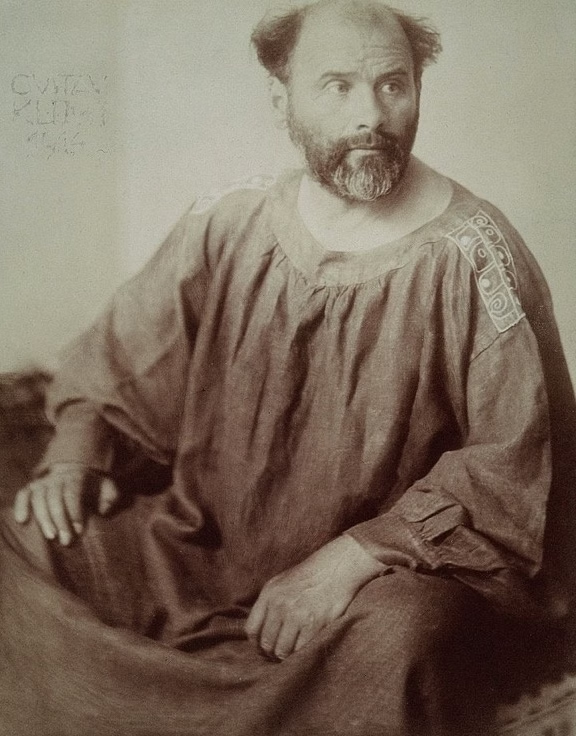
Gustav Klimt is one of the most fascinating figures of European art at the turn of the nineteenth and twentieth centuries. An Austrian painter, founder of the Vienna Secession and central figure of the Art Nouveau movement, he revolutionised decorative painting by elevating it to the status of a major art. His sumptuous canvases, in which human bodies dissolve into fields of gold and geometric ornament, embody both the splendour and the contradictions of a Vienna at the peak of its civilisation, on the eve of its collapse. Love, death, femininity and eroticism form the thematic bedrock of a body of work that never ceases to bewitch the eye.
A Classical Formation in Imperial Vienna
Gustav Klimt was born on 14 July 1862 in Baumgarten, now a district of Vienna, into a modest family. His father, Ernst Klimt, was a gold engraver of Bohemian origin; his mother, Anna Finster, had dreamed of a musical career that circumstances never allowed. Gustav was the second of seven children, two of his brothers, Ernst and Georg, also showing artistic inclinations.
In 1876, at fourteen, Gustav was admitted to the Vienna School of Applied Arts (Kunstgewerbeschule), where he received rigorous training in the decorative arts and painting. He studied mosaic, fresco and illustration — techniques that would profoundly influence his later style. He formed a friendship there with Franz Matsch, with whom he would collaborate for many years.
On completing his studies in 1883, Klimt founded with his brother Ernst and Franz Matsch the Künstler-Companie (Artists' Company), a studio that quickly received prestigious official commissions: the decoration of theatres in Reichenberg, Fiume and Karlsbad, then work for the monumental staircase of the Kunsthistorisches Museum in Vienna (1890–91), where Klimt produced allegories of the history of painting that earned him the Imperial Prize. At this stage he was a recognised academic artist, admired for his technical skill and sense of decorum.
The Vienna Secession: Breaking with Academicism
The death of his brother Ernst in 1892, followed shortly by that of his father, plunged Klimt into a period of mourning and profound self-examination. He withdrew from public life for several years, reflecting on his practice and steeping himself in the new artistic currents sweeping Europe — Symbolism, Art Nouveau and the researches of the English Pre-Raphaelites.
In 1897, Klimt led a group of artists who decided to break with the Künstlerhaus, the official artists' association judged too conservative. They founded the Wiener Sezession (Vienna Secession), of which Klimt became the first president. The movement's motto, engraved on the façade of its landmark building designed by the architect Joseph Maria Olbrich, summed up their ambition: "Der Zeit ihre Kunst, der Kunst ihre Freiheit" — "To every age its art, to art its freedom."
The Secession organised innovative exhibitions, published the journal Ver Sacrum (Sacred Spring) and invited foreign artists such as Auguste Rodin. Klimt was its figurehead and creative engine. In 1902, he produced for the Secession's fourteenth exhibition a monumental frieze around Max Klinger's Beethoven sculpture: the Beethoven Frieze, a thirty-four-metre work that blended allegory, nude figures and relief ornament, and in which all the great themes of his later painting can already be read.
The Scandal of the Faculty Paintings
Between 1900 and 1907, Klimt worked on three large canvases commissioned by the Austrian Ministry of Education to adorn the ceiling of the Great Hall of Vienna University: Philosophy, Medicine and Jurisprudence. These works, presented successively at Secession exhibitions, caused an uproar. Where classical and reassuring allegories of reason and knowledge had been expected, Klimt offered troubling visions peopled with intertwined nude bodies, suffering figures and representations of illness and death. More than eighty university professors signed a petition against their installation.
The scandal was enormous, but it consecrated Klimt as an artist who refused all compromise. In 1905, he returned his commission and bought back the paintings with the help of private patrons. All three were unfortunately destroyed in 1945 by fire during their evacuation from Schloss Immendorf in Austria ahead of the Allied advance. They are now known only from black-and-white photographs.
The Golden Period and the Masterpieces
From 1898, and above all in the years 1900–10, Klimt developed what art historians have called his "golden period," characterised by intensive use of gold leaf — a direct inheritance from his father's trade and his mosaic work. This technique allowed him to create backgrounds and garments of extraordinary visual richness, in which human bodies seemed simultaneously imprisoned and sublimated.
Portrait of Adele Bloch-Bauer I (1907), commissioned by the wealthy industrialist Ferdinand Bloch-Bauer for his wife Adele, is one of the most emblematic works of this period. Covered in gold and silver leaf and scattered with geometric and Egyptianising motifs, the portrait is less a likeness than an icon in the religious sense. In 2006, after a long legal battle pitting the heirs of the Bloch-Bauer family (whose works had been confiscated by the Nazis) against the Austrian state, the painting was restituted to Maria Altmann, Adele's niece, then sold for 135 million dollars to an American collector — a record at the time for a work of art.
The Kiss (1907–08), held at the Belvedere in Vienna, is perhaps Klimt's most famous canvas. Two lovers embrace on a golden ground, their bodies wrapped in ornate garments, their faces close in a moment suspended between tenderness and passion: the work synthesises Klimt's obsessions — the fusion of bodies, ornament as the expression of interiority, and beauty as a response to death.
Personal Life and the Relationship with Women
Klimt never married. He had relationships with numerous women, including several models who posed for him in his studio. His deepest and most enduring connection was that which he formed with Emilie Flöge, a Viennese fashion designer and businesswoman, with whom he maintained an intimate friendship from 1891 until his death. The exact nature of their relationship — romantic, intellectual, or both — remains a matter of debate among historians. It is established, however, that Klimt acknowledged paternity of several children born of his liaisons, including at least three sons.
His studio was reputed to be a place of absolute freedom, where models moved naked between posing sessions. Klimt observed and drew them with obsessive acuity — his graphic work, comprising several thousand pencil and chalk drawings, testifies to a gaze that was simultaneously clinical and passionate towards the female body.
Final Years and Death
In 1905, Klimt and several Secession members, including the architect Josef Hoffmann, left the movement following internal disagreements. Klimt continued to paint, explored new directions — notably under the influence of Byzantine art, Japanese art and the Ravenna mosaics he visited in 1903 — and remained a presiding figure on the Viennese art scene. He supported and encouraged the younger generation of artists, notably Egon Schiele and Oskar Kokoschka, who regarded him with unreserved admiration.
On 11 January 1918, Klimt suffered a stroke that partially paralysed him. Weakened, he contracted Spanish flu a few weeks later and died on 6 February 1918 in Vienna, aged fifty-five. He left in his studio numerous unfinished canvases, including The Bride and Adam and Eve.
A Radiant Legacy
Gustav Klimt profoundly marked the history of art by demonstrating that decorative beauty could be the vehicle of intense philosophical and emotional depth. His work has influenced generations of painters, graphic designers and designers, and his canvases are among the most reproduced in the world. The Belvedere Museum in Vienna, which holds The Kiss and several major portraits, is one of the most visited museums in Austria.
Beyond aesthetics, Klimt embodies a pivotal age: that of a brilliant, cosmopolitan and cultivated Vienna that sensed its own approaching end. His art, stretched between the celebration of beauty and a sharp awareness of death, remains one of the most accomplished expressions of a modernity that was simultaneously luminous and twilight-tinged.


