The Third of May Executions
Artwork by Francisco Goya • 1814
🖼️ Reproduce this artwork — 📗 Book on Francisco Goya on Amazon
About this artwork - painting analysis
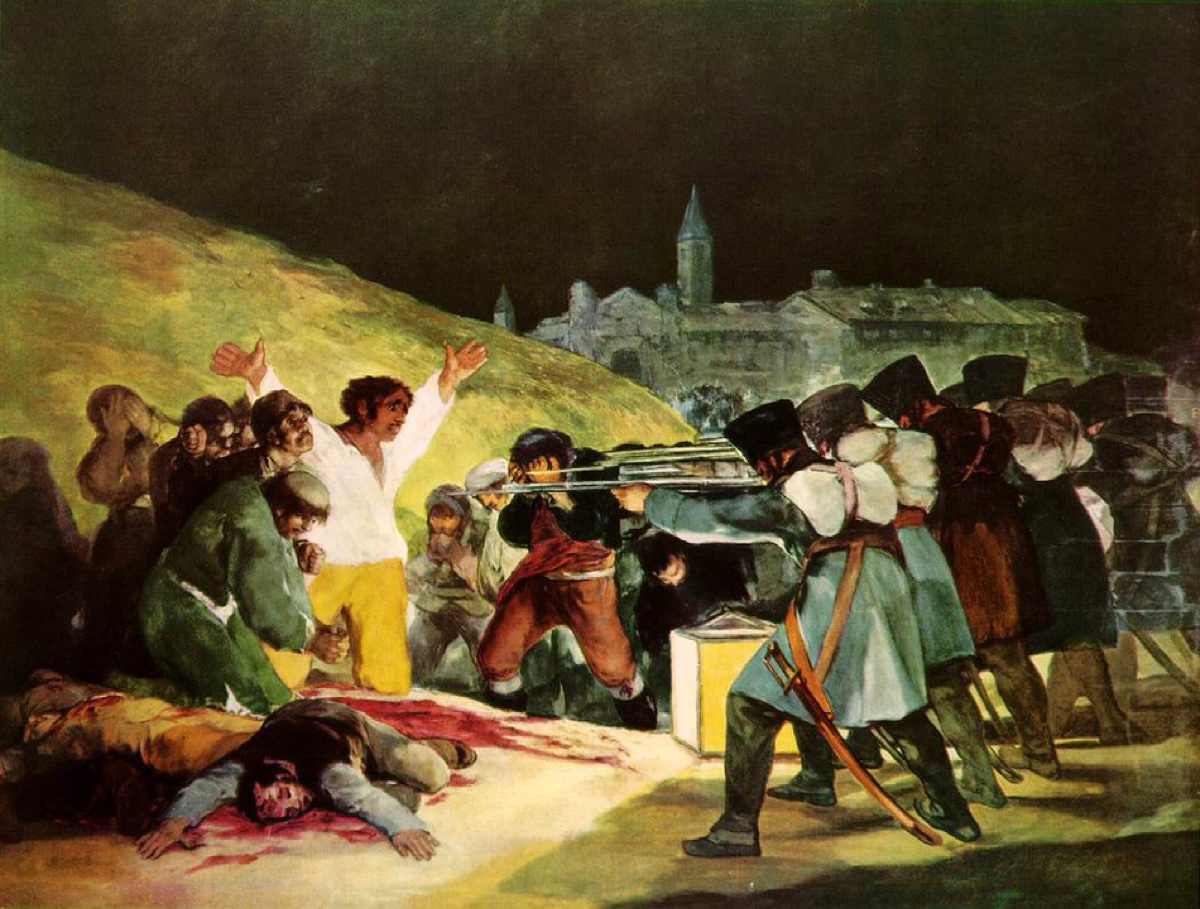
Charged with overwhelming violence and unprecedented dramatic intensity, The Third of May 1808 by Francisco Goya remains one of the most gripping representations of the horror of war in the history of painting. Completed in 1814, this monumental canvas measuring 265 x 345 cm immortalizes the summary execution of Spanish patriots by Napoleonic troops during the Madrid uprising of 1808. Housed in the Museo del Prado in Madrid, the work stands in radical contrast to traditional heroic depictions of conflict, offering instead a raw and profoundly humanist vision of military brutality.
The composition revolves around a striking contrast between the condemned and their executioners. On the left, a man in a white shirt with his arms raised embodies the Christ-like figure of the martyr, illuminated by the harsh light of a lantern placed on the ground. This light source creates a dramatic chiaroscuro that bathes the victims in brilliant ochre and yellow tones, while plunging the French soldiers into shadow, dehumanized by their dark uniforms and mechanical postures. The bodies of those already executed lie in pools of blood in the foreground, macabre details that underscore the barbarity of the scene. In the background, the ghostly silhouette of Madrid stands out against the night, a silent witness to the carnage.
Goya deploys here an audacious technique that heralds Romanticism and prefigures modern expressionism. The vigorous, almost violent brushstrokes convey the emotional urgency of the moment. The artist, once a court painter turned critical witness to his era, abandons all academic idealization in favor of brutal truth and immediate emotion. This formal freedom, coupled with profound moral commitment, transforms this canvas into an anti-war manifesto ahead of its time.
Through its testimonial force and formal innovation, The Third of May 1808 exerted considerable influence on subsequent generations, from Manet to Picasso, who would draw inspiration from it for Guernica. The work transcends its historical context to become a universal symbol of resistance against oppression and a cry against the dehumanization wrought by war.
If you appreciate "The Third of May Executions" and other paintings by Francisco Goya, we offer you 10% off the purchase of an art poster from our partner europosters with the promo code GRANDSPEINTRES10.
Image license: faithful photographic reproduction of a two-dimensional public domain work of art.