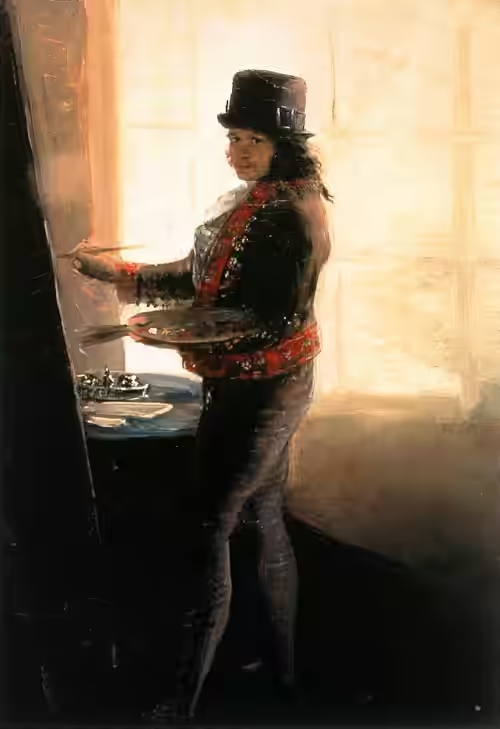
Francisco Goya is one of the most fascinating and complex painters in the history of Western art. A Spanish artist of the late eighteenth and early nineteenth century, he led a double artistic life: official painter and brilliant portraitist of the Spanish court on the one hand, visionary haunted by madness, war and inner demons on the other. His Caprices, his Disasters of War, his Black Paintings and his great canvases of the Napoleonic invasion opened radically new territories of representation — ugliness, violence, horror, the irrational — that prefigure Romanticism, Expressionism and the politically engaged art of the twentieth century. Goya is at once the last of the great masters of the classical tradition and the first of the moderns.
An Aragonese Youth and a Difficult Formation
Francisco José de Goya y Lucientes was born on 30 March 1746 in Fuendetodos, a small village in Aragon, into a modest family. His father, José Goya, was a master gilder; his mother, Gracia Lucientes, came from a family of minor rural nobility. The family soon moved to Saragossa, where the young Francisco learned drawing under José Luzán, a local painter influenced by the Neapolitan masters.
In 1763 and 1766 he made unsuccessful attempts to enter the Royal Academy of Fine Arts of San Fernando in Madrid. In 1769 he left for Italy, staying in Rome and perhaps Naples, where he studied the Italian masters. In 1771 he won a prize at the Parma Academy competition, earning him some recognition. He returned to Spain that same year and began working as a fresco painter in Saragossa, decorating the church of El Pilar among other commissions.
In 1773 he married Josefa Bayeu, sister of the painter Francisco Bayeu, an influential figure on the Madrid art scene. This marriage opened the doors of the Royal Tapestry Factory in Madrid, for which he produced between 1775 and 1792 some sixty tapestry cartoons depicting popular Spanish scenes — games, picnics, markets, promenades — of a freshness and lightness that reveal a sharp eye for the everyday. These cartoons allowed him to refine his technique and make himself known at Court.
The Court and the Portrait
In 1780, Goya was elected to the Royal Academy of Fine Arts of San Fernando. In 1786 he was named painter to King Charles III. In 1789, under Charles IV, he became First Painter of the Chamber — the highest title in the artistic hierarchy of the Spanish Court. These decades of official favour allowed him to develop an exceptional career as a portraitist.
His portraits of the royal family and the Spanish aristocracy are distinguished by a penetrating psychology that is not unlike Velázquez's portraits, which he deeply admired. The Family of Charles IV (1800–01, Prado, Madrid) is one of the most famous and singular group portraits in the history of painting: the royal family is depicted frontally, in a staging that evokes Velázquez's Méninas — Goya himself appears on the left, standing before his canvas — but with a pitiless realism that neither embellishes nor idealises his sitters. Queen Marie-Louise, who exercised considerable influence over her ineffectual husband Charles IV, appears dominant and vulgar. It has often been said that Goya was mocking his patrons — he himself denied it, but the result leaves little doubt.
Illness and the Turning Point of 1792
In 1792–93, Goya was struck by a serious illness — probably encephalitis or severe neurological damage — that left him deaf and almost mute for several months, close to death. He survived, but the deafness was permanent. This event was the most profound turning point in his life and work: the man who emerged from it was simultaneously more liberated and more tormented, more aware of the fragility of reason and more determined to paint the dark underside of the luminous world he had previously depicted.
In the following years he produced a series of small paintings on metal — held by the San Fernando Academy — depicting scenes of madhouses, inquisition, bandits and shipwrecks, of striking freedom and modernity. These were the first manifestations of a dark vein that would now run through all his work.
The Caprices and the Disasters of War
In 1799, Goya published Los Caprichos (The Caprices), a series of eighty etchings depicting the failings, superstitions and follies of Spanish society of his time. The most famous plate — El sueño de la razón produce monstruos (The Sleep of Reason Produces Monsters) — shows a man asleep at his desk, assailed by owls and bats. This image, readable as a critique of irrational superstitions or as a confession of Goya's own fascination with darkness, became one of the most powerful visual formulas of modernity.
The Napoleonic War in Spain (1808–14) inspired his most engaged and most overwhelming works. The Third of May 1808 in Madrid (1814, Prado) — depicting the execution of Spanish patriots by Napoleonic soldiers in the night — is a composition of unprecedented moral power and dramatic intensity. The white-shirted figure with arms outstretched in a gesture recalling the Crucifixion, his face lit by the soldiers' lantern, facing the anonymous rifles and the bodies already fallen: the image became the prototype of political painting, from which Manet (Execution of Maximilian) and Picasso (Guernica) would draw directly.
The Disasters of War — a series of eighty-two prints made between 1810 and 1820 and published only in 1863, after Goya's death — depict with brutal documentary precision the atrocities committed by both sides during the war: rape, massacre, hangings, mass graves. These images, among the most terrible and most important in the entire Western graphic tradition, have no precedent in their refusal to show war with heroism or idealisation.
The Quinta del Sordo and the Black Paintings
Around 1819, deaf, old and increasingly isolated, Goya bought a house on the outskirts of Madrid that came to be called the Quinta del Sordo (the Deaf Man's House). On the walls of this house he painted directly in oil a series of compositions of hallucinatory darkness and violence, with no known commission or destination: the Black Paintings. Saturn Devouring One of His Sons (1820–23, Prado), Witches' Sabbath, The Great He-Goat, Fight with Cudgels: these images, surpassing in freedom and violence everything that painting of the period had dared, seem to surge directly from the depths of the unconscious. They were transferred to canvas and moved to the Prado only in 1874.
Exile and Death
In 1824, after the failure of the Spanish liberal revolution and the return of absolutist repression under Ferdinand VII, Goya chose exile. At seventy-eight he settled in Bordeaux, where a community of Spanish liberal exiles had gathered. He stayed there until his death, continuing to draw and paint with astonishing vitality — even mastering the new technique of lithography. He died in Bordeaux on 16 April 1828, aged eighty-two.
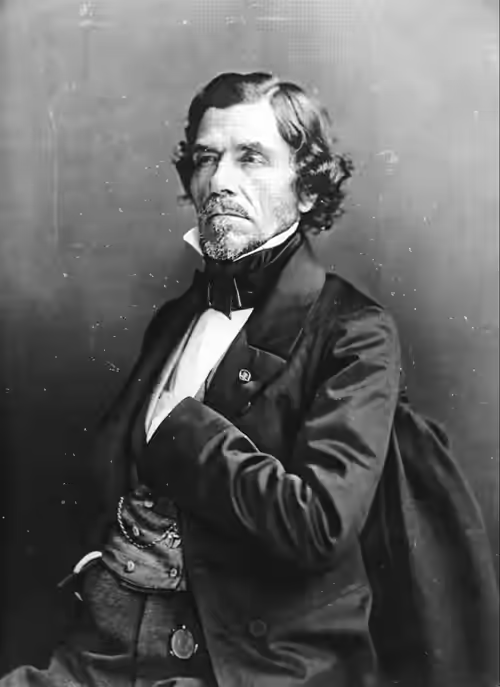
His influence on nineteenth and twentieth-century art is considerable: Delacroix owes him something of his Romantic violence; Manet learned from his way of treating the figure against the background; Picasso cited him among his most important masters. The Prado in Madrid holds the largest and most important collection of his works.