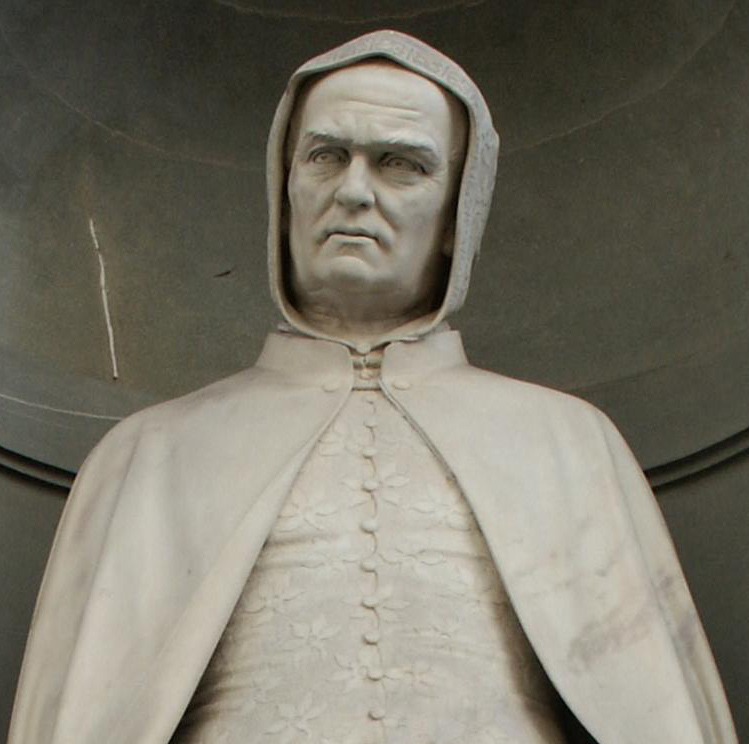
Some artists advance their age, others change its course altogether. Giotto belongs to the second category. A Florentine painter and architect of the thirteenth and fourteenth centuries, he was the first person in the history of Western painting to give painted figures a body, a weight, a presence in space — and an interior life. Before him, medieval painting was essentially symbolic: flat figures on gold backgrounds, closer to theological signs than to beings of flesh. After him, the path was open towards everything the Renaissance would accomplish a century later. Dante acknowledged him in the Divine Comedy; Boccaccio celebrated him as the first to have restored painting to nature. These are not mere literary tributes: they are testimonies to a revolution that his contemporaries perceived and named.
Obscure Origins and a Tenacious Legend
Almost nothing is known with certainty about Giotto di Bondone's origins. The tradition, reported notably by Giorgio Vasari in his Lives of the Artists (1550), holds that he was born around 1267 in the village of Vespignano, in the Mugello north of Florence, the son of a peasant. The legend adds that the young Giotto, tending his father's sheep, was drawing the animals on flat stones when the great painter Cimabue passed by, was astonished by his talent and took him to Florence as an apprentice. A fine story, possibly apocryphal — but revealing of the exceptional status his contemporaries accorded to Giotto.
What is established is that he trained in the Byzantine painting tradition still dominant in Italy at the time, probably in the workshop of Cimabue, the most celebrated Florentine painter of the previous generation. Cimabue himself had already softened the rigid forms of the Greek tradition — but Giotto would go infinitely further.
Assisi and the Franciscan Revelation
Giotto's first great commission — and perhaps the most decisive for understanding his approach — was the Basilica of Saint Francis in Assisi. The precise attribution of his work in this church is complex and still debated by art historians: he is generally credited with the fresco cycle of the life of Saint Francis in the upper basilica (nave, c.1290–95), though some specialists see there instead the hand of a "Master of Isaac" or a more collective workshop. What is certain is that these frescoes mark a radical rupture in the history of Italian medieval painting.
Giotto's approach coincides deeply with the Franciscan spirituality of his time. Saint Francis of Assisi (1181–1226) had preached an incarnate faith, turned towards concrete creation, sensitive to the beauty of the visible world — birds, the sun, chosen poverty. This theology of incarnation naturally calls for a painting of incarnation: bodies that have weight, faces that express real emotions, spaces in which human beings stand and act. Giotto gave visual form to this spiritual intuition with a coherence and force that make him far more than a technical innovator.
The Scrovegni Chapel: The Absolute Masterpiece
Between 1303 and 1305, Giotto produced what is universally recognised as his masterpiece: the complete decoration of the Scrovegni Chapel in Padua, commissioned by the wealthy banker Enrico Scrovegni, perhaps to atone for his father's sins of usury. The small chapel is entirely covered in frescoes on three superimposed registers, depicting the life of the Virgin and the life of Christ, in an iconographic programme of remarkable coherence and scope.
These frescoes are extraordinary on several counts. First, they show figures in a coherent three-dimensional space: the architecture has depth, figures move in a space that seems real, bodies have volume and mass. Giotto had not yet discovered the geometrical perspective that Brunelleschi would codify a century later, but he gave an intuitive approximation of it of startling accuracy.
Second, and this may be his most original contribution, these figures have an interior life. In the scene of the Betrayal of Christ — one of the chapel's most celebrated — Judas envelops Christ in his cloak in a gesture of false tenderness, and the two faces confront each other at a few centimetres' distance: Judas's hard, cold gaze against Christ's calm and pained expression. Before Giotto, painting had never captured psychology so precisely, a moment so dramatically interior. Dante remembered it. Petrarch would own a Virgin by Giotto that he cherished until his death.
Other scenes in the chapel are equally remarkable: The Lamentation over the Dead Christ, where the bowed heads of apostles and holy women around the recumbent Christ create a composition of silent grief of an intensity that few artists have equalled; The Annunciation to Anne and The Annunciation, where architectural space is handled with an ease that still astonishes today.
Florence and the Major Commissions
After Padua, Giotto worked in Florence, Naples and Rome, enjoying a reputation that had no equal in the Italy of his time. In Florence he decorated several chapels in the Basilica of Santa Croce: the Bardi Chapel (Life of Saint Francis, c.1325) and the Peruzzi Chapel (Life of Saint John the Baptist and Saint John the Evangelist) are the best-preserved witnesses of his late period, of remarkable maturity and compositional breadth.
In Naples, at the court of Robert of Anjou, he spent several years producing frescoes and portraits of which nothing survives. The reputation he acquired there with the king — one of the most cultivated courts in Europe — testifies to the exceptional status the artist now occupied in fourteenth-century Italian society: Giotto was the first painter in history to have been treated, during his own lifetime, as an illustrious man.
In 1334, near the end of his life, the city of Florence entrusted him with the direction of works on the Cathedral of Santa Maria del Fiore and the bell tower that bears his name — the tower with its inlays of white, pink and green marble that flanks the Dome. He designed its plans and began construction before dying on 8 January 1337, leaving completion to his successors.
A Legacy That Changed Everything
What Giotto accomplished can be expressed in a few words that conceal an immense revolution: he gave painting the real world. Not the world as theologians conceptualised it, not the world of symbols and celestial hierarchies — the world as we see it, as we feel it, with bodies that fall and faces that weep. Once made, this conquest was irreversible. Masaccio, in the early fifteenth century, follows directly in his lineage. Leonardo da Vinci and Michelangelo are his distant heirs. In a large measure, the history of Western painting begins with him.