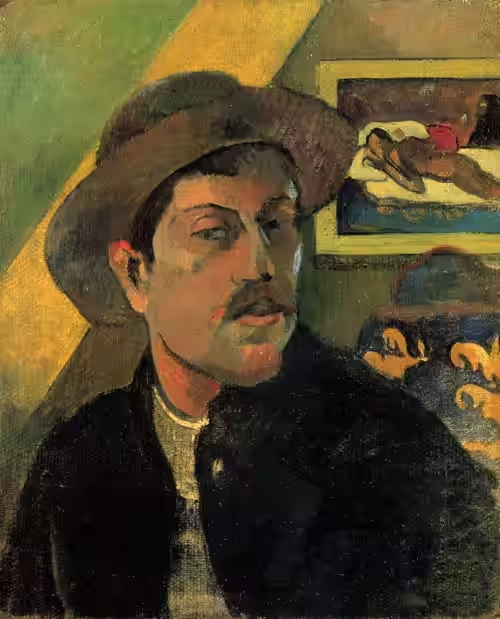
Paul Gauguin is one of the most fascinating and most controversial artists of Post-Impressionism. A former Paris stockbroker who gave up everything for painting, he spent his entire life trying to flee Western civilisation and recover a primitive, spontaneous and spiritual humanity that the modern world had corrupted. His quest would take him to Brittany, then Tahiti, then the Marquesas Islands, where he died in poverty and sickness. His work — with its sumptuous flat colours, monumental serene figures and enigmatic symbols — is one of the most recognisable in the entire history of art, and his influence on the twentieth century, from Fauvism to Expressionism, is considerable.
A Childhood Between Lima and Paris
Eugène Henri Paul Gauguin was born on 7 June 1848 in Paris. His father, Clovis Gauguin, was a Republican journalist; his mother, Aline Marie Chazal, was of French and Peruvian origin — her own mother, Flora Tristan, was an important figure of French utopian socialism and the nascent labour movement. After the 1848 revolution, the family fled to Lima, Peru, where maternal relatives lived. Clovis Gauguin died at sea during the crossing. Paul grew up in Lima until the age of seven, in a Latin American environment that left an indelible mark on his memory — vivid colours, the sensuality of the climate, the mixed culture.
In 1855 the family returned to France and settled in Orléans. Paul studied, then signed up as a merchant navy pilot in 1865, sailing the world's seas for six years. He then joined the navy for the duration of the Franco-Prussian War (1870–71) before settling in Paris, where he found a position as a stockbroker at the Bertin bank.
In Paris he married the Dane Mette-Sophie Gad in 1873, with whom he had five children. He began painting as an amateur, collected Impressionists — notably Pissarro, who became his mentor — and exhibited with the Impressionist group from 1879. In 1882, the banking crisis that hit his employer forced a choice: he decided to paint full time.
Brittany and the Break with Impressionism
In 1886, Gauguin stayed at Pont-Aven in Brittany, where a small artists' colony had formed around the Pension Gloanec. He returned in 1888, surrounding himself with young painters such as Émile Bernard, Paul Sérusier and Charles Laval. It was at Pont-Aven that "Synthetism" or "Cloisonnism" was defined: the use of pure flat areas of colour separated by dark outlines, inspired by medieval stained glass, Japanese prints and primitive art, simplifying forms to their symbolic essence. Vision After the Sermon or Jacob Wrestling with the Angel (1888, National Gallery of Scotland, Edinburgh) is the founding work of this new language.
In October–December 1888, the shared stay with Van Gogh in Arles ended in psychological catastrophe: Van Gogh, in a state of extreme excitement, cut off his ear after a violent argument. Gauguin returned to Paris, then to Pont-Aven, definitively convinced that European civilisation was incompatible with the life he desired.
Tahiti: The Paradise Sought, the Paradise Disappointed
In 1891, after an auction of his works and an exhibition that allowed him to raise enough money, Gauguin sailed for Tahiti with an official mission from the French government and the certainty of finding a primitive and intact paradise there. Reality disappointed him: Tahiti was already partially colonised, Christianised, Westernised. Papeete resembled an ordinary colonial town.
He nonetheless settled in a coastal village, lived with a young Tahitian woman — Teha'amana, whom he called Tehura — and painted with extraordinary fervour and productivity. The Tahitian paintings of this first period (1891–93) are among his most sumptuous works: Ia Orana Maria (1891, Metropolitan Museum of Art, New York), depicting the Virgin Mary and the Christ Child in a tropical Tahitian setting; Manao Tupapau (The Spirit of the Dead Keeps Watch, 1892, Albright-Knox Art Gallery, Buffalo), a female nude stretched in darkness, haunted by the figure of a spirit; and the large compositions of monumental female figures in intense orange and yellow, bathed in a tropical light that has no equivalent in Western painting.
Returning to Paris in 1893, he organised an exhibition at Durand-Ruel's that was a commercial failure. He published Noa Noa, a semi-autobiographical, semi-fictional account of his Tahitian stay. Disappointed, riddled with debts and disease, he returned to Tahiti in 1895.
The Return to Tahiti and Where Do We Come From?
This second Tahitian stay (1895–1901) was marked by mounting difficulties: illness, sores on his legs, conflicts with the colonial administration, the death of his daughter Aline in 1897. In January 1898, in despair, Gauguin swallowed a massive dose of arsenic to kill himself. He survived this attempt and continued to paint.
It was in this state of despair that he produced Where Do We Come From? What Are We? Where Are We Going? (1897–98, Museum of Fine Arts, Boston), a vast composition nearly four metres wide that he conceived as his pictorial testament. The painting, read from right to left, represents the cycle of human life — birth, youth, adulthood, old age, death — in a deeply coloured and mysterious arcadian Tahitian landscape. The philosophical question it poses, inscribed in the titles themselves, has no answer — and perhaps that is where the painting's greatness lies.
The Marquesas and Death
In 1901, Gauguin settled in Atuona on the island of Hiva Oa in the Marquesas, hoping to find an even purer humanity and less direct conflict with the colonial administration. There he built his "House of Pleasure," decorated its panels with sculptures and continued to paint despite his increasingly painful legs. He published polemical articles in the local newspaper and defended the indigenous population against the abuses of the colonial administration and the Church.
He died in Atuona on 8 May 1903, aged fifty-four, from an overdose of morphine — accident or suicide, we do not know. He was buried on the spot, in the Catholic cemetery of Hiva Oa.
An Immense Legacy
Gauguin's influence on twentieth-century art is considerable and multiform. The Fauves — Matisse, Derain, Vlaminck — owe him the use of pure, arbitrary colours freed from any descriptive function. The German Expressionists (Die Brücke, Der Blaue Reiter) recognised in his work a deep kinship with their own quest for primal and direct expression. His rejection of Western civilisation and his search for an essential humanity nourished generations of artists and intellectuals. His works are today held in the greatest museums in the world, and his Tahitian canvases fetch record prices at international auctions — a bitter irony for a painter who died in poverty.