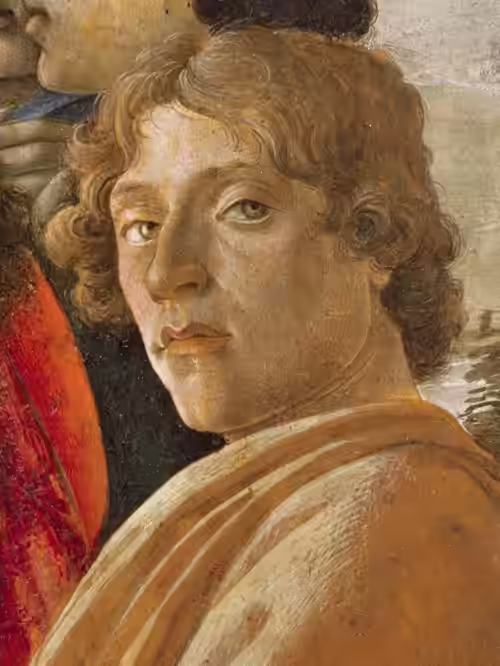
There is in Botticelli's painting something immediately recognisable and at the same time indefinable — a quality of line, a way of treating faces, a gentle melancholy that casts even the most joyful scenes in an imperceptible veil of unease. His great mythological compositions — The Birth of Venus, Primavera — are perhaps the most popular paintings of the entire Italian Renaissance. And yet Botticelli was a deeply paradoxical artist: painter of ideal beauty in the service of a brilliant Neoplatonic philosophy, he would end his days haunted by the apocalyptic preaching of Savonarola, perhaps burning some of his own works in the "bonfires of the vanities." Between light and darkness, between celebrated Antiquity and tormented faith, Botticelli was an artist who never ceased to oscillate.
Florence, the Medici and an Early Vocation
Alessandro di Mariano di Vanni Filipepi was born in 1445 in Florence, in the Ognissanti district. His father, Mariano Filipepi, was a tanner — a modest trade, but one that allowed him to give his children a decent education. The nickname "Botticelli" (little barrel) is said to have come from his elder brother Giovanni, a stout man who passed the sobriquet to the whole family. Little is known of the future painter's childhood, except that he showed an early gift for drawing.
Around 1464–65, he entered the studio of Filippo Lippi, one of Florence's most important painters, known for his delicately graceful Madonnas and his clearly readable narrative compositions. Lippi exercised a capital influence on the young Botticelli: from him he inherited a taste for precise and expressive contour, for slightly melancholy faces and for careful rendering of draperies. Lippi's death in 1469 ended the apprenticeship, but by then Botticelli was already capable of opening his own studio.
His first independent commissions came from great Florentine families. His Magnificat Madonna (1481, Uffizi) and his many small private altarpieces testified to an already very assured mastery. But it was his entry into the Medici circle that would transform his career.
The Platonic Academy and the Mythological Revolution
Florence under Lorenzo de' Medici — the Magnificent — was the most active centre of humanist thought in Europe. Around Marsilio Ficino and Pico della Mirandola gathered the Neoplatonic Academy, an intellectual circle debating the synthesis between ancient philosophy and Christian faith, between the Platonic ideal of beauty and the spirituality of the Gospel. Botticelli was admitted to this world — and the major commissions that resulted would produce his most celebrated works.
Primavera (c.1477–82, Uffizi), commissioned by a Medici cousin, is one of the most debated and most fascinating paintings of the entire Renaissance. An orange grove, nine figures — Venus, the three Graces, Mercury, Flora, Zephyr, Chloris — in a composition whose exact significance has never been definitively established. What strikes, beyond the learned iconographic debates, is the atmosphere: this painting resembles no other of its time. The figures float slightly, the ground has no real weight, the light casts no naturalistic shadows. We are in a mental, intellectual and poetic space rather than a representation of the visible world.
The Birth of Venus (c.1484–86, Uffizi) is perhaps the most immediately known work of the Renaissance in the world. The goddess emerging from the waters, standing on her shell, her hair floating in the wind, greeted by Flora and the Horae: the composition has an elegance and beauty that seem timeless. But look more closely: Venus has that slightly absent gaze, turned inward, that Botticelli so often gives to his female figures. The joy the scene should inspire is tempered by something impalpable — a gravity, a distance, a veil.
Rome and the Sistine Chapel
In 1481, Botticelli was called to Rome by Pope Sixtus IV to participate, alongside Ghirlandaio, Perugino and Signorelli, in the decoration of the lateral walls of the Sistine Chapel — which Michelangelo would cover about thirty years later. He painted three frescoes there: The Temptation of Christ, The Calling of the Sons of Zebedee and The Punishment of Korah. This relatively brief Roman sojourn confirmed his status as a leading painter at national level — but it was to Florence that he would return and where his art would reach full maturity.
Portraits and Psychological Fineness
Besides his great mythological and religious compositions, Botticelli was one of the most perceptive portrait painters of the Florentine Renaissance. His portraits of men — such as the young man holding a medal of Cosimo de' Medici (c.1474–75, Uffizi) — are striking for their psychological acuity and the way the figure seems to exist in a space slightly withdrawn from the real world. There is always, in a Botticelli portrait, an interiority suggested rather than exhibited.
His Madonnas, too, constitute one of the most coherent and moving series in fifteenth-century painting. Where his contemporaries often depicted a triumphant and serene Virgin, Botticelli painted melancholy mothers whose distant gaze already seems to carry the weight of the coming Passion. This tension between formal beauty and anticipated sorrow is one of the deepest characteristics of his work.
Savonarola and the Spiritual Turning Point
The arrival in Florence of the Dominican friar Girolamo Savonarola from 1490 overturned the city's spiritual life. His fiery sermons denounced the corruption of the Church, the luxury of the Medici and the vanity of secular art. Florence entered a period of intense penitential fervour. The bonfires of the vanities of 1497 and 1498, to which the people brought jewels, mirrors, books and paintings, left a lasting cultural trauma.
Botticelli was profoundly affected. According to Vasari's testimony, he may have burned some of his own works. Whether or not one accepts this claim at face value, Botticelli's late works testify to a radical stylistic and spiritual shift. The Mystic Crucifixion (c.1500, Fogg Art Museum, Cambridge), The Mystic Nativity (1500–01, National Gallery, London) — in which angels dance on the roof of a stable while demons flee — are compositions of an Expressionist intensity that broke with the serene grace of his Medicean works. Figures distort slightly, colours cry out, the composition wavers.
Final Years and Oblivion
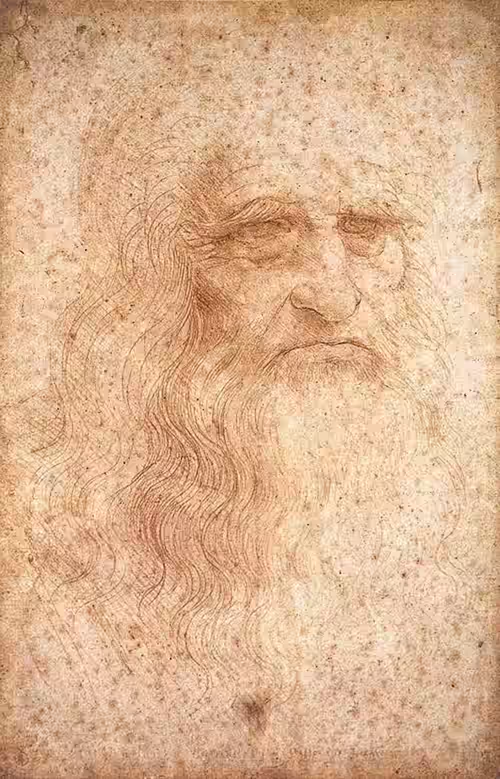
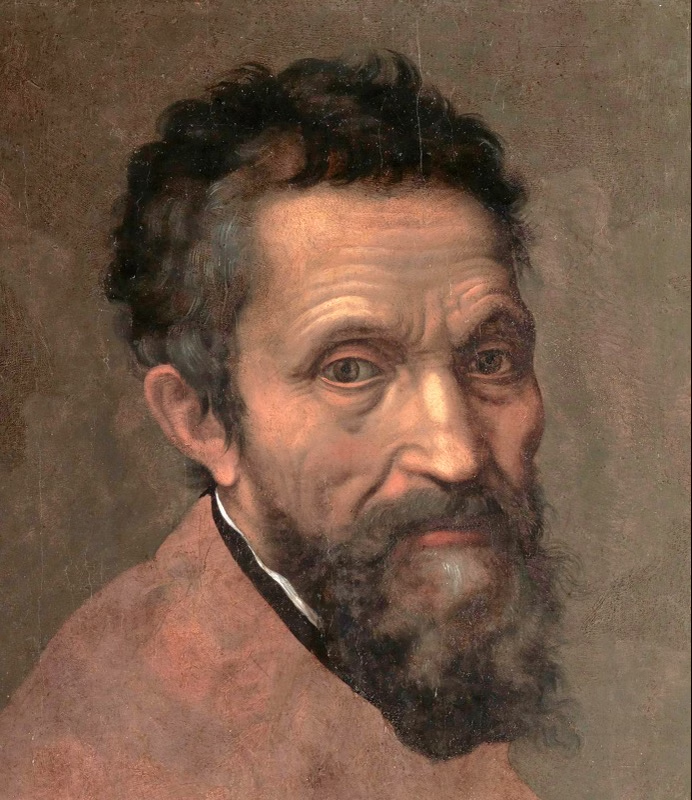
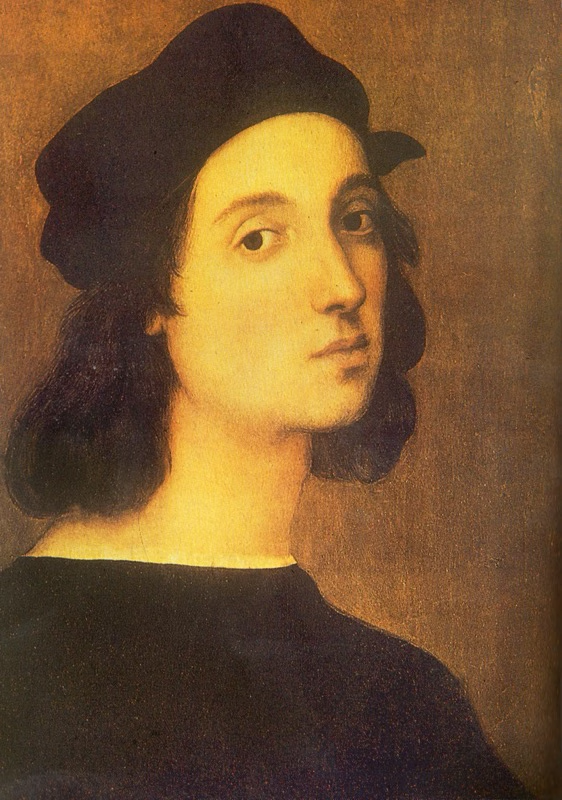
Botticelli died in Florence in 1510 in relative obscurity. The generation of Leonardo, Michelangelo and Raphael had profoundly transformed the canons of painting, and Botticelli's style — linear, anti-naturalistic, spiritual — seemed to belong to a world already past. His works remained in Florence, relatively neglected, for nearly four centuries.
The rediscovery came in the nineteenth century, carried by the English Pre-Raphaelites — Dante Gabriel Rossetti, Edward Burne-Jones — who saw in his melancholy grace and linear purity a welcome alternative to the dominant academic naturalism. John Ruskin celebrated him. The Uffizi became a pilgrimage destination for art lovers from around the world.
Today Botticelli is one of the most reproduced and best-loved painters in the world. The Venus of his Birth of Venus has become an icon of absolute beauty, reproduced infinitely on posters, coffee mugs and magazine covers. This popularity — which would surely have shamed him — should not obscure what matters: Botticelli was a great artist because he gave beauty a troubling dimension, grace an anxious depth, joy a shade of melancholy that renders them eternal.
Technique and Stylistic Legacy
Technically, Botticelli was an artist deeply rooted in the Florentine tradition of drawing. His painting rested on a precise and expressive contour — the line, for him, was not merely a tool for delimiting forms but carried its own rhythmic quality, almost musical. His draperies undulated according to laws that owed more to formal elegance than to actual gravity; his hair floated in an ideal wind. This freedom in relation to strict naturalism — which would be harshly judged by the generation of Leonardo and Michelangelo — is precisely what makes his work so recognisable and so endearing.
He used egg tempera for most of his major paintings, a technique that allowed him to achieve colours of remarkable luminosity and purity: the celestial blues, tender greens, pinks and golds of his mythological compositions have a freshness that seems to defy the centuries. This exceptional preservation of colour — unlike oils, which darken and oxidise — is one of the reasons his paintings remain so striking after five hundred and fifty years.
His own drawings for Dante's Inferno and Paradise, commissioned by Lorenzo de' Medici and never published during his lifetime, testified to a draughtsmanship of a delicacy and precision that rivalled the best draughtsmen of his century.