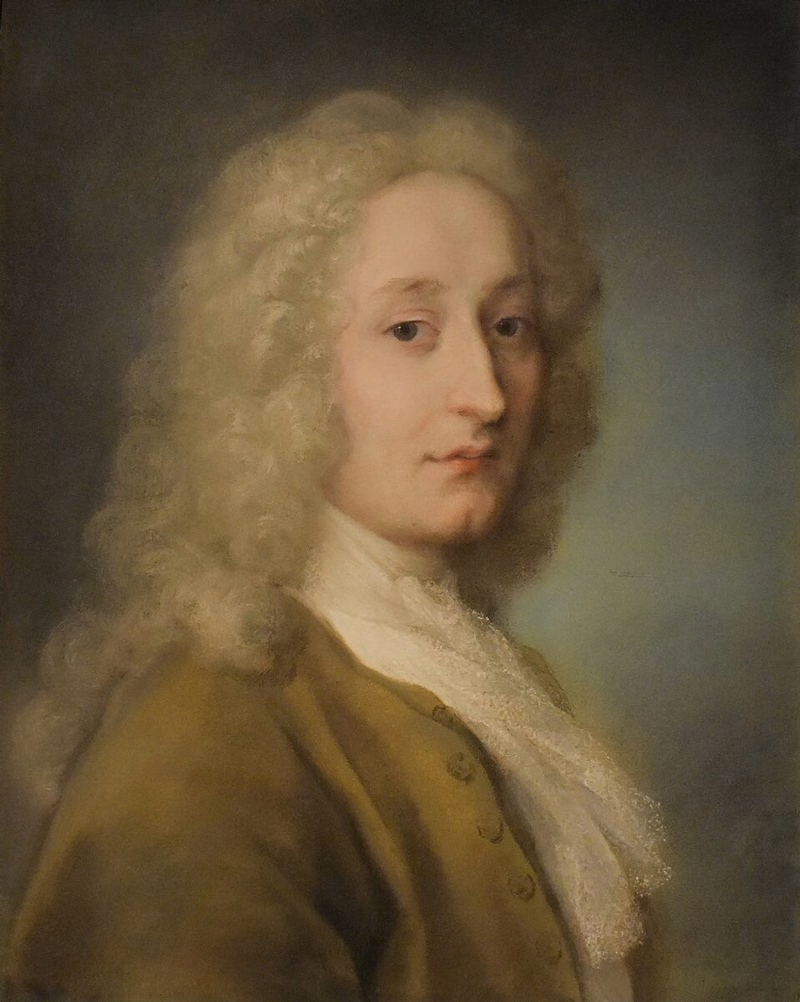
Antoine Watteau lived thirty-six years, and that was not nearly enough — not for lack of talent, but because he had too much of it and too little time. A French painter born in Flanders, the founder of an entirely new pictorial genre (the fête galante) and a precursor of the Rococo, he created in fewer than twenty years of active career a body of work of a delicacy and poetry that has no equivalent in the French painting of his time. His paintings show elegant figures in idyllic parks, preparing to arrive or depart somewhere, playing music or gently courting one another — and yet beneath this surface of grace and lightness, something melancholy and elusive always surfaces, as though the happiness depicted were already in the act of receding.
Valenciennes and Paris: A Vocation Against All Odds
Jean-Antoine Watteau was born on 10 October 1684 in Valenciennes, a Flemish town recently annexed by France. His father, Jean-Philippe Watteau, was a roofer, a rough man of no particular culture who looked unfavourably on his son's artistic aspirations. Antoine, from childhood, drew with a compulsion and talent that attracted the attention of the local painter Jacques-Albert Gérin, under whom he trained.
Around 1702, at eighteen, he left for Paris without money or connections — the journey on foot from Valenciennes took several days. He found work as a copyist in a workshop on the rue Saint-Jacques that mass-produced copies of landscapes and devotional scenes for the popular market. This repetitive and exhausting bread-and-butter work nonetheless taught him mastery of touch and speed of execution.
His luck turned when he entered the studio of Claude Gillot, a painter of theatre scenes and commedia dell'arte, and above all that of Claude Audran III, decorator of Versailles and keeper of the Luxembourg, who gave him access to the palace's picture gallery and its collections of Flemish paintings and Rubens. The discovery of Rubens — his chromatic richness, his freedom of touch, his fleshy nude women in verdant landscapes — was one of the most profound influences on Watteau's style.
The Fête Galante: A New Genre
In 1717, Watteau presented to the Académie Royale de Peinture his reception piece: The Pilgrimage to the Island of Cythera (Louvre, Paris). The work shows a troupe of elegant couples in a golden, wooded landscape, preparing to embark — or to disembark, historians still debate — for the mythological island of love, the domain of Venus. The scene is of a poetic grace and luminosity that fit no existing category: it is not a mythological scene in the classical sense, nor an ordinary genre scene. The Académie, confronted with the unclassifiable, invented for him a new official category: "painter of fêtes galantes."
This term — fête galante — henceforth designated this particular genre of outdoor scenes in which elegant figures, often costumed as comedy characters or as shepherds, amuse themselves, court one another and make music in Arcadian gardens. Watteau often depicted types from the commedia dell'arte — Harlequin, Pierrot, Columbine — mingled with contemporary figures, in a delicious ambiguity between theatre and real life.
Melancholy Beneath the Grace
What distinguishes Watteau from his many successors and imitators in the genre — Pater, Lancret — is precisely this melancholy note that runs through his finest paintings like a slight fracture. His figures are celebrating, certainly, but they also seem slightly absent from themselves, pensive, turned towards something the painting does not show. The joy they seem to share is always a little distant, as though it already belonged to memory.
This tension between the luminous surface and the underlying unease is perhaps not unrelated to Watteau's own life. He was afflicted by tuberculosis from at least the 1710s, and lived with the certainty of dying young. His fragile health obliged him to repeated country retreats, giving him a relationship with time and beauty that was not that of a healthy man.
Gilles (c.1718–19, Louvre, Paris) is perhaps his most singular painting. The character of Pierrot — the naïve and often unhappy comedy figure — stands upright, facing us, arms at his sides, in a luminous white costume, while behind him other commedia dell'arte characters plot or chat in indifference. Pierrot's gaze — vague, slightly stunned, neither sad nor truly happy — has something unforgettable about it. Some see it as a spiritual self-portrait.
Drawing and Touch
Watteau was also one of the most gifted and most prolific draughtsmen of his century. He practised a three-crayon drawing technique (black chalk, red chalk, white chalk) on beige paper that allowed him to capture in a few strokes the draperies, faces and gestures of his models with a lightness and precision that remain unequalled in the French tradition. These sketch sheets — collections of which were published after his death under the title Figures de différents caractères — are among the finest in the entire history of European drawing.
His pictorial technique is equally characteristic: a short, vibrant touch, laid in diagonal hatching that creates effects of textual shimmer in silk clothing and tree canopies. The palette is golden, warm, lit by a twilight or early-evening light that bathes all his scenes in an in-between atmosphere — between day and night, between the real and the dream.
Death
In 1719, Watteau left for London, hoping that the physician Richard Mead could cure his advanced tuberculosis. The stay was a medical failure: English treatments achieved nothing. He returned to France and settled in Nogent-sur-Marne with his friend the art dealer Gersaint — for whom he reportedly painted in a few days the shop sign of incomparable beauty and freedom known as Gersaint's Shopsign (1720–21, Charlottenburg, Berlin). He died on 18 July 1721 at Nogent-sur-Marne, in Gersaint's arms, at thirty-six. Shortly before his death he had asked for a crucifix he felt was too scantily dressed for the majesty of God, and had reworked it until his final days.