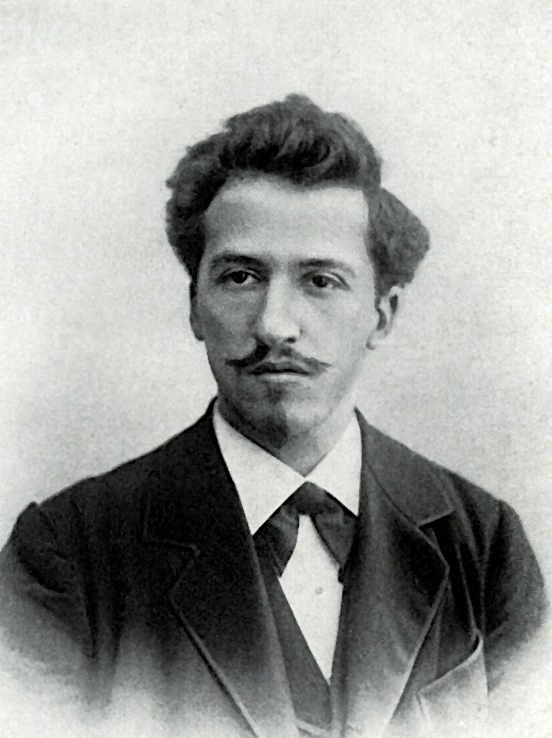
There is an outsized ambition in Piet Mondrian's work — one you might not immediately perceive when standing before his canvases of black lines and red, blue and yellow rectangles. But what Mondrian was after was nothing less than the universal truth hidden beneath the chaos of appearances — the fundamental structure of reality, stripped of everything anecdotal, particular and illusory. His entire life was the story of a progressive simplification, a systematic stripping away of everything that was not essential, until he arrived at a painting containing only the bare minimum needed to say something true about the universe. That absolute rigour, combined with a deep spiritual sincerity, makes Mondrian one of the most radical and consistent artists in the entire history of modern art.
A Calvinist Childhood in the Netherlands
Pieter Cornelis Mondriaan — he would Frenchify his name to Mondrian around 1912 — was born on 7 March 1872 in Amersfoort, a small town in the central Netherlands. His father, Pieter Cornelis Mondriaan Sr., was a primary school headmaster and amateur draughtsman; his uncle Fritz Mondriaan was a professional landscape painter. Mondrian's childhood was shaped by a strictly Calvinist family atmosphere — God, discipline, austerity, seriousness. That rigorous moral and spiritual formation had a direct influence on his conception of art: his quest for formal purity and universality was in part a secularised transposition of the Protestant ideal of stripping away the superfluous.
In 1892 he enrolled at the Amsterdam Academy of Fine Arts, where he received a conventional academic training — life drawing, landscape painting. His early works, landscapes of the Dutch polders and Brabant countryside, are careful and competent naturalism, influenced by the Hague School. Nothing yet announced the revolution to come.
Towards Abstraction: A Trajectory in Three Stages
Mondrian's path towards abstraction is one of the most documented and legible in the entire history of art, because he frequently painted the same motif at successive stages of his evolution — making it possible to follow the process of simplification step by step.
The first turning point was his discovery of Theosophy around 1908–09. Theosophy — the esoteric movement founded by Helena Blavatsky — holds that a deep spiritual reality lies hidden beneath the material appearances of the world, and that the arts can help perceive this hidden reality. For Mondrian, this conviction reinforced his intuition that painting must go beyond the sensory appearances of the world to reach universal truths. He joined the Theosophical Society in 1909 and its ideas would influence him until the end of his life.
The second turning point was his discovery of Cubism at an Amsterdam exhibition in 1911. Mondrian, who had already begun simplifying his forms, recognised in Cubism a direction that corresponded to his own intuitions. In 1912 he went to Paris and immersed himself in Cubist circles. His series of trees from this period — trees whose branches progressively decompose into networks of lines increasingly autonomous from the original motif — show how he used Cubism as a launching pad towards something more radical.
The third and decisive turning point came between 1914 and 1917. Stranded in the Netherlands by the war, Mondrian pushed his research to total abstraction. He reduced his palette to the pure primary colours (red, yellow, blue) and the non-colours (black, white, grey). He reduced his lines to the horizontal and vertical exclusively — the two basic directions that structure human space (gravity and the horizon). He eliminated every curve, every diagonal, every residue of nature. What he called neoplasticism was born.
De Stijl and Theory
In 1917, Mondrian co-founded with Theo van Doesburg the journal De Stijl (The Style), which became the theoretical vehicle for their ideas. The neoplasticism he developed there is a complete philosophical aesthetic: art must express the universal rather than the particular, dynamic equilibrium rather than static symmetry, the relationship between opposites (horizontal/vertical, colour/non-colour, void/solid) rather than representations of nature.
These ideas had a considerable influence on design, architecture and the graphic arts of the twentieth century — the Bauhaus drew from them, and the architecture of Gerrit Rietveld (the Red and Blue Chair, the Rietveld Schröder House) is their most direct application.
Mondrian and Van Doesburg fell out in 1924: Van Doesburg introduced the diagonal into his compositions, which Mondrian absolutely refused as a betrayal of the fundamental principle of neoplasticism. That rupture, superficially anecdotal, illustrates the seriousness and intransigence with which Mondrian defended his convictions.
Paris, London, New York
Mondrian lived in Paris from 1919 to 1938, in a small studio on the rue du Départ whose white walls and primary-colour rectangles were themselves a work of art — several artists and visitors testified to the strange luminous beauty of that space. He loved dancing — the foxtrot, the boogie-woogie — and moved through Parisian artistic circles with a discretion and warmth that contrasted with the rigour of his art.
In 1938, the Nazi threat drove him to London, and in 1940 to New York, where he settled permanently. The city enchanted him: the rhythm of Manhattan's urban grid, the liveliness and colour of Broadway, the jazz — all of it resonated with his own sensibility. His final New York canvases — Broadway Boogie-Woogie (1942–43, MoMA) and Victory Boogie-Woogie (1942–44, Gemeentemuseum, The Hague) — are the most colourful and vibrant of his life: the black grid is replaced by yellow lines punctuated with small squares of colour, like jazz notes in a visual score.
He died in New York on 1 February 1944, of pneumonia, aged seventy-one, leaving Victory Boogie-Woogie unfinished. His work is today in the greatest collections in the world, and his influence on twentieth-century graphic design, product design and architecture is beyond measure.