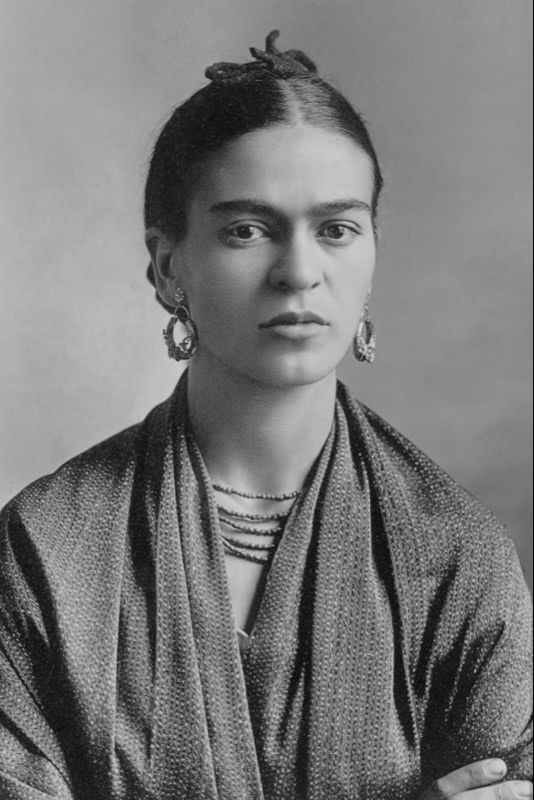
Frida Kahlo is one of the most iconic figures of twentieth-century art. A Mexican painter whose work is inseparable from her life, she transformed physical and emotional pain into pictorial creation of rare intensity. Her self-portraits, peopled with symbols drawn from Mexican popular culture, pre-Columbian mythology and Catholic iconography, make her a unique artist standing at the crossroads of Surrealism, magical realism and folk art. Celebrated during her lifetime, rediscovered from the 1970s onwards, she is today one of the most recognised and best-loved painters in the world.
A Childhood Marked by Illness and Revolution
Magdalena Carmen Frida Kahlo y Calderón was born on 6 July 1907 in Coyoacán, on the southern outskirts of Mexico City, in the family home known as the Casa Azul (the Blue House). Her father, Guillermo Kahlo, was a photographer of Hungarian and German origin who became a Mexican citizen; her mother, Matilde Calderón y González, was of mixed heritage, combining indigenous and Spanish blood. Frida grew up in a cultivated household where photography, nature and collections of pre-Columbian art occupied a central place.
At six, she contracted poliomyelitis, which left her right leg atrophied and slightly thinner than her left. This physical difference, a source of mockery in childhood, would mark her durably. To compensate for the disability, she developed intense physical activity, swimming, cycling and practising other sports encouraged by her father.
In 1922, she enrolled at the prestigious Escuela Nacional Preparatoria in Mexico City, one of the country's finest schools, where she was among the few young women admitted. There she received a rigorous intellectual formation and came into contact with the revolutionary ideas stirring post-revolutionary Mexico. It was also there that she first caught sight of Diego Rivera, the celebrated muralist, who had come to paint a fresco in the school's amphitheatre.
The Accident That Changed Everything
On 17 September 1925, while returning from school by bus with her friend Alejandro Gómez Arias, the vehicle was struck by a tram. The accident was of extreme violence: Frida Kahlo was impaled by an iron handrail that entered through her hip and emerged through her vagina. She suffered multiple fractures — spinal column, collarbone, ribs, pelvis — as well as a broken right leg in eleven places. The doctors doubted she would survive.
She spent several months bedridden, immobilised in a plaster corset. It was during this forced convalescence that her mother had a mirror fitted to the ceiling above her bed, and Frida began to paint herself. Painting became both a refuge and a means of overcoming immobility. She would later say: "I paint myself because I spend a lot of time alone and because I am the subject I know best."
Throughout her life she would undergo more than thirty surgical operations related to the aftermath of this accident. Chronic pain, orthopaedic corsets, crutches and repeated hospitalisations became permanent realities, recurring elements in her work.
Diego Rivera and a Turbulent Love Life
In 1928, Frida Kahlo encountered Diego Rivera again at a Mexican Communist Party meeting, of which she had recently become a member. She showed him her first canvases for his opinion; he immediately recognised exceptional talent. Their love affair began quickly, and they married on 21 August 1929. The union between the twenty-two-year-old woman and the world-famous forty-two-year-old painter scandalised their circle — Frida's mother called it a marriage between "an elephant and a dove."
Their relationship was passionate and destructive by turns, marked by mutual infidelity, violent quarrels and two divorces — they remarried in 1940 after a year of separation. Rivera maintained numerous liaisons, one of them with Frida's own sister Cristina, a betrayal Kahlo never fully forgave. Frida in turn had relationships with others, both men and women, most notably with the Russian revolutionary León Trotsky, who was housed with her in Coyoacán from 1937 to 1939.
Their relationship, as painful as it was, remained central to Frida's life and work. Rivera's face, which she sometimes depicted on her forehead as a third eye, haunts her paintings.
A Symbolic and Autobiographical Body of Work
Frida Kahlo's output is limited in volume — around 143 paintings, most in modest formats — but of extraordinary density. Self-portraits form the heart of her production: she depicted herself with unflinching frankness, wearing her corsets and her scars and her tears, but also surrounded by monkeys, deer, parrots and tropical plants, in a teeming iconography.
Her paintings addressed the themes of physical suffering (The Broken Column, 1944, in which she depicts her torso opened up and held together by a corset), impossible motherhood (she suffered several miscarriages related to her injuries, which appear in My Birth, 1932, and Henry Ford Hospital, 1932), Mexican identity and cultural hybridity (The Two Fridas, 1939), and death (Viva la Vida, 1954, one of her last works).
André Breton, during his stay in Mexico in 1938, called her work Surrealist. Kahlo rejected the label: "They think I am a Surrealist, but I am not. I have never painted dreams. What I painted was my own reality." She nevertheless participated in Surrealist exhibitions, including one in Paris in 1939, where her canvas The Frame was acquired by the Louvre — a rare honour for a Mexican artist at the time.
International Recognition and the Final Years
After the 1939 Paris exhibition, Frida Kahlo's international reputation grew progressively. In 1953, a few months before her death, the Galería de Arte Contemporáneo in Mexico City devoted to her her first solo exhibition in her native country. Too weak to stand, she attended the opening lying in her bed, which was transported to the venue for the occasion — a theatrical gesture that illustrated her determination to live fully despite illness.
In 1953, the complications of her injuries led to the amputation of her right leg below the knee. This ordeal plunged Frida into a profound depression. She died on 13 July 1954 in Coyoacán, aged forty-seven. The official cause was pulmonary embolism, though some historians have raised the possibility of a deliberate overdose of medication. The last words of her journal were: "Joyfully, I hope never to come back."
Her body was displayed at the Palacio de Bellas Artes in Mexico City, where thousands came to pay their respects. Her ashes rest at the Casa Azul, now a museum and one of the most visited cultural sites in Mexico.
An Immense Legacy
Rediscovered globally from the 1970s, notably through the feminist movement that claimed her work as an act of resistance, Frida Kahlo has become a planetary cultural icon. Her self-portraits adorn posters, T-shirts and book covers around the world. In 1990, her painting Diego y yo sold for 1.4 million dollars — a record for a Latin American artist at the time — before being widely surpassed in 2021 by Dos desnudas en el bosque, sold for 8 million dollars.
Her influence extends well beyond the art world: she has become a symbol of resilience, freedom of identity, feminism and Mexican pride. Her work, deeply rooted in the experience of the suffering body and the search for self, continues to speak to generations of artists and viewers who find in it a reflection of their own humanity.