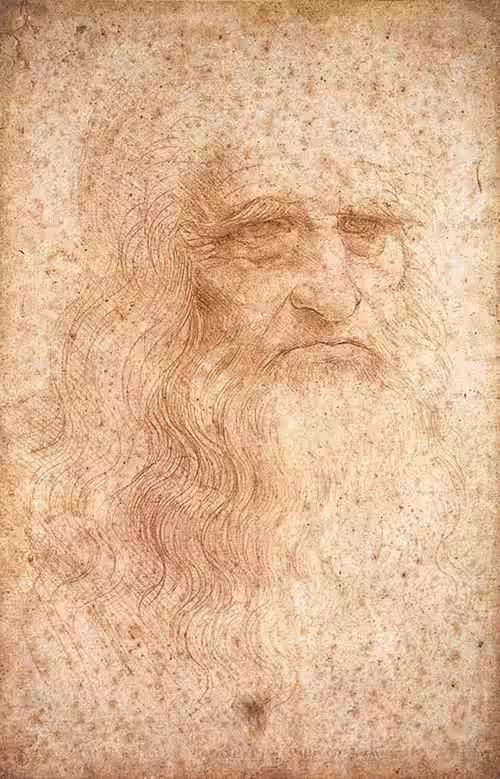
If one seeks a single name to embody the Renaissance ideal — that ideal of a human being capable of embracing the totality of knowledge, mastering art and science equally, the beautiful and the true, hand and mind — that name is Leonardo da Vinci. Painter, sculptor, architect, engineer, anatomist, botanist, geologist, musician, poet: Leonardo is in himself a living encyclopaedia, an unfathomable curiosity before the entire universe. And yet, despite — or because of — this immensity, he painted very little. His painted oeuvre runs to about fifteen canvases, several of them unfinished. But these few paintings are enough to make him the most famous painter in the history of Western art, the creator of the most watched portrait in the world.
Vinci, Illegitimacy and a Childhood Between Two Worlds
Leonardo was born on 15 April 1452 in Vinci, a small Tuscan town between Florence and Pisa, the natural son of Ser Piero da Vinci, a prosperous Florentine notary, and a young peasant woman named Caterina. His birth outside of marriage excluded him by default from the liberal professions his father practised — he could not be a notary, lawyer or doctor. This exclusion, which Leonardo experienced as a wound but also as a liberation, pushed him towards a noble artisan's trade: painting.
He grew up first in his maternal grandfather's house in Vinci, then joined Florence in his father's home. Around 1466, at fourteen or fifteen, he entered the studio of Andrea del Verrocchio, the most celebrated painter and sculptor in the city, a protégé of the Medici. Verrocchio ran a versatile workshop — painting, sculpture, goldwork, festive decoration — and Leonardo learned everything there with a voraciousness and speed that astonished his masters.
Tradition holds that Leonardo, tasked with painting the left angel in Verrocchio's Baptism of Christ (c.1475, Uffizi), produced an angel of such perfection that his master, humiliated, decided never to paint again. The story is probably embellished, but it says something true about the precocity of Leonardo's talent.
Milan and the Sforza Court
In 1482, Leonardo left Florence for Milan, where he entered the service of Ludovico il Moro, the city's duke. He would spend seventeen years there — the longest period of his life in a single city — and it was there that he produced his two most important works. In Milan he practised the versatility that characterised him: military engineer, organiser of festivities, designer of monuments, lutenist and improviser of verses, as well as painter.
The Virgin of the Rocks (two versions: 1483–86 and c.1495–1508, Louvre and National Gallery, London) was his first major Milanese composition. The scene shows the Virgin, the Christ Child, the young John the Baptist and an angel in a landscape of cavernous rocks bathed in mysterious light. What strikes one in this painting is above all the quality of the sfumato — that imperceptible blending of outlines in a misty atmosphere that Leonardo was in the process of inventing and that would give painting an entirely new depth and softness. The figures seem to emerge from shadow with a presence and fleshy warmth that belonged to him alone.
The Last Supper (1494–98, Santa Maria delle Grazie, Milan) is probably the most influential narrative painting in the entire history of Western art. Painted as a fresco on the refectory wall of the convent — but with a hybrid technique that caused early and considerable deterioration — it depicts the precise moment in the Gospel of John when Christ announces to his apostles that one of them will betray him. Leonardo managed to represent simultaneously the reaction of each of the twelve apostles — surprise, indignation, pain, guilt — according to their individual characters, in a composition of unprecedented clarity and dramatic force. The figure of Christ, at the centre, radiates a serenity that contrasts with the agitation of his disciples. It is a meditation on betrayal, faith and inner solitude as much as a biblical scene.
Sfumato and the Revolution of the Gaze
Leonardo's contribution to painting was multiple, but his most personal invention was undoubtedly sfumato — from the Italian sfumare, to fade. Where his contemporaries, even the finest, defined forms with a more or less precise outline, Leonardo dissolved them in an atmosphere, let them vanish into a luminous mist from which they seemed to emerge rather than be traced. This technique created an illusion of depth and atmosphere of striking effectiveness, but it also did something else: it gave faces an ambiguity, an interior life, a resistance to simple reading that is one of the sources of mystery in his great works.
His interest in anatomy — he personally performed more than thirty dissections of human cadavers to understand the workings of muscles, bones and organs — directly nourished his painting. The way he represented hands, torsos and faces testified to a knowledge of the human body without equal among his contemporaries.
The Mona Lisa: A Portrait That Looks at the World
Painted between approximately 1503 and 1517, The Mona Lisa (Louvre, Paris) is the most celebrated, most reproduced and most discussed portrait in the entire history of art. Its subject is most likely Lisa Gherardini, wife of a Florentine merchant, Francesco del Giocondo — hence the titles Monna Lisa and La Gioconda. But Leonardo never delivered it to the patron: he took it with him to France and worked on it until his last years.
What distinguished this painting from all the portraits that preceded it was, first, the model's posture — a three-quarter view woman, arms folded over the parapet of a balustrade, body slightly turned — which created an impression of naturalism and living presence then new in the history of the portrait. And then there is that smile: neither fully smiling nor fully serious, it seems to change according to the angle of observation and the light, and it is this fundamental ambiguity that has for five centuries fuelled attempts at explanation and emotional projections from viewers. With the Mona Lisa, Leonardo created something unique: a portrait that seems to look at each viewer individually, sizing them up, questioning them.
The Notebooks and Thought in Action
What Leonardo painted was only a fraction of what he thought. His notebooks — some five thousand surviving manuscript pages, out of an estimated ten to twenty thousand — constitute one of the most fascinating and most bewildering corpora in the entire history of human thought. Anatomy of the human body, studies of water movements, designs for flying machines, war chariots, movable bridges and hydraulic devices; philosophical reflections, abandoned literary projects, jokes and riddles: everything mingles in a mirror script (from right to left) that seems designed to discourage impatient readers.
Leonardo thought through drawing as much as through words. His anatomical studies — the foetus in the uterus, the human skull in cross-section, the muscles of the arm — are among the most precise and most beautiful in the history of medicine. His hydrological studies prefigured principles that science would not formalise until several centuries later. His ornithopter and aerial screw designs anticipated concepts that would not be realised until the twentieth century.
France and Death at Amboise
In 1516, at sixty-four, Leonardo accepted the invitation of the young King Francis I and moved to France, to the Château du Clos-Lucé in Amboise. The king granted him the title of "first painter, architect and engineer to the king," a generous pension and complete freedom of research. Leonardo would paint little more there — his right hand was paralysed by a probable stroke — but he continued to draw with his left hand and to think.
He died in Amboise on 2 May 1519, aged sixty-seven, in the arms — as legend has it — of the king himself. The real death of Leonardo is perhaps also the abandonment of all his unfinished projects: statues never cast, paintings left half done, treatises never published. But this very incompleteness is perhaps the truest signature of a man for whom curiosity had no end.
Painting as a Synthesis of All Knowledge
What fundamentally distinguished Leonardo from the other great painters of the Renaissance was his refusal to separate painting from other forms of knowledge. For him, to paint correctly a head of hair in the wind required understanding the laws of hydrodynamics; to paint a human face demanded knowledge of the muscles underlying expression; to paint a landscape implied understanding geology and meteorology. Painting was, in his vision, the queen discipline that synthesised all others — science, nature, perception, emotion. This is what he himself called the cosa mentale: painting as a thing of the mind, not merely of the hand.
This conception explains both his extraordinary productivity in the notebooks and his relative rarity as a painter. If painting correctly requires knowing everything, and if one can never know everything, one can never quite finish painting. Leonardo's chronic incompleteness was not laziness — it was the logical consequence of a boundless exigency. And the works he nonetheless brought to completion — the Mona Lisa, The Last Supper, The Virgin of the Rocks — are precisely those in which this synthesis between science, observation and beauty reached its most accomplished expression.
His direct influence on contemporaries and subsequent generations was immense: Raphael copied his style, Michelangelo distinguished himself in opposition to it, and all of sixteenth-century European painting had to define itself in relation to him.