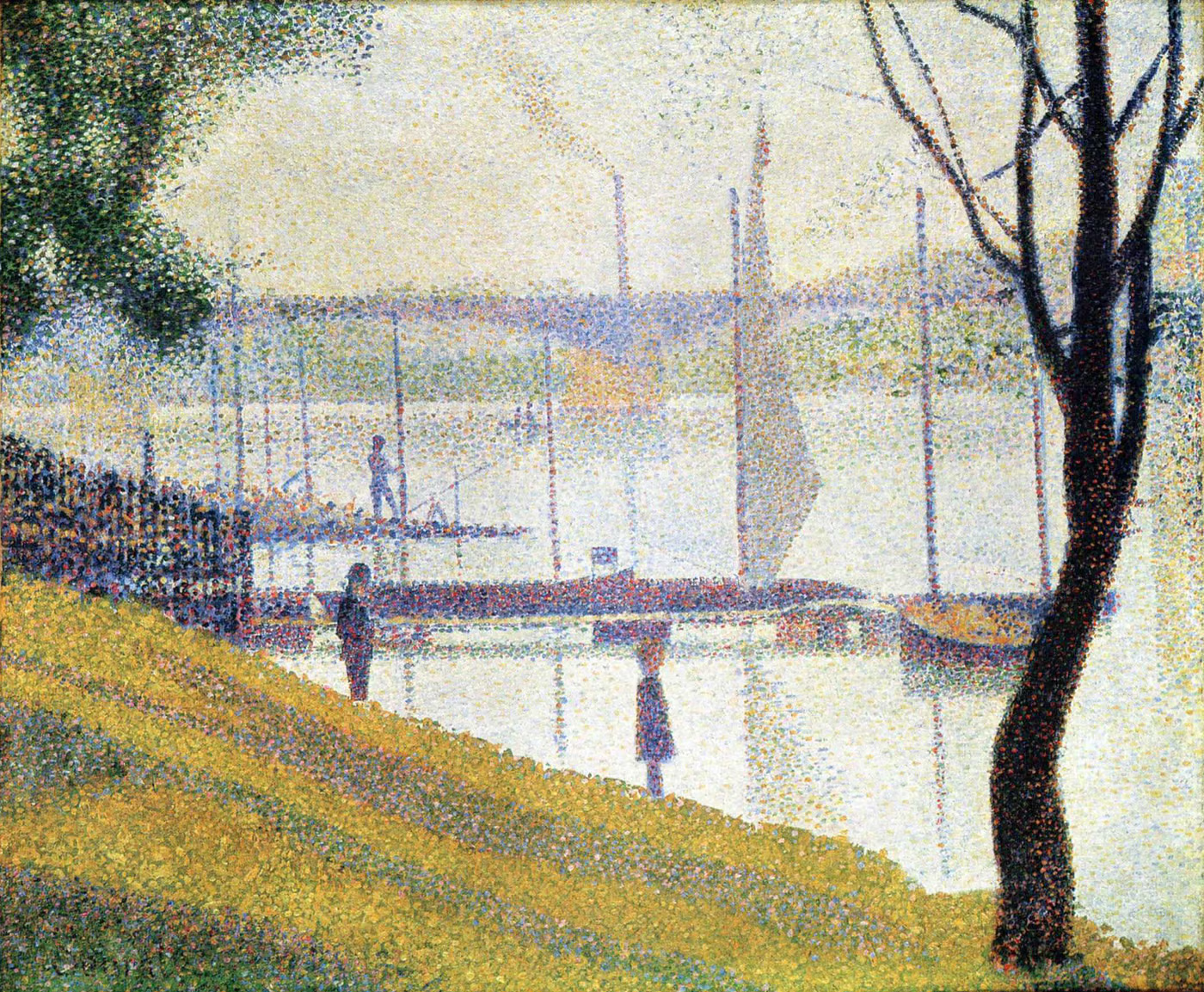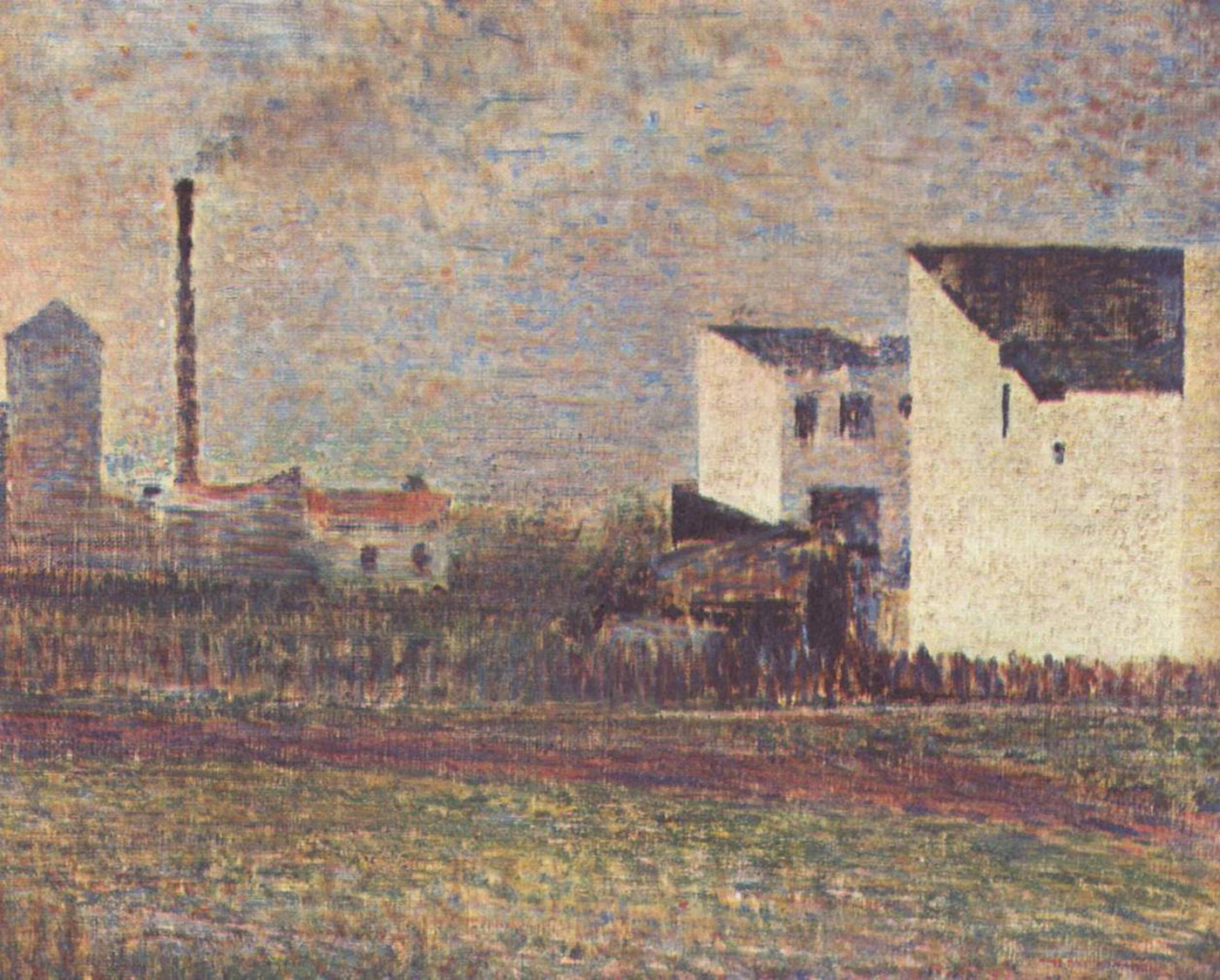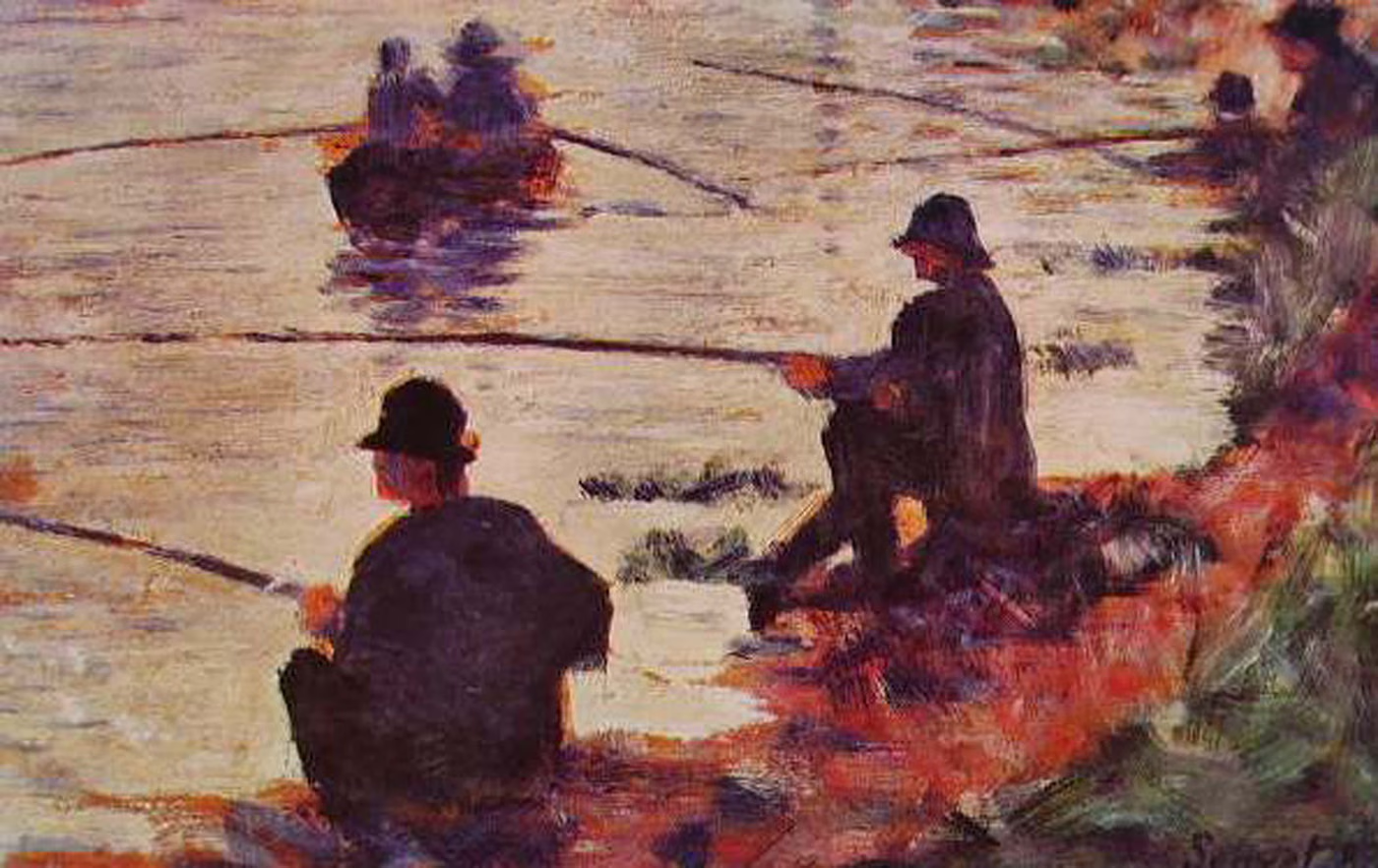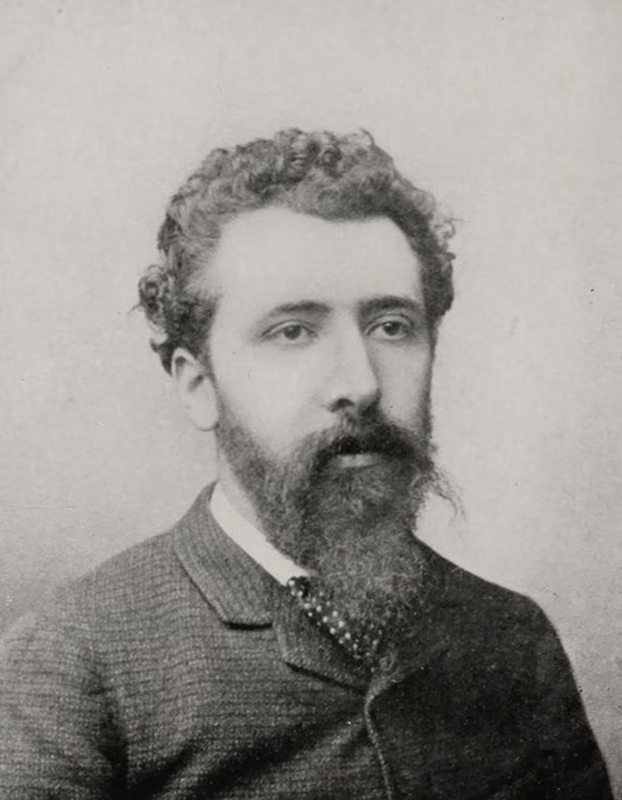
Georges Seurat is one of the most original and rigorous artists of the late nineteenth century. Founder of Neo-Impressionism and inventor of Pointillism — the technique of applying colour in small, separate touches or dots whose juxtaposition optically reconstitutes a luminous chromatic range — he attempted to give Impressionist painting the scientific foundations he believed it lacked, drawing on the theories of vision and colour that were most advanced in his time. In only ten years of active production — he died at thirty-one — he produced a small but extraordinarily coherent and ambitious body of work, whose absolute masterpiece, A Sunday Afternoon on the Island of La Grande Jatte, remains one of the most admired and singular paintings in the entire history of art.
A Bourgeois Parisian Childhood and an Early Calling
Georges Pierre Seurat was born on 2 December 1859 in Paris, in the La Villette district, into a comfortable middle-class family. His father, Antoine Chrysostome Seurat, was a minor court official, a solitary and eccentric man who lived in the country and returned to Paris only on Tuesdays for family dinners. His mother, Ernestine Faivre, was an attentive and cultivated homemaker who encouraged her son's artistic inclinations.
From childhood, Georges drew with remarkable diligence and precision. In 1875, at sixteen, he enrolled in municipal drawing classes run by the sculptor Justin Lequien, where he received solid training in academic drawing. In 1878 he was admitted to the École des Beaux-Arts in Paris, entering the studio of Henri Lehmann, himself a pupil of Ingres. This Ingriste formation confirmed his taste for rigour in drawing and formal construction.
His military service, carried out at Brest in 1879–80, left him time to read and think. On his return to Paris he devoted himself entirely to his project: founding a scientifically rigorous painting capable of controlling the effects of light and colour on solid theoretical foundations.
Colour Theory and the Birth of Pointillism
To build his system, Seurat drew on the work of the most advanced scientists and colour theorists of his day: the chemist Michel-Eugène Chevreul, whose treatise On the Law of Simultaneous Contrast of Colours (1839) established that two complementary colours placed side by side intensify each other; the American physicist Ogden Rood, whose Modern Chromatics (1879) analysed the composition of light; and the theorist David Sutter, whose articles in the journal L'Art (1880) popularised Helmholtz's optical theories.
From these readings Seurat drew a conviction: if pure colours are applied to the canvas in small juxtaposed touches rather than mixed on the palette, the spectator's eye will optically reconstitute the resulting hue — and this optical synthesis will produce a purer, more vibrant and luminous light than the physical mixing of pigments. He called this technique "chromoluminarism" or "Divisionism" — the word "Pointillism," popularised by critics, was originally pejorative.
Bathers at Asnières: The First Major Canvas
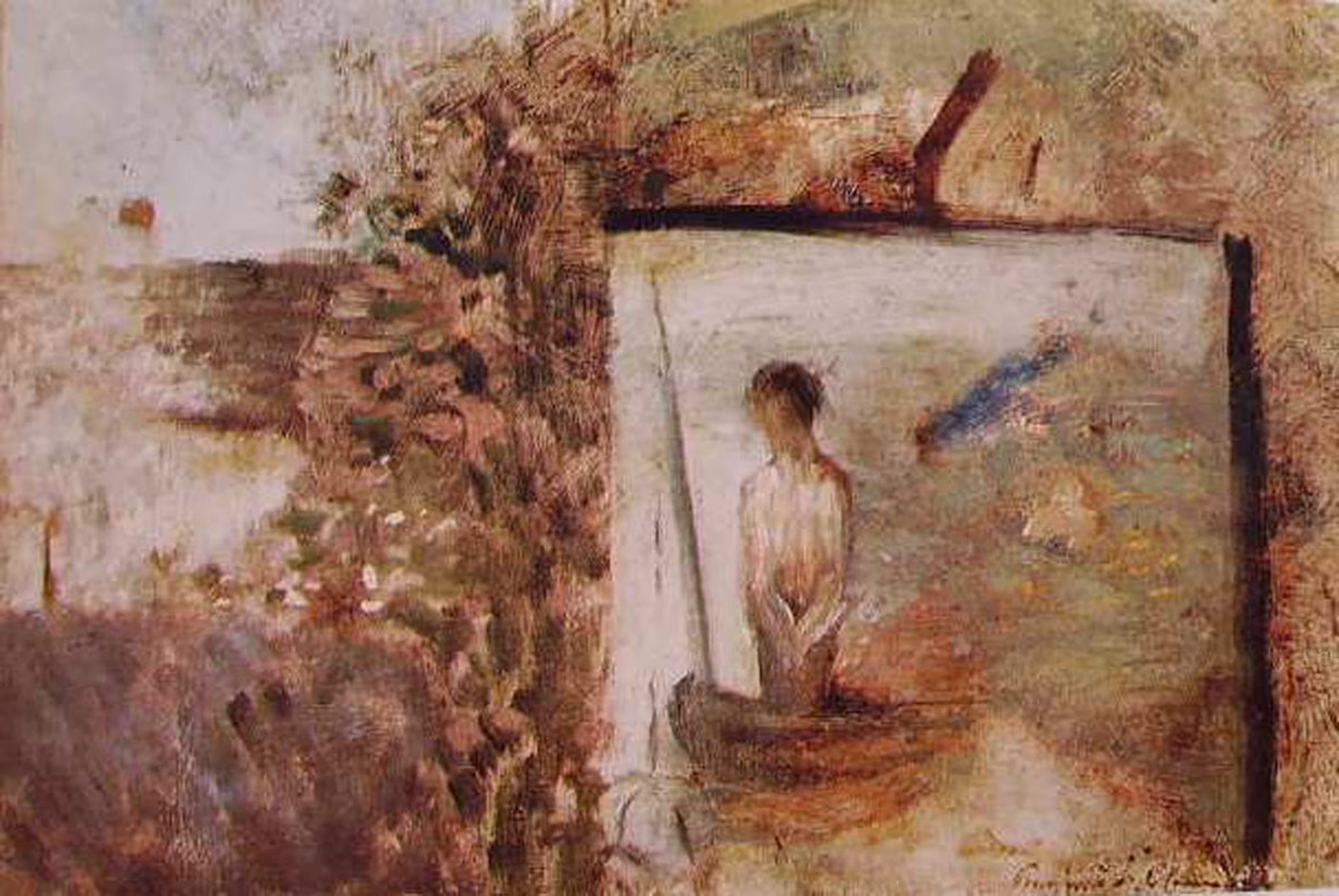
In 1883–84, Seurat worked on his first large-format painting: Bathers at Asnières (1884, National Gallery, London). It shows men and boys resting and bathing on the bank of the Seine at Asnières, an industrial suburb north-west of Paris. The composition, with its classical geometry and serenity — evoking Poussin as much as Impressionism — was prepared through dozens of outdoor studies and conté crayon drawings, a technique in which Seurat handled light and shadow effects with incomparable virtuosity.
The painting was rejected by the official Salon of 1884. It was shown instead at the first exhibition of the Groupe des Artistes Indépendants, which Seurat helped found that same year with Paul Signac, who would become his closest friend and the most passionate defender of Neo-Impressionism.
A Sunday Afternoon on the Island of La Grande Jatte: The Masterpiece
From 1884 to 1886, Seurat worked on his masterwork: A Sunday Afternoon on the Island of La Grande Jatte (Art Institute of Chicago). The painting, of monumental dimensions (2.08 x 3.08 metres), shows about fifty figures — bourgeois strollers, children, soldiers, boatmen — resting on the island of La Grande Jatte, in the middle of the Seine between Asnières and Courbevoie, on a warm summer afternoon. The composition is arrestingly strange: the figures seem frozen in their poses, like figures in an antique frieze or a dream vision, in a light of extraordinary vibrancy obtained by the meticulous application of millions of tiny dots of pure colour.
Seurat prepared this work with scientific rigour and extraordinary patience: seventy preparatory studies, two years of work, dozens of visits to the site at different hours of the day. The result is an image that is simultaneously hyper-real and strangely unreal, documentary and dreamlike, which has fascinated successive generations with its cold beauty and unfathomable mystery.
Shown at the eighth and final Impressionist exhibition in 1886 — which also saw the emergence of Pissarro, temporarily converted to Pointillism — the painting caused a sensation. The critic Félix Fénéon devoted a landmark article to Seurat in the journal L'Art moderne, coining the term "Neo-Impressionism" for the new movement.
Final Works and Premature Death
In the five years that remained to him, Seurat deepened and refined his system, producing a series of large compositions each of which constituted a new exploration. The Parade (1887–88, Metropolitan Museum of Art, New York) shows the entrance to a fairground circus in the evening, in a greenish artificial light of intense poetic strangeness. Le Chahut (1889–90, Kröller-Müller Museum, Otterlo) and The Circus (1890–91, Musée d'Orsay, Paris) — left unfinished at his death — explore movement and gaiety in an increasingly decorative and linear style, influenced by Charles Henry's aesthetic theories on ascending and descending lines and their emotional effects.
Seurat led a deliberately discreet and secretive life. Few contemporaries knew that since 1889 he had been living with a young model, Madeleine Knobloch, by whom he had a son, Pierre-Georges, born in February 1890. He kept this relationship hidden even from his own family. In March 1891, Seurat exhibited his last works at the Salon des Indépendants. A few days later he was struck down by a fulminant case of diphtheric angina. He died in Paris on 29 March 1891, aged thirty-one. His son died of the same illness a few weeks later.
A Considerable Legacy Despite a Short Life
Seurat's influence on twentieth-century art is considerable, despite the brevity of his life and the relatively small number of his major works. The Divisionism he invented directly influenced the Fauves — notably Matisse and Derain during their stay in Collioure in 1905, where they practised a liberated form of Neo-Impressionism — and the Italian Futurists, who adapted it to their own expressive ends. Paul Signac, his travelling companion, disseminated his theories throughout the European art world through his book From Eugène Delacroix to Neo-Impressionism (1899).
La Grande Jatte remains one of the most reproduced, copied, parodied and revisited works in the history of art: Stephen Sondheim devoted a musical to it, Sunday in the Park with George (1984); countless contemporary artists have referenced it. Seurat's masterpiece is today the principal attraction of the Art Institute of Chicago, one of the most visited art museums in the United States. In ten years of active production, Seurat produced a pictorial revolution whose consequences reverberated across the entire following century.