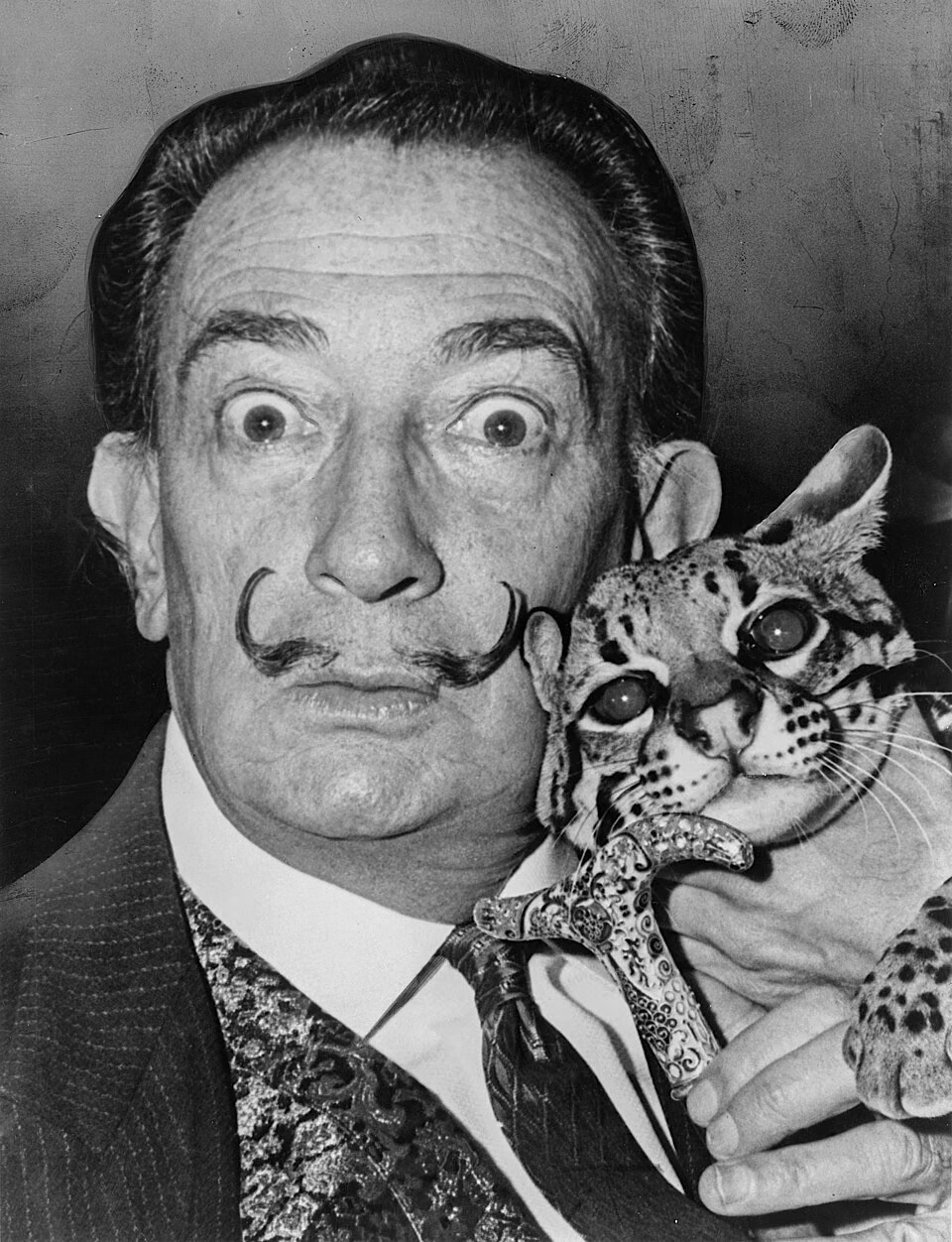
Salvador Dalí is one of the most famous artists of the twentieth century — and probably one of the most misunderstood. The upswept moustache, the thunderous pronouncements, the eccentricities calculated to the last millimetre, the character of "Dalí" constructed with the care of a work of art in itself: all of this made him a global icon, while also obscuring what he actually was — a painter of exceptional technical mastery, nourished by encyclopaedic learning, whose most serious work engages fundamental questions about dreams, desire, death and faith. Disentangling the genius from the performance in Dalí is one of the most stimulating exercises that art history has to offer.
A Catalan Childhood Between Shadow and Light
Salvador Domingo Felipe Jacinto Dalí i Domènech was born on 11 May 1904 in Figueres, a small Catalan town at the foot of the Pyrenees. His birth came nine months after the death of a first son, also named Salvador, at the age of twenty-two months. This double Salvador — the dead and the living — would haunt Dalí's psychology throughout his life: his father regularly showed him his brother's grave, suggesting that he was merely his reincarnation. Dalí would later say he had spent his childhood wondering whether he really existed.
His father, Salvador Dalí i Cusí, was a notary, an authoritarian and liberal man in equal measure, who supported his son's artistic ambitions while maintaining a turbulent relationship with him. His mother, Felipa Domènech Ferrés, died of uterine cancer in 1921 when Salvador was sixteen — a loss from which he never fully recovered, and which would feed a significant part of his feminine and maternal iconography.
From childhood, he drew with a mastery and frenzy that astonished everyone around him. He read, observed and accumulated scientific and artistic knowledge with an intellectual voracity that never left him. In 1921 he entered the Academy of Fine Arts of San Fernando in Madrid, where he met Federico García Lorca and Luis Buñuel — two of the greatest figures of twentieth-century Spanish culture, with whom he forged intense and complex friendships.
Paris and Surrealism
In 1926, expelled from the Madrid Academy for declaring his professors incompetent to judge him — a claim not entirely without foundation — he visited Paris and met Picasso, whom he deeply admired. His first Paris exhibition at the Galerie Goëmans in 1929 was preceded by a short stay in Cadaqués, a Catalan fishing village on the Costa Brava where he had a house, in the company of a group of Surrealists including Paul Éluard and his wife Elena Ivanovna Diakonova, known as Gala.
The encounter with Gala — ten years his senior, Russian-born, of dark beauty and a dominant personality — was the thunderbolt of his life. She would leave Éluard for him. Dalí's devotion to Gala was both absolute and mystical: she was his model, his manager, his protector and his anchor in reality — for someone who easily lost himself in fantasy and phobia. He would sign some of his canvases "Gala-Salvador Dalí."
In 1929 he was formally admitted to André Breton's Surrealist group, whose fascination with Freud and the unconscious he shared. He brought to the movement an entirely original technical contribution: his paranoiac-critical method, which he defined as a technique for accessing the unconscious through systematic delusional interpretation of image associations. In practice, this produced paintings in which the same motif can be read simultaneously as two different things — a face and a landscape, a woman and a rock.
Technique and the Major Paintings
Dalí's painting is, paradoxically, among the most technically accomplished of the twentieth century. He worked with the minuteness and patience of a miniaturist, drawing inspiration from the fifteenth-century Flemish masters — Van Eyck, Vermeer — and from the Spaniards, above all Velázquez, whom he revered. His touch is imperceptible; his surfaces as smooth as enamel. It is precisely this photographic precision that makes his delirious visions so unsettling: they are painted with the same application as an actual landscape, which makes them all the more convincing and destabilising.
The Persistence of Memory (1931, MoMA, New York) — the soft watches drooping over the rocks of the Costa Brava — is the most famous work of Surrealism. Dalí would explain that he painted it while thinking of a piece of Camembert melting on a table, and of time as a plastic rather than rigid substance. The composition, small in format (24 x 33 cm), is of a hallucinatory precision and clarity.
Soft Construction with Boiled Beans (1936, Philadelphia Museum of Art) was painted a few months before the Spanish Civil War, which he had sensed coming — a mass of torn and twisted flesh, of premonitory violence. Dream Caused by the Flight of a Bee Around a Pomegranate, a Second Before Awakening (1944, Thyssen-Bornemisza, Madrid) shows Gala asleep on a rock above the sea, assailed by creatures erupting from a dream. The Madonna of Port Lligat (1950, Marquette University, Milwaukee) marks his declared return to the Catholic faith — a monumental Virgin and Child within an architecture of vertiginous precision.
The Break with Breton and American Exile
In 1940, Dalí and Gala fled war-torn Europe and settled in the United States, where they would remain until 1948. These American years were ones of growing celebrity and intense commercial productivity — spectacles, shop windows, magazine covers — which earned Dalí the nickname "Avida Dollars" from Breton, who expelled him from the Surrealist group. Dalí responded with royal insouciance and went his own way.
Back in Europe after the war, he settled permanently at Port Lligat on the Costa Brava, in the house he had transformed over the years into a labyrinth of interconnecting rooms and courtyards, and at Púbol, a medieval castle he gave to Gala as a private retreat.
Final Years
Gala died in 1982. Inconsolable, Dalí retreated to the castle at Púbol, refused to paint and declined rapidly. An accidental fire in 1984 — possibly set by Dalí himself, according to some biographers — drove him from the castle. He was installed in the Torre Galatea in Figueres, next door to the Dalí Theatre-Museum he had designed and built himself, and which today is the most visited museum in Spain after the Prado. He died there on 23 January 1989, aged eighty-four. He is buried in the crypt of the museum, beneath the stage, in accordance with his final wishes.