There is something deliberately unsettling about René Magritte's work — and that is entirely the point. His paintings take the most banal objects in the world — a bowler hat, a pipe, a green apple, a man in a grey overcoat — and place them in situations that make us doubt our confidence in reality as we think we know it. No monsters, no delirious visions of the Dalí variety, no explosions of colour: just ordinary reality, slightly displaced, suddenly winking at us to reveal that nothing is as solid as we thought. Magritte is the sceptical philosopher of twentieth-century painting — the artist who posed, with the means of a Sunday academic painter, questions that philosophers of language and theorists of representation have not yet finished unpacking.
A Belgian Childhood Marked by Tragedy
René François Ghislain Magritte was born on 21 November 1898 in Lessines, a small Walloon town in Belgium. His father, Léopold Magritte, was a tailor; his mother, Régina Bertinchamps, a milliner. The family moved several times around the Walloon region. In 1912, when René was thirteen, his mother drowned in the Sambre under circumstances that were never fully explained. The legend — perhaps invented, but widely repeated — has it that Régina's body was found with her hands over her face, and that this image of a hidden face haunted Magritte's work, in which faces concealed by apples, hats, sheets or birds became a recurring motif.
Magritte himself neither confirmed nor denied this biographical link — his natural reticence and taste for ambiguity prevented him from doing so. But it is hard not to think of it when standing before canvases like The Lovers (1928), in which two figures kiss with their heads wrapped in white cloth.
Brussels, Early Years and Georgette
In 1916, Magritte enrolled at the Royal Academy of Fine Arts in Brussels. His training was academic and undistinguished. What mattered more was his meeting around this time with Georgette Berger, the daughter of a Liège butcher, with whom he would spend the rest of his life — they married in 1922. Georgette would be his principal model and his domestic anchor in an existence of deliberate regularity and ordinariness.
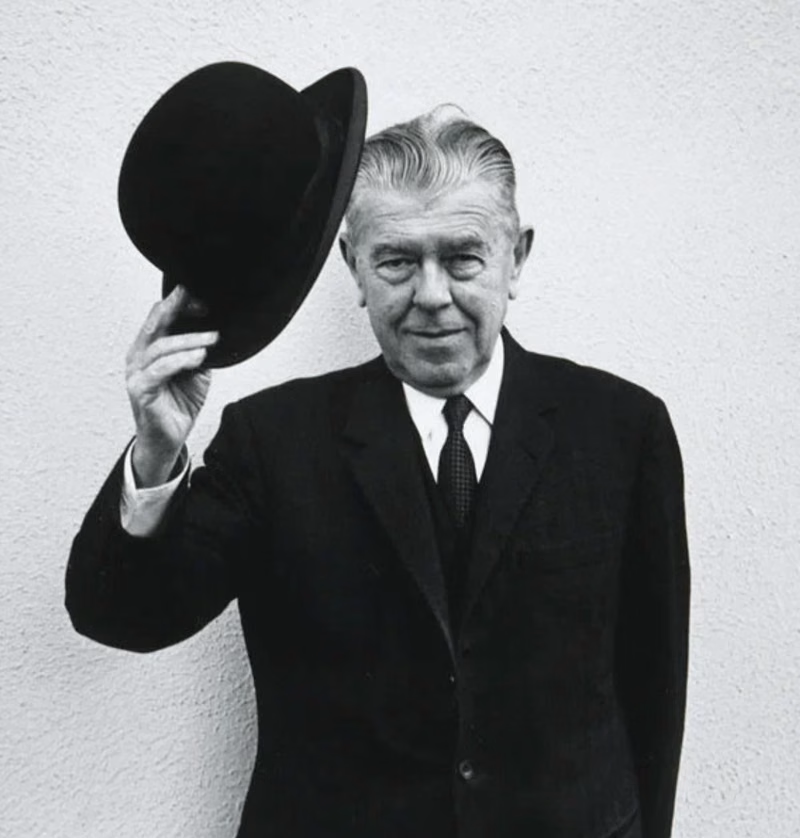
Magritte made a permanent, conscious choice in favour of ordinary life. Unlike Picasso in Montmartre or Dalí at Port Lligat, he never cultivated the image of the bohemian or eccentric artist. He lived in a bourgeois house in Brussels, wore a bowler hat (which would become his emblematic self-portrait), did the shopping, walked the dog, painted in his dining room. This refusal of the picturesque was itself an artistic position: painting should not be the product of an extraordinary life, but of an ordinary gaze that perceives the extraordinary within the ordinary.
In the 1920s he worked in the advertising industry to make ends meet, producing posters and wallpaper. His contact with commercial imagery — with the text-image relationship, with direct and synthetic communication — left its mark on his later work.
Paris and Surrealism: An Uneasy Alliance
In 1927, Magritte and Georgette moved to Paris for three years, settling in the suburb of Perreux-sur-Marne. He made contact with André Breton's Surrealist group. But the relationship was complicated: Magritte did not share the psychic automatism, unconscious writing and explicit Freudian dimension that Breton placed at the heart of Surrealism. His approach was more intellectual, closer to a philosophical problem than to uncontrolled dreaming.
In 1928–29 he painted several of his most important works. The Treachery of Images (1929, LACMA, Los Angeles) shows a pipe rendered with near-photographic precision, accompanied by the handwritten legend "Ceci n'est pas une pipe" — This is not a pipe. The puzzle is at once simple and vertiginous: of course it's not a pipe — it's a painting of a pipe. But once you have said that, you have put your finger on something essential about the nature of all representation, about the relationship between sign and thing, image and reality. Foucault would devote an entire essay to this painting — This Is Not a Pipe (1973) — exploring its implications for the theory of language.
Brussels and Maturity
Back in Brussels in 1930, Magritte stayed there for the rest of his life, in the same house on the rue Esseghem in Jette (today converted into a museum). He alternated advertising work with painting, developing at a quiet, steady pace a body of work of remarkable coherence and diversity.
His recurring themes — men in bowler hats, floating rocks, skies behind paintings, windows that are also canvases, objects enlarged to the point of absurdity, days that are also nights — constitute a genuine visual vocabulary that evolved through variations and returns rather than through ruptures. The Human Condition (1933, National Gallery of Art, Washington), in which a canvas placed in front of a window depicts precisely the landscape behind it, raises the central question of all his work: what is the relationship between representation and the real? The Empire of Light (1954, Musées Royaux des Beaux-Arts, Brussels), in which a lit house at night sits beneath a full daylight sky, creates an impossible coexistence of two states of illumination that should be shocking but, mysteriously, seems truer than reality.
Final Years and International Recognition
In the 1960s, Magritte's international recognition erupted suddenly — partly thanks to American Pop art, whose Andy Warhol and Jasper Johns recognised in his work questions they were themselves asking about reproduction and representation. Major retrospectives were held in New York, London and Stockholm. The quiet old gentleman from Brussels who spent his time playing chess and walking his dog found himself celebrated as one of the most important artists of the century.
He died of pancreatic cancer on 15 August 1967 in Brussels, aged sixty-eight. His paintings are today among the most reproduced in the world — an irony for a painter who spent his life interrogating the very nature of reproduction and representation.