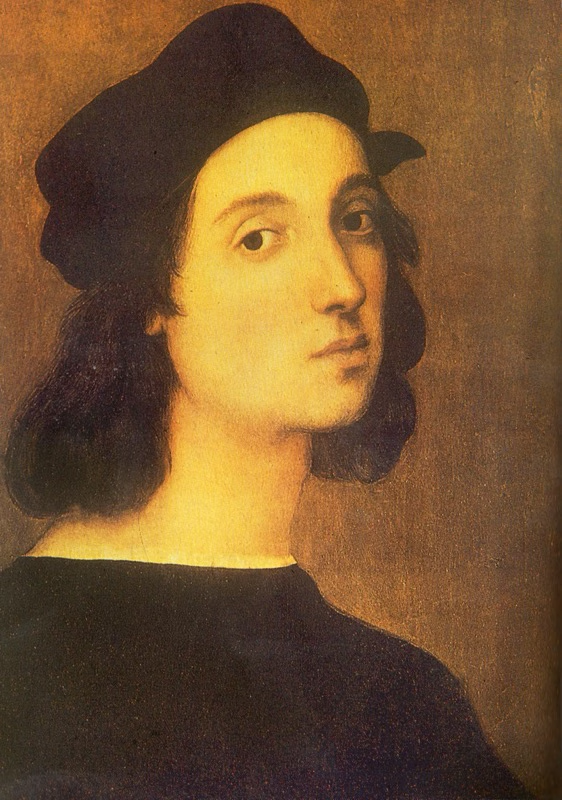
Raffaello Sanzio, known as Raphael, is one of the three towering figures of the Italian High Renaissance, alongside Leonardo da Vinci and Michelangelo. In just thirty-seven years of life — a blazing existence cut short at the summit of his glory — he produced a body of work of incomparable beauty and serenity that defined the very ideal of classical painting for centuries. A portraitist of subtle psychological insight, a painter of Madonnas of unrivalled tenderness and a decorator of genius, he absorbed the most diverse influences and fused them into a style of absolute clarity and grace. Venerated during his lifetime as a prince, mourned at his death by all of pontifical Rome, Raphael embodies more than anyone the humanist ideal of beauty as the expression of the good.
An Umbrian Childhood and an Early Formation
Raffaello Sanzio was born on 6 April 1483 in Urbino, one of the most refined courts in Italy, where his father, Giovanni Santi, was the official painter to Duke Federico da Montefeltro. Giovanni Santi was a painter of the second rank but a cultivated man, who introduced his son from childhood into the artistic and intellectual circles of the Urbino court, one of the most brilliant in Italy at the end of the fifteenth century. The young Raffaello grew up in contact with the humanists, musicians and artists who gravitated around the ducal palace.
His mother, Magia di Battista Ciarla, died in 1491 when he was only eight. His father Giovanni died in turn in 1494, leaving the young Raffaello an orphan at eleven. Despite this double early bereavement, Raffaello had already received from his father the solid foundations of an artistic formation, and his vocation was clearly laid out.
Around 1495–96, he entered as an apprentice the studio of the painter Pietro Vannucci, known as Perugino, in Perugia — one of the most celebrated painters in Italy at that time, whose harmonious style, balanced compositions and taste for soft, luminous Umbrian landscapes exercised a decisive influence on the young Raphael. He absorbed the master's manner so perfectly that some of his earliest works were long attributed to Perugino himself. Among his first independent productions was The Marriage of the Virgin (Lo Sposalizio, 1504), now in the Pinacoteca di Brera in Milan, in which one already perceives an aspiration to clarity and harmony that surpasses his master.
Florence: Confrontation with the Giants
In 1504, at twenty-one, Raphael left Umbria for Florence, drawn by the city's reputation and its artists. He stayed there intermittently until 1508, in a period of intense learning and profound transformation of his style. Florence was then dominated by two giants: Leonardo da Vinci, recently returned from a long Milanese period, and Michelangelo, who was working on the David and the cartoons for The Battle of Cascina.
Raphael studied the works of these two masters with passionate attention. From Leonardo he absorbed sfumato, the psychological subtlety of portraiture and, above all, the pyramidal arrangement of figure groups. From Michelangelo he steeped himself in anatomical power and bodily dynamism. This capacity to absorb the lessons of others without ever losing his own voice is one of the most remarkable traits of his genius.
The Florentine period produced the great Madonnas: The Madonna del Granduca (c.1505), La Belle Jardinière (1507), The Madonna del Cardellino (1506) — works in which Raphael perfected his depiction of maternal tenderness, the balance of figure groups and the golden light that bathes his faces. These paintings met with immediate success and established his reputation throughout Italy.
Rome and the Vatican Stanze: The Supreme Consecration
In 1508, Pope Julius II called Raphael to Rome to decorate his private apartments in the Vatican Palace, known as the Stanze di Raffaello (Raphael's Rooms). Raphael was twenty-five. The commission was enormous in scale: covering the walls and ceilings of several papal reception rooms with frescoes.
The first room decorated, the Stanza della Segnatura (1508–11), is universally regarded as his absolute masterpiece. Its four walls bring together allegories of the four great forms of human knowledge: Theology (The Disputation of the Holy Sacrament), Philosophy (The School of Athens), Justice and Poetry (The Parnassus). It is The School of Athens that has most lastingly impressed itself on the imagination: an immense coffered hall inspired by antique architecture, peopled with more than fifty Greek philosophers and scholars gathered around the central figures of Plato and Aristotle. Plato — whose features are those of Leonardo da Vinci — points upward; Aristotle extends his hand towards the earth: a visual synthesis of the debate between idealism and empiricism that runs through all of Western philosophy.
In this fresco, Raphael included a discreet self-portrait as a young man at the left edge of the composition. He also introduced a melancholy figure leaning against a marble block in the foreground — generally identified as Heraclitus, whose features are said to be those of Michelangelo, as a tribute to the giant he admired.
The Stanze occupied Raphael and his workshop for much of his Roman life. The Stanza d'Eliodoro (1511–14) and the Stanza dell'Incendio di Borgo (1514–17) allowed him to explore more dramatic and narrative compositions, demonstrating ever greater mastery of space and movement.
Portraitist and Architect: A Versatile Genius
Alongside these great decorative projects, Raphael established himself in Rome as the most sought-after portraitist of his time. His portraits combined acute psychological likeness with mise en scène of incomparable elegance. The Portrait of Julius II (1511–12, National Gallery, London) is one of the first great psychological portraits in the history of painting: the old pope, tired and pensive, is caught in a moment of interiority far from any triumphant official representation.
The Portrait of Baldassare Castiglione (c.1514–15, Louvre) is considered one of the most accomplished portraits of the entire Renaissance: the celebrated author of The Book of the Courtier appears in a palette of extraordinary subtle greys and blues, radiating natural nobility and sovereign serenity. Rembrandt, seeing it at an Amsterdam sale in 1639, made a drawing of it.
From 1514, following the death of the architect Bramante, Raphael was appointed chief architect of St Peter's Basilica by Pope Leo X. He also worked on documenting Rome's ancient monuments, producing a report on the state of the ruins that constitutes one of the first testimonies to a modern sense of cultural heritage.
The Madonnas and the Sistine Madonna: The Summit of Grace
Among the painted works of his Roman maturity, representations of the Virgin continued to hold a central place. The Sistine Madonna (1512), commissioned for the church of San Sisto in Piacenza and now in the Gemäldegalerie in Dresden, is one of the most celebrated religious compositions in the history of art. The Virgin advances towards the viewer carrying the Christ Child, flanked by Saint Sixtus and Saint Barbara, in a movement of aerial lightness and grace, while two pensive angels — who have become a universal graphic icon — rest at the base of the composition, their gaze lifted to the heavens.
The Transfiguration (1516–20), his last great painting, left unfinished at his death and completed by his pupils, brings together in a single composition two distinct Gospel scenes: the Transfiguration of Christ on Mount Tabor in the upper part, and the healing of an epileptic child below. The work, of a dramatic complexity and intensity that anticipates the Baroque, marks a shift towards greater tension and movement in his style.
A Sudden Death at Thirty-Seven
Raphael's Roman life was that of an artist overwhelmed with commissions and honours, but also of a man who lived intensely, surrounded by friends, collaborators and women. He directed a considerable workshop in which dozens of pupils and assistants worked — Giulio Romano, Giovanni Francesco Penni, Perino del Vaga — who participated in executing his many commissions.
His relationship with a woman known as La Fornarina (the baker's daughter), whose real name was Margherita Luti, became famous: he depicted her in several paintings, including the eponymous portrait held at the Galleria Nazionale d'Arte Antica in Rome.
On 6 April 1520, his thirty-seventh birthday, Raphael died in Rome after a brief illness — a violent fever whose exact cause remains debated. His death plunged Rome into mourning. His body was displayed in his studio, surrounded by his works, before being interred in the Pantheon — a singular honour — where his tomb bears the epitaph written by the poet Pietro Bembo: Ille hic est Raphael, timuit quo sospite vinci rerum magna parens et moriente mori — "Here lies Raphael, by whom the Great Mother of all things feared to be outdone while he lived, and when he died feared to die herself."
A Founding Classical Legacy
Raphael's influence on Western painting was immense and multiform. For three centuries, from the Baroque through Neoclassicism, he was regarded as the painter par excellence, the unsurpassable model of harmony, grace and compositional clarity. The royal academies of painting, from Rome to Paris, Madrid and London, made his work the absolute reference for artistic teaching.
Poussin and Ingres openly claimed him as their forefather. Delacroix and the Romantics moved away from him but could not ignore him. In the nineteenth century, the British Pre-Raphaelites — who defined themselves precisely in opposition to the Raphaelesque academicism they found too conventional — paid him paradoxical tribute by placing his name at the heart of their own artistic identity.
Today his works are held in the greatest museums in the world — the Vatican, the Uffizi in Florence, the Louvre, the National Gallery, the Prado, the Kunsthistorisches Museum in Vienna — and continue to exercise an undiminished fascination. In a blazingly brief life, Raphael achieved a formal perfection that his own contemporaries recognised as unique, and bequeathed to posterity an ideal of serene and human beauty that remains one of the most accomplished expressions of Renaissance civilisation.