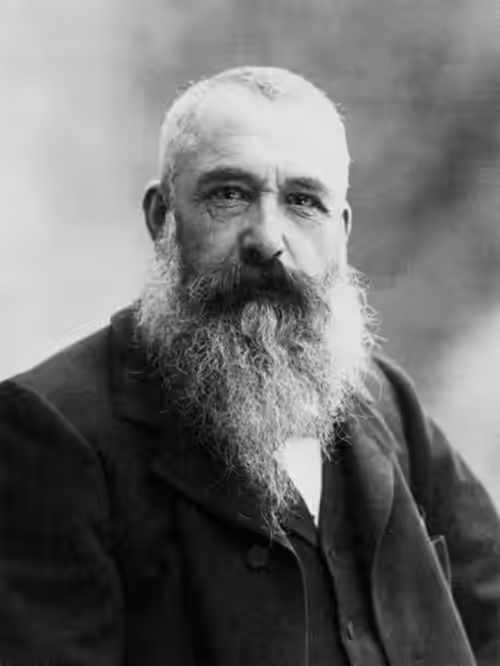
Claude Monet is the impressionist painter par excellence — the artist whose name is inseparable from the movement he helped found and define. By devoting his entire life to capturing the fleeting effects of light on water, trees, cathedrals and gardens, he carried out a quiet but radical revolution in the history of Western painting: the subject is no longer the thing depicted, but the light that reveals it at a precise instant, under particular atmospheric conditions. That conviction, sustained with an obstinacy and rigour that defied both age and failing eyesight, led him ultimately to the great Water Lilies compositions — the masterwork of his old age, which the twentieth century came to recognise as an anticipation of lyrical abstraction.
A Norman Childhood and an Early Calling
Oscar-Claude Monet was born on 14 November 1840 in Paris, but grew up in Normandy: the family settled in Sainte-Adresse, near Le Havre, in 1845, when he was five. His father, Adolphe Monet, ran a grocery business and hoped his son would one day take it over. But the young Claude drew with a compulsive energy and talent that quickly drew attention. By fifteen, he was known locally as a caricaturist, selling his sketches through a stationery shop in Le Havre.
It was in that same shop that he met, around 1856, the painter Eugène Boudin — a Norman landscape artist who specialised in beaches and skies. Boudin took him out to paint in the open air and taught him that natural light, with all its changes and impermanence, is the painter's true subject. Monet would later say it was Boudin who "opened his eyes." In 1859 he went to Paris to study, attending the Académie Suisse and the studio of Charles Gleyre, where he met Renoir, Sisley and Bazille. In 1862–63 he worked alongside these friends outdoors in the Forest of Fontainebleau, developing a quick, light-filled technique that foreshadowed impressionism. He was deeply influenced by the Barbizon landscape painters, by Courbet's solidity, and by the English painters Turner and Constable, whom he discovered during a stay in London in 1870–71 while taking refuge from the Franco-Prussian War.
The Birth of Impressionism
In 1874, Monet was a central figure in the group that organised the first impressionist exhibition in the photographer Nadar's studio on the Boulevard des Capucines. His painting Impression, Sunrise (1872, Musée Marmottan, Paris) — depicting the port of Le Havre through morning mist, factory smoke and the reflection of the sun on water — inadvertently gave the movement its name. The critic Louis Leroy, in a satirical piece in Le Charivari, mocked what he called these "impressionists," and the label stuck.
Monet's technique in this period is characteristic: visible, broken brushwork; colours applied directly to the canvas without a brown undercoat; subjects drawn from contemporary life; work done outside, or quickly finished in the studio from outdoor studies. His preferred motifs were the landscapes of the Paris region and Normandy — the Seine, the cliffs at Étretat, regattas, gardens, railway stations. The series of paintings of the Gare Saint-Lazare (1877) was among his first systematic experiments with light as a serial subject: by painting the same station repeatedly under different conditions of light and atmosphere, he explored the chromatic range of a single motif for the first time.
The Great Series: Haystacks, Cathedrals, Poplars
From 1890 onwards, Monet pushed this idea of the series to its full maturity. His Haystacks (1890–91), Poplars (1891), Rouen Cathedrals (1892–94) and Views of the Thames in London (1899–1901) are all ensembles in which the same motif is painted dozens of times, at different hours of the day, across different seasons, in different weather.
The Rouen Cathedrals may be the most ambitious and radical of all these undertakings. Monet painted the Gothic façade from the same window of a building across the street, across two successive campaigns in 1892 and 1893. The roughly thirty canvases that resulted show the same stone face in morning fog, midday glare, late afternoon sun, winter frost — chromatic states so different from one another that they seem to represent entirely distinct realities. When the series was shown at the Durand-Ruel gallery in 1895, it was a critical success. Cézanne, who saw it, reportedly said: "Monet is only an eye — but what an eye!"
Giverny, the Garden and the Water Lilies
In 1883, Monet settled in Giverny, a village in the Eure some eighty kilometres from Paris, where he rented and later bought the property that would become his total artwork. He laid out an extraordinary garden — flower beds arranged by colour and flowering season, rose-covered walkways, a green room — and had a pond dug and planted with Japanese water lilies, spanned by a wooden bridge inspired by the Japanese prints he collected. From 1895 onwards, this garden became both the setting and the principal subject of his work.
The Water Lilies series, begun around 1896 and continued until his death, is the most monumental undertaking of his career. He painted the pond in all its moods — the milky dawn, the blazing midday, the mauve evening, the autumn mist — in compositions that grew steadily larger and freer, with contours dissolving into light and the water's reflections erasing the boundary between surface and depth.
From 1912, Monet suffered from a double cataract that progressively impaired his sight. For years he put off the operation, afraid of losing what vision remained. His palette became warmer and darker — some canvases from this period are dominated by reds and oranges corresponding to his altered perception. He was finally operated on in 1923, partially recovered his sight, and reworked a number of paintings.
Shortly before his death, he donated to the French state two large Water Lilies compositions intended for two oval rooms at the Orangerie des Tuileries in Paris. These "Grand Decorations," nearly ninety metres in total length, were installed after his death and opened to the public in 1927. They remain one of the most enveloping and moving artistic experiences that modern art has ever produced.
Personal Life
Monet's emotional life was shaped by two important women. Camille Doncieux, his first companion and the model for paintings throughout the 1860s and 70s — including the famous Woman with a Parasol (1875, Musée d'Orsay) — died of cancer in 1879, leaving Monet with two children. Some years later, he formed a blended family with Alice Hoschedé, the widow of a former patron, whom he married in 1892. Alice died in 1911, plunging Monet into a grief that deepened his natural tendency towards solitude.
In his final years, Monet received illustrious visitors at Giverny — among them Clemenceau, his old friend, who pushed him to make the gift of the Water Lilies to the state — along with artists, critics and dealers from around the world who recognised him as one of the greatest living painters. He died at Giverny on 5 December 1926, aged eighty-six.
A Boundless Legacy
Monet's influence on twentieth-century art is immense and far-reaching. The American Abstract Expressionists — Pollock, Rothko, de Kooning — acknowledged the late Water Lilies as a direct precedent for their own work: the dissolution of form into colour, the canvas as a field of luminous energy rather than a representation of the world. The Musée Marmottan in Paris and the Orangerie des Tuileries hold the most important collections of his work. Giverny is today one of the most visited cultural sites in France, drawing hundreds of thousands of visitors each year to walk in the garden where light and water lilies nourished one of the most beloved bodies of work in the history of art.