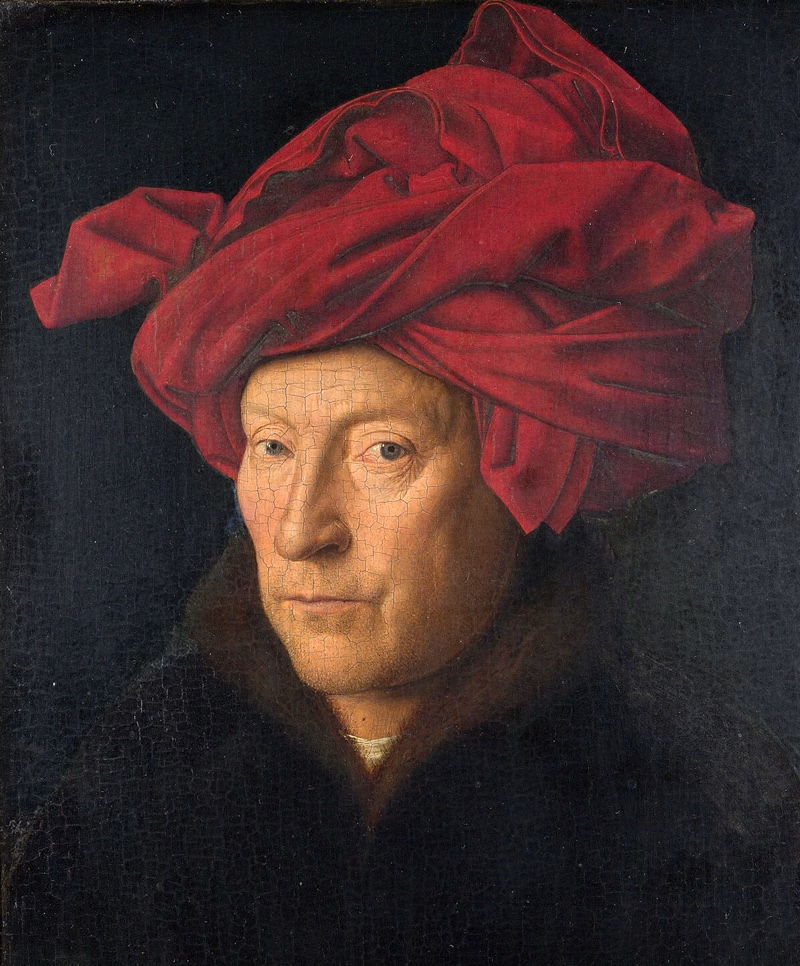
Jan van Eyck is one of the most important painters in the entire history of Western art, and perhaps the most disconcerting. His paintings have something that exists nowhere else in fifteenth-century painting — a precision in the rendering of light, materials, reflections and textures that seems entirely anachronistic, as if someone had projected into the waning Middle Ages techniques that should not have appeared until two or three centuries later. Standing before the Portrait of Giovanni Arnolfini and His Wife or before The Ghent Altarpiece, one is stunned by the light passing through stained glass windows, by the fur that seems genuinely soft to the touch, by the faces in which every pore of the skin and every reflection in the iris appear captured with photographic acuity. That is van Eyck: the painter who invented reality in painting.
Obscure Origins, a Life Documented in Fragments
Very little is known about Jan van Eyck's life before he appears in the archives as court painter to Duke John III of Bavaria in The Hague, around 1422. His date and place of birth remain uncertain: tradition holds that he came from Maaseik in present-day Belgium (hence his name — van Eyck means "from Eyck," like many Dutch place names), and that he was born around 1390, perhaps earlier. He had an elder brother, Hubert van Eyck, about whom even less is known, and whose share in the execution of the Ghent Altarpiece has long been the subject of historiographical debate.
In 1425, he entered the service of Philip the Good, Duke of Burgundy, in Bruges — the richest and most cultivated court in Northern Europe at that time. Philip accorded him exceptional esteem and trust: van Eyck was not merely his painter, he was also his diplomat and secret emissary, entrusted with delicate missions in Spain (1427) and Portugal (1428–29), where he went to portray the Princess Isabella of Portugal whom Philip was considering marrying. This hybrid position — artist and diplomatic agent — gave him proximity to the circles of power and a knowledge of the world rare for a painter of the period.
He settled in Bruges in 1430, married a woman named Margaretha, with whom he had several children, and remained there until his death on 9 July 1441.
Oil Paint: A Technical Revolution
The long-popular tradition that van Eyck invented oil painting is a legend — the technique of drying oil as a binder for pigments existed before him. What he achieved was subtler and more revolutionary: he perfected and systematised the use of linseed and walnut oils in a way that opened entirely new possibilities in the representation of light and materials.
Tempera (egg-based), the dominant technique of the Middle Ages, dries quickly and does not allow tones to be blended progressively — transitions between colours must be achieved through hatching or successive layers. Oil paint dries slowly and allows imperceptible gradations, transparent glazes layered one upon another that create effects of depth and inner light impossible to obtain by any other means. Van Eyck exploited these possibilities with a mastery that would remain unequalled for several generations.
It is this technique that allowed him to paint light passing through a stained glass window and reflected on a marble floor, crimson velvet absorbing light differently according to the angle, the polished metal of a chandelier reflecting an entire scene in its curve, the individual hairs of a fur coat in half-shadow. Every surface in his paintings has a different texture, its own way of interacting with light, a specific material presence.
The Ghent Altarpiece
The most monumental and most ambitious work associated with van Eyck is the Ghent Altarpiece (Adoration of the Mystic Lamb), a polyptych of twenty panels commissioned for the Cathedral of Saint Bavo in Ghent and completed in 1432. A painted inscription on the frame attributes the beginning of the work to Hubert van Eyck, who died in 1426, and its completion to Jan. The respective share of the two brothers in this work remains uncertain.
This altarpiece is one of the most important works in all of European painting. Open, it unfolds a paradisiacal vision of the world gathered before the Lamb of God: musician angels, saints, pilgrims, knights, philosophers, all converging towards the centre in a landscape of extraordinary verdure and light. The outer panels, visible when the altarpiece is closed, show an Annunciation in grisaille of striking beauty and precision, and the portraits of the donors — Jodocus Vijd and his wife Elisabeth Borluut — of a psychological realism rarely attained in Northern painting of that period.
This work has been one of the most stolen, copied and coveted in the entire history of art: several panels were removed, sold to foreign collections, recovered, lost again. The panel of the Just Judges was stolen in 1934 and has never been recovered — replaced by a copy. The history of the altarpiece is as eventful as an adventure novel.
The Arnolfini Portrait and the Mystery of the Mirror
The Portrait of Giovanni Arnolfini and His Wife (1434, National Gallery, London) is probably the most analysed and commented painting in all of fifteenth-century Flemish art. This double portrait shows a wealthy Lucchese merchant settled in Bruges and, according to the long-dominant interpretation of the historian Erwin Panofsky, constitutes a kind of legal document of their marriage, every detail of the painting — the removed shoes, the lit candle, the dog, the open window — carrying a precise symbolic significance.
What is astonishing in this painting is the presence in the background of a convex mirror reflecting the entire room, including two figures in the doorway — identified as witnesses, or perhaps as van Eyck himself. Above the mirror, a Latin inscription reads: Johannes de Eyck fuit hic 1434 — Jan van Eyck was here 1434. The first known example of an artist signing a painting by asserting his presence rather than merely his execution.
Van Eyck's entire body of work — portraits, small private altarpieces, religious compositions — is held in some twenty European museums. The Groeningemuseum in Bruges, the National Gallery in London, the Louvre and the Gemäldegalerie in Berlin hold the finest examples.