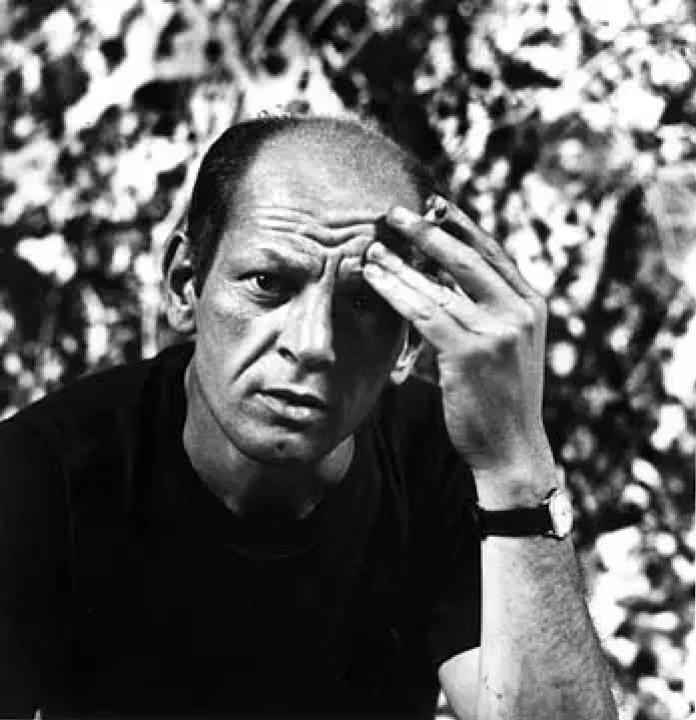
Jackson Pollock is the American artist of the twentieth century who pushed furthest the idea that painting can be an act as much as an object — that what counts in a canvas is not only the visible result but the gesture, the energy, the physical presence of the artist inscribed in the material. His drip paintings of 1947–50 — made by pouring, dripping and flinging paint onto a canvas laid flat on the floor, in a full-body dance — changed art's relationship to space, gesture and trace in ways that artists have not yet finished measuring. His life, brief and shattering like his canvases, became a work of art in itself — the legend of the damned painter of post-war America.
A Childhood in the American West
Paul Jackson Pollock was born on 28 January 1912 in Cody, Wyoming, into a family of Irish and Scottish descent. He was the fifth and youngest son of LeRoy Pollock, a farmer by origin, and Stella McClure, an ambitious and domineering woman who projected her own frustrated aspirations onto her sons. The family was unstable, moving constantly through the American West — Arizona, California, back to Los Angeles — following his father's repeatedly disappointing attempts at farming.
Pollock's childhood was marked by poverty, frequent moves and early alcoholism. He started drinking at fourteen. Art entered his life in 1927 when he became interested in his mother's theosophical publications and began to draw, then in 1930 when he joined his brother Charles in New York to study at the Art Students League under Thomas Hart Benton, a realist painter of the American Regionalist movement. Benton had little direct influence on Pollock's eventual style — but he taught him the importance of rhythm, dynamic composition and physical energy in painting.
New York and Decisive Influences
During the 1930s Pollock lived in New York in chronic precarity, working odd jobs and painting. He worked briefly for the Federal Art Project of the New Deal, a government programme that employed artists during the Great Depression. He frequented galleries and discovered the Mexican muralists — Orozco, Rivera, Siqueiros — whose large-scale, energetic and political compositions genuinely influenced his conception of painting at monumental scale.
In the 1940s two more decisive influences arrived. The first was Jungian psychoanalysis: Pollock entered therapy in 1939 to address his alcoholism, and successive therapists encouraged him to draw his dreams and interior states. The Jungian idea of a collective unconscious, populated by universal archetypes accessible through art, fed his conviction that painting could express deep psychic realities.
The second was the European Surrealists who had taken refuge in New York during the war — Ernst, Masson, Matta, Breton himself — who introduced him to psychic automatism as an artistic method. The practice of automatic drawing — letting the hand trace without conscious control — fascinated him. He drew conclusions from it that went far beyond anything the Surrealists had envisaged.
In 1941 he met the painter Lee Krasner, who would become his wife, his informal mentor and the manager of his career and reputation — before and especially after his death. Krasner was a considerably talented artist whom posterity has too often reduced to the role of Pollock's companion.
Drip Painting: A Revolution
In 1947, Pollock took the step that would set him apart from all his contemporaries. He abandoned the easel and the brush. He laid the canvas flat on the floor — sometimes very large format — and projected paint onto it while moving above it, in circles and crossings, using sticks, syringes and punctured paint cans. He literally danced around and over the canvas, his whole body part of the movement — arms, legs, breath.
The result — entangled networks of lines, splatters and trickles of paint, thicknesses and transparencies, with no defined centre or periphery — was entirely new in the history of painting. It was not abstract in the geometric sense: it was a trace of energy, a map of gesture, a recording of the body's movement through time.
The great drip canvases of 1947–50 — Number 1A (1948, MoMA, New York), Lavender Mist (1950, National Gallery of Art, Washington), Autumn Rhythm (1950, Metropolitan Museum, New York), One: Number 31 (1950, MoMA) — are among the most important works in the entire history of American painting. Their often monumental scale imposes on the viewer a physical experience of immersion that had not existed in painting before Pollock. You do not look at these canvases from a distance, as through a window: you are enveloped by them, you enter them.
In 1950 the photographer Hans Namuth documented Pollock at work in a celebrated series of photographs and a film. These images — the painter in jeans and T-shirt, moving with savage concentration around his canvas — went around the world and defined for decades the romantic image of the post-war American artist.
Decline and Death
From 1951, Pollock went through a deep crisis. He began drinking heavily again after two years of sobriety. His painting evolved — he returned to more figurative forms, in black on white — but the creative confidence seemed broken. The canvases became fewer and less assured. Lee Krasner, exhausted and despairing, left for Europe in 1956 to recuperate.
On 11 August 1956, at Springs, Long Island, drunk, Pollock missed a bend in a country road and crashed into the trees. He died on impact at the age of forty-four. Ruth Kligman, his mistress, was seriously injured but survived. He was buried at Springs in the Green River Cemetery, beneath a large standing stone.
His early death — like those of Van Gogh, Modigliani, Schiele — helped forge around him the legend of a blazing genius. But the work speaks for itself, without needing biography to impress: those swirls of colour laid down on the floor, those networks of frozen energy on the canvas, remain among the most powerful and most free visual experiences that painting has ever produced.