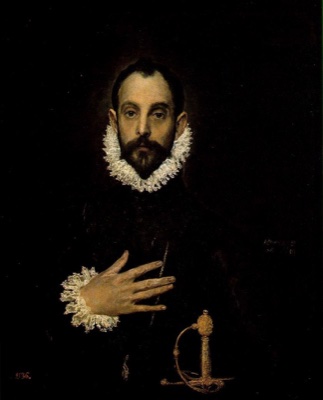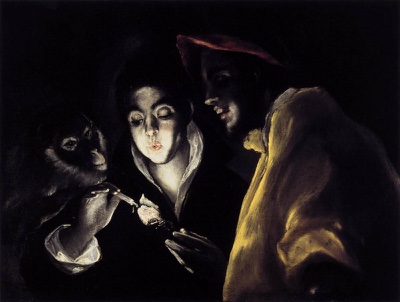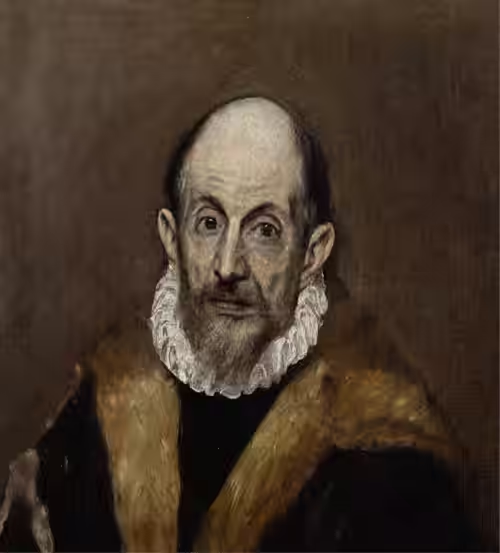
El Greco is one of the most singular and fascinating painters in the entire history of Western art. Born in Crete, trained in Venice and Rome, settled in Toledo for the rest of his life, he developed a radically personal style — figures stretched towards the vertical, colours of unreal intensity, an inner light that seems to emanate from bodies rather than illuminate them — that resembles no other artist and that, after two centuries of neglect, was rediscovered in the twentieth century as an extraordinary anticipation of Expressionism and modern art. As the painter of ardent faith and the Spanish soul at its most mystical, he became one of the presiding figures of Spanish painting, though he never ceased to be Greek until the end of his life.
A Formation Between Crete, Venice and Rome
Domenikos Theotokopoulos — whom the Spanish would simply call "El Greco," the Greek — was born around 1541 in Candia (present-day Heraklion), the capital of Crete, then a possession of the Venetian Republic. His initial training was in the Byzantine tradition of icon painting, and several post-Byzantine icons are today attributed to him with certainty, including the Dormition of the Virgin (Cathedral of Syros) and the Adoration of the Magi (Benaki Museum, Athens). This foundational formation, with its hieratic frontality, gold backgrounds, flattened figures and conception of colour as spiritual rather than naturalistic light, would remain present in his work throughout his life.
Around 1567 he left for Venice, with which Crete had close cultural ties. There he most likely entered the studio of Titian, then over ninety but still active, and absorbed the lessons of Venetian colourisim — the richness of tone, the fluency of the brush, the luminosity of flesh. He also studied Tintoretto, whose bold foreshortening, dramatic contrasts of light and emotional intensity influenced him deeply, as well as Bassano.
Around 1570 he moved to Rome, entering the circle of Cardinal Alessandro Farnese and frequenting the library of Fulvio Orsini. There he studied Michelangelo and Raphael and confronted the art of the Counter-Reformation. His Roman sojourn is marked by a revealing anecdote: he reportedly offered to repaint Michelangelo's Last Judgement in the Sistine Chapel, claiming he could produce a work as decent and as beautiful. The remark, which earned him lasting enemies, reflects a self-confidence bordering on arrogance — but also an independence of judgement that would characterise his entire career.
Settling in Toledo
Around 1577, El Greco left Italy for Spain, probably hoping to receive commissions for the decoration of the Escorial, the great monastic complex Philip II was building near Madrid. The hope was disappointed: the king did not appreciate his style and did not give him the expected work. But El Greco settled in Toledo, the former capital of Castile and spiritual and intellectual centre of Counter-Reformation Spain, and would remain there until the end of his life.
In Toledo he quickly found clients and recognition. His first major Spanish commission, El Espolio (The Disrobing of Christ, 1577–79), for the sacristy of Toledo Cathedral, was an immediate coup: the composition, centred on the figure of Christ in a scarlet robe surrounded by soldiers and tormentors, was of a power and originality that astonished viewers. But it also generated the first controversies — the cathedral chapter disputed the proportions and certain iconographic details, and a lawsuit was brought to fix the price of the work.
The Burial of the Count of Orgaz: The Masterpiece
In 1586–88, El Greco painted for the church of San Tomé in Toledo what is generally considered his masterpiece: The Burial of the Count of Orgaz. The painting, of monumental dimensions (4.80 x 3.60 metres), depicts on two superimposed registers the miraculous scene in which, during the funeral of the Count of Orgaz in 1323, Saints Augustine and Stephen reportedly appeared and lowered the body into the tomb themselves, in the presence of Toledo's notables. The lower, earthly register is of striking realism and portrait precision — El Greco depicted the most eminent figures of contemporary Toledo, and probably himself and his son Jorge Manuel. The upper, heavenly register is of an entirely different nature: the sky opens in luminous, unreal clouds as the count's soul rises towards Christ in a procession of elongated, flaming figures.
This partition between the real and the supernatural, between earthly gravity and spiritual aspiration, is at the heart of his vision — and the way the two registers coexist on a single canvas without contradiction is one of the most ingenious and beautiful solutions in all Western religious painting.
A Style Without Equal
El Greco's style is immediately recognisable and resembles no other painter of his time. His figures stretch to the point of impossibility, limbs elongate, faces tilt upwards towards an invisible vanishing point — as though earthly gravity were giving way to a spiritual upward thrust. The colours are of unreal intensity: electric blues, acid yellows, phosphorescent greens and ardent reds create atmospheres that defy all naturalistic logic. Light, far from being an optical phenomenon, seems to emanate from the flesh and drapery themselves, as though the figures were inhabited by an inner incandescence.
These characteristics, which his contemporaries accepted as the expression of a spiritual vision, led eighteenth and nineteenth-century critics to suppose that eye problems — astigmatism or myopia — had distorted his perception. This hypothesis is now rejected: El Greco suffered no particular visual deficiency, and his formal choices were deliberate and consistent.
Among his major works: View of Toledo (c.1599–1600, Metropolitan Museum of Art, New York), a landscape of dramatic intensity and formal freedom that has no equivalent before Romanticism; The Opening of the Fifth Seal (c.1608–14, Metropolitan Museum of Art, New York), a visionary composition of striking Expressionist freedom and power; and his many paintings of saints — Saint Francis, Saint Jerome, Saint Sebastian — in which mystical ecstasy takes visual form with a force rarely matched.
Personal Life and Final Years
El Greco lived in Toledo with Jerónima de Las Cuevas, with whom he had his son Jorge Manuel Theotokopoulos, born in 1578, who would himself become a painter and architect. Though they never married, their relationship appears to have been stable and lasting. El Greco always signed his works with his Greek name, Domenikos Theotokopoulos, sometimes adding "Crès" (Cretan) — an assertion of his original identity that he never renounced.
He died in Toledo on 7 April 1614, aged approximately seventy-two, leaving many unfinished works. His son Jorge Manuel managed his estate.
Oblivion and Resurrection
After his death, El Greco's work fell into relative obscurity for more than two centuries. His painting seemed too strange, too eccentric, too far from the canons of classicism to find favour with eighteenth and nineteenth-century critics. The rediscovery came at the turn of the twentieth century: Symbolists and Expressionists, searching for precedents for their own approach, recognised in his distorted figures and hallucinatory colours a language that spoke directly to them. Cézanne, Picasso (who saw a kinship between his figures and Les Demoiselles d'Avignon) and the German Expressionists all gave him a prominent place in their personal pantheons. Today his works are held principally at the Museo del Prado in Madrid, the Metropolitan Museum of Art in New York, and of course in the collections of Toledo, where he remains the city's principal cultural draw.