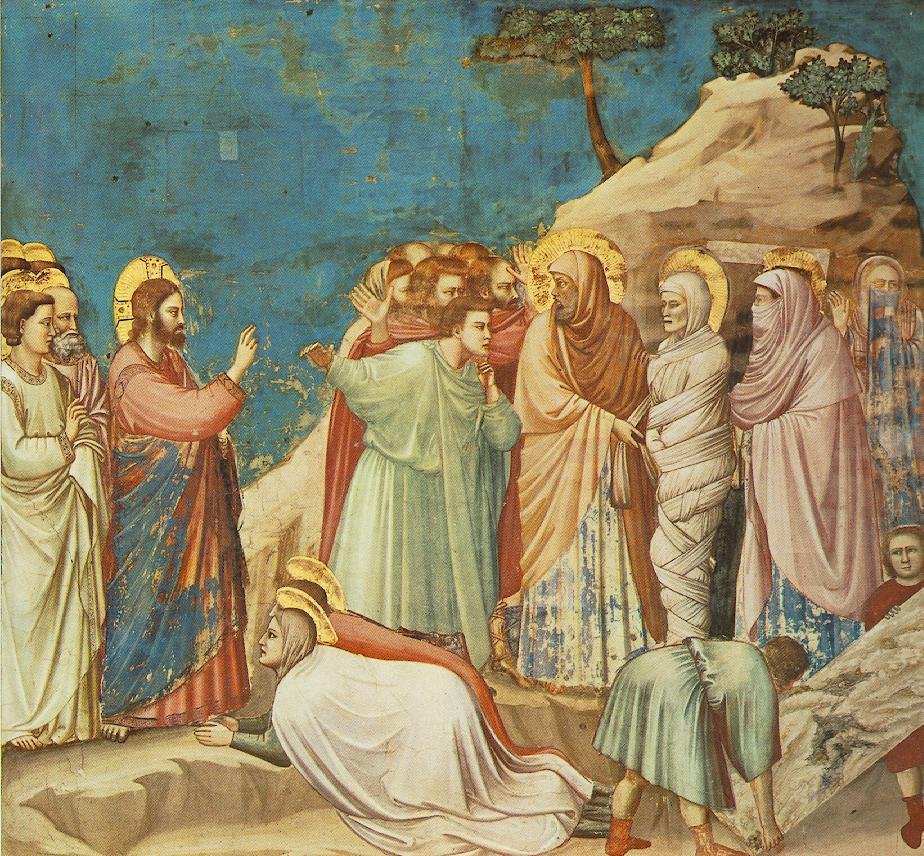

The Resurrection of Lazarus
Artwork by Giotto • 1305
🖼️ Reproduce this artwork — 📗 Book on Giotto on Amazon
About this artwork - painting analysis
Giotto di Bondone transforms the biblical episode of The Resurrection of Lazarus into a human drama of overwhelming intensity, painted in the early 14th century within the prestigious framework of the Scrovegni Chapel in Padua. This monumental fresco measuring 185 x 200 cm illustrates the miracle of Christ resurrecting his friend after four days spent in the tomb, a narrative drawn from the Gospel according to Saint John. The Florentine painter organizes his composition around two magnetic poles: on the left, Christ who, with an authoritative gesture of his hand, commands the return to life; on the right, Lazarus swathed in his white shroud, emerging from his rocky sepulcher while attendants pinch their noses, evoking the stench of decay.
The scene unfolds in a stripped-down landscape dominated by ochres, deep blues and delicate pinks, Giotto's chromatic signature. The artist revolutionizes medieval painting here by conferring upon his figures an unprecedented corporeal presence, a sculptural volume that breaks with the flat figures of Byzantine tradition. The faces express a palette of authentic emotions—astonishment, hope, disbelief—that anchor the miracle in tangible reality. The light, though not naturalistic, structures the space and guides the viewer's gaze toward the central action, creating innovative spatial depth for the period.
Created between 1303 and 1305 in the context of Italian Trecento, this fresco is part of the complete narrative cycle of Christ's life commissioned by the wealthy banker Enrico Scrovegni. Giotto, considered the precursor of the Renaissance, gradually abandons Byzantine conventions to infuse Western painting with revolutionary naturalism. His buon fresco technique testifies to exceptional mastery, applying pigments to the still-fresh plaster to guarantee secular adhesion and durability.
The Resurrection of Lazarus remains a fundamental milestone in art history, heralding the plastic upheavals that Italian painting would experience in the centuries to follow and establishing Giotto as the spiritual father of European pictorial modernity.
If you appreciate "The Resurrection of Lazarus" and other paintings by Giotto, we offer you 10% off the purchase of an art poster from our partner europosters with the promo code GRANDSPEINTRES10.
Image license: faithful photographic reproduction of a two-dimensional public domain work of art.


