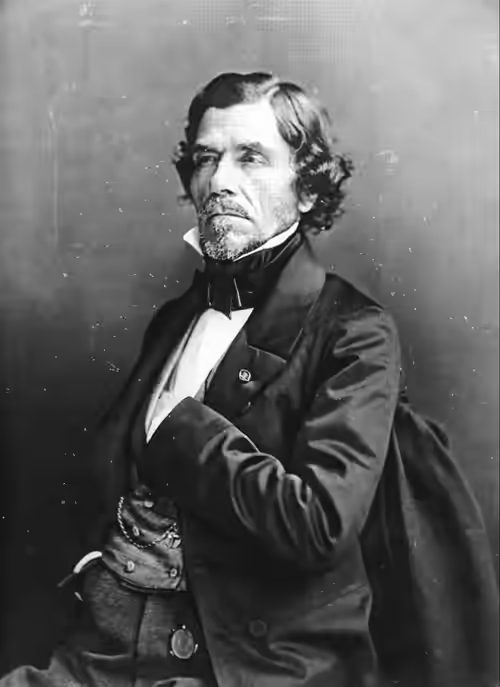
Eugène Delacroix is the unchallenged leader of Romanticism in French painting and one of the most important artists of the nineteenth century. By choosing colour over drawing, movement over pose, passion over reason, he embodied the opposite pole to Ingres in the great aesthetic debate that structured all of French artistic life in the first half of the century. His great historical and literary compositions — The Barque of Dante, The Massacre at Chios, Liberty Leading the People, The Death of Sardanapalus — are among the most powerful and emotionally charged canvases in the entire French tradition. Painter, draughtsman, and also one of the most remarkable writers among artists — his Journal, kept for decades, is a masterpiece of French prose — Delacroix is a total figure of Romantic civilisation.
A Birth Under the Sign of Mystery
Ferdinand Victor Eugène Delacroix was born on 26 April 1798 in Charenton-Saint-Maurice, near Paris. His official father, Charles Delacroix, was a senior civil servant and diplomat of the Revolution. But his biological father may have been, according to a hypothesis that many historians find very plausible, the Foreign Minister Talleyrand, of whom Charles Delacroix was the subordinate and with whose wife, Victoire Oeben, Talleyrand maintained close relations. This uncertain paternity fed a Romantic legend around the painter, whose aristocratic character, natural nobility and ease in cultivated circles correspond more readily to a natural son of Talleyrand than to a son of a provincial civil servant.
Whatever the truth, Eugène grew up in a cultivated, arts-friendly environment. His mother, Victoire Oeben, was the daughter and granddaughter of great cabinetmakers — the Oebens and Rieseners, suppliers of royal furniture. She died in 1814 when Eugène was sixteen. His father Charles had died in 1805. An orphan, he was taken in by his sister Henriette and her husband Raymond de Verninac.
Formation and Early Works
In 1815, Delacroix entered the studio of Pierre-Narcisse Guérin, a Neoclassical painter who was simultaneously training Géricault — a decisive encounter between the two most important figures of first-half-century French painting. Géricault's influence on the young Delacroix was immediate and profound: The Raft of the Medusa (1819), which Géricault prepared before his eyes and for which he posed as a model, revealed to him that a history painting could be contemporary, physical, violent, and have no need of an antique subject to achieve greatness.
He was simultaneously a diligent student at the Louvre, where he copied Rubens, Titian, Velázquez and the Venetian masters. The encounter with Rubens's work was particularly decisive: the flamboyant colour, the dynamism of bodies in movement, the way painting seems to live of itself in the Flemish master's canvases became for him the model of an animated, passionate painting opposed to Davidian coldness.
His first works shown at the Salon — The Barque of Dante (1822, Louvre), inspired by the Divine Comedy — immediately revealed a strong personality and a colourist mastery without equivalent in contemporary French painting.
The Great Romantic Battles
The Massacre at Chios (1824, Louvre), depicting the massacre of the Greeks of the island of Chios by the Ottoman Turks in 1822, made Delacroix the leader of Romanticism and the direct rival of Ingres — whose The Vow of Louis XIII was shown at the same Salon of 1824. Gros called the painting "the massacre of painting"; Adolphe Thiers praised it. The polemic was launched and would last the lifetimes of both artists.
The Death of Sardanapalus (1827–28, Louvre), inspired by a poem by Byron, is perhaps his most provocative and most Baroque canvas: the Assyrian king Sardanapalus, reclining on his immense bed, watches with criminal serenity the destruction of his riches and the massacre of his women and slaves, rather than let them fall to the victorious enemy. The composition, of extraordinary chromatic richness and erotic violence, was a deliberate challenge to all the Neoclassical principles of sobriety and order.
Liberty Leading the People (1830, Louvre), painted in response to the July Revolution (the Three Glorious Days), is his only work with a contemporary subject and his most popular canvas. The allegorical figure of Liberty — a bare-breasted woman, Phrygian cap, tricolour flag — advancing over the barricades on the bodies of fallen insurgents became the most recognisable image of Republican France, reproduced on banknotes and stamps for decades.
The Morocco Journey and the Orient
In 1832, Delacroix accompanied the Comte de Mornay on a diplomatic mission to Morocco and Algeria. This six-month journey was a revelation: the Maghreb light, the colours of clothing, the beauty of faces, the quality of shadows — all of this profoundly renewed his palette and his vision. He filled sketchbooks with drawings and watercolours of remarkable freshness and documentary precision.
The works that came from this journey — Women of Algiers in Their Apartment (1834, Louvre), The Jewish Wedding in Morocco (1839, Louvre), Arab Horses Fighting in a Stable (1860, Musée d'Orsay) — rank among his most luminous and sensual works. The palette lightened, shadows became coloured rather than grey — observations that directly prefigure the discoveries of the Impressionists, several of whom would cite Delacroix as an essential precursor.
The Great Decorations and Maturity
The final decades of his life were devoted to immense decorative commissions that Delacroix undertook with an energy and ambition that defied his fragile health: the paintings of the Salon du Roi and the Library of the Chambre des Députés in the Palais Bourbon (1833–47), the Senate library in the Palais du Luxembourg (1840–47), the Apollo Gallery in the Louvre (1850–51), and above all the chapel of the Holy Angels in the church of Saint-Sulpice in Paris (1861), where he depicted Jacob Wrestling with the Angel and Heliodorus Driven from the Temple in compositions of power and freedom that represent the culmination of his entire life.
Death and Legacy
Delacroix died on 13 August 1863 in Paris, aged sixty-five, from a slow-burning tuberculosis that had undermined him for years. That same year, Manet showed Le Déjeuner sur l'herbe — the torch passed.
His influence on the Impressionists was direct and acknowledged by them: Monet, Renoir and Pissarro owed him the permission of pure colour and coloured shadows. Cézanne admired him deeply and produced several variations on his works. Van Gogh made him a presiding figure. The Musée Delacroix in Paris, housed in his last studio on the Place de Furstenberg, and the Louvre hold the most important collections of his work.