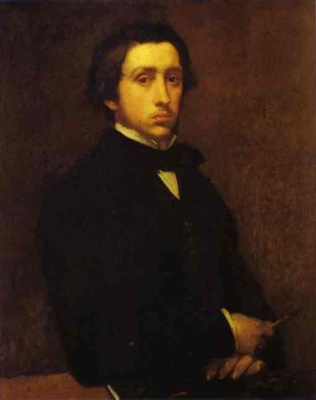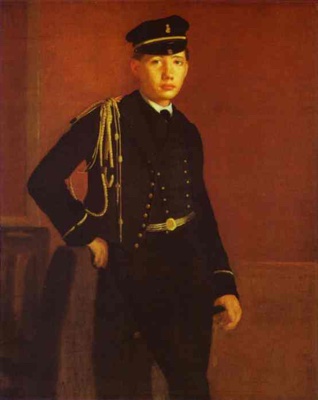
Edgar Degas is one of the most original and complex figures of the Impressionist movement — an artist who shared his contemporaries' taste for modern life and artificial light, yet set himself apart through a rigorous classical training, a passion for draughtsmanship inherited from Ingres, and a sharp psychological eye that makes him one of the most penetrating portraitists of his century. Painter, sculptor, draughtsman and photographer, he devoted a central part of his work to two favourite subjects — the dancers of the Paris Opéra and women at their toilet — which his contemporaries considered too commonplace for serious painting, and in which he found an inexhaustible source of formal inquiry into movement, space and artificial light.
A Bourgeois Childhood and a Classical Education
Hilaire-Germain-Edgar De Gas — he later simplified the name to Degas — was born on 19 July 1834 in Paris, into a comfortable, cultivated family. His father, Auguste De Gas, was a Neapolitan-born banker who ran the Paris branch of a family bank; his mother, Célestine Musson, was American, of Creole descent from New Orleans. She died in 1847 when Edgar was only thirteen, leaving his father to raise five children alone. The family was steeped in art and music — Auguste regularly took the young Edgar to private collections and galleries, training his eye and his taste.
In 1853, after his baccalaureate, Edgar enrolled in law, but stayed only a few months before devoting himself entirely to painting. In 1855 he entered the École des Beaux-Arts in the studio of Louis Lamothe, a pupil of Ingres — a decisive encounter: the cult of draughtsmanship, the primacy of line over colour, and the rigour of formal construction would become the immovable foundations of his approach. That same year he briefly met Ingres himself, then seventy-five, who gave him his legendary piece of advice: "Draw lines, young man, many lines."
From 1856 to 1859, Degas spent long periods in Italy — Naples, Rome, Florence — studying the Renaissance and antique masters with exemplary thoroughness. His Italian sketchbooks, filled with copies after Mantegna, Ghirlandaio, Pontormo and the Greek sculptures in the Vatican, testify to a seriousness and capacity for assimilation that few artists have matched.
Meeting Manet and the Impressionists
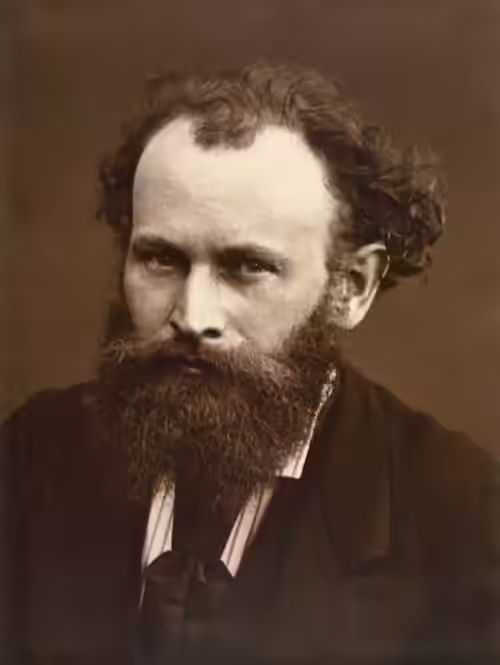
Back in Paris in 1859, Degas first turned to large-format history paintings — Semiramis Building Babylon (1860–62), Scene of War in the Middle Ages (1865) — still fairly conventional in their academic ambitions. The decisive encounter with Édouard Manet, around 1862 at the Louvre, where both men happened to be copying a Velázquez, gradually reoriented him towards modern life.
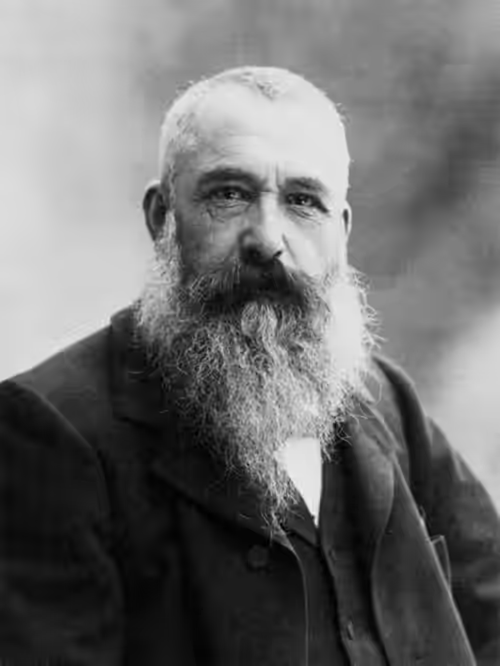
Manet introduced him to the circles of the Café Guerbois, where the future Impressionists — Monet, Renoir, Pissarro, Cézanne, Sisley — gathered alongside supportive critics and writers including Émile Zola and Edmond Duranty. Degas shared the group's conviction that contemporary life was a legitimate subject for art, but remained closer to Ingres than to Monet in his relationship to drawing and colour. He had no fondness for painting outdoors and preferred the artificial light of theatres, cafés and interiors.
The Opéra, the Dancers and Artificial Light
From the early 1870s, Degas settled into the subjects that would define his career: the Paris Opéra and its dancers, horse racing, cafés and café-concerts, scenes of labour — laundresses, milliners. These subjects, outside the noble repertoire of academic painting, allowed him to explore the formal questions that obsessed him: movement, the gesture caught in its instantaneity, the deformation of the body under physical effort, the plunging or oblique perspective, the effects of artificial light on flesh and costume.
His dancers — painted in oil, in pastel, drawn in red chalk or modelled in bronze — are not idealised visions of feminine grace. Degas catches them in moments of work and fatigue: stretching at the barre, tying their shoes, waiting in the wings, adjusting a tutu under the hard light of the footlights. He gained access to the backstage spaces and rehearsal rooms of the Opéra — a rare privilege — and observed with clinical attention the gestures and postures of young women whose bodies were professional tools.
The Dance Class (1871–74, Musée d'Orsay, Paris), The Star (1878, Musée d'Orsay), the many series of blue and pink dancers from the 1890s: these pastel works, in which colour is laid down in crossing hatches of extraordinary richness and vibrancy, rank among the finest and most recognisable paintings of nineteenth-century France.
Women at Their Toilet and Old Age
From the 1880s, Degas developed the other great theme of his maturity: women at their toilet. Series of female nudes — bathing, drying themselves, combing their hair — seen from behind or in profile, at unusual angles and with abrupt perspectives that seem to have been observed unawares. Degas himself described these women as "human animals tending to themselves," saying he wanted to show them "as if you were looking through a keyhole." That provocative formula was in reality a cover for intense formal inquiry into how to represent a body in motion within a confined space.
In the same period he produced a series of wax and clay sculptures — the only one exhibited in his lifetime being the celebrated Little Dancer Aged Fourteen (1881), with her real hair, fabric tutu and satin ballet shoes — which represent a three-dimensional exploration of movement parallel to his painting.
The progressive deterioration of his sight from the 1890s profoundly changed his working methods: his late pastels, increasingly dense in their material and intense in their colour, are testimony to an adaptation to failing vision that paradoxically produced some of his most powerful works.
A Difficult Personality
Degas was famous for his misanthropic, caustic and solitary character. Never married, with little inclination for lasting relationships, he lived alone and fell out successively with most of his close friends — most notably during the Dreyfus Affair in 1894, when his virulent antisemitic positions alienated Pissarro, Monet and many former companions. This dark side should not obscure the generosity he showed towards younger artists — he bought paintings by Gauguin and Mary Cassatt, the American artist he supported and encouraged for decades.
He died in Paris on 27 September 1917, aged eighty-three, nearly blind and wandering the streets of the city. At his death, his studio revealed an extraordinary accumulation of unfinished or hoarded works — hundreds of pastels, drawings and paintings, as well as the wax sculptures that would be cast in bronze after his death. The Musée d'Orsay in Paris holds the most important collection of his work.
A Considerable Legacy
Degas's influence on twentieth-century art is both direct and diffuse. His way of capturing movement through gesture rather than pose has nourished generations of draughtsmen and filmmakers. His freedom with framing and perspective — partly inherited from photography and Japanese prints — influenced Toulouse-Lautrec, Bonnard and Vuillard. And his conviction that beauty can be found in the most ordinary gestures and the most tired bodies remains one of the most valuable lessons that modern painting has to offer.