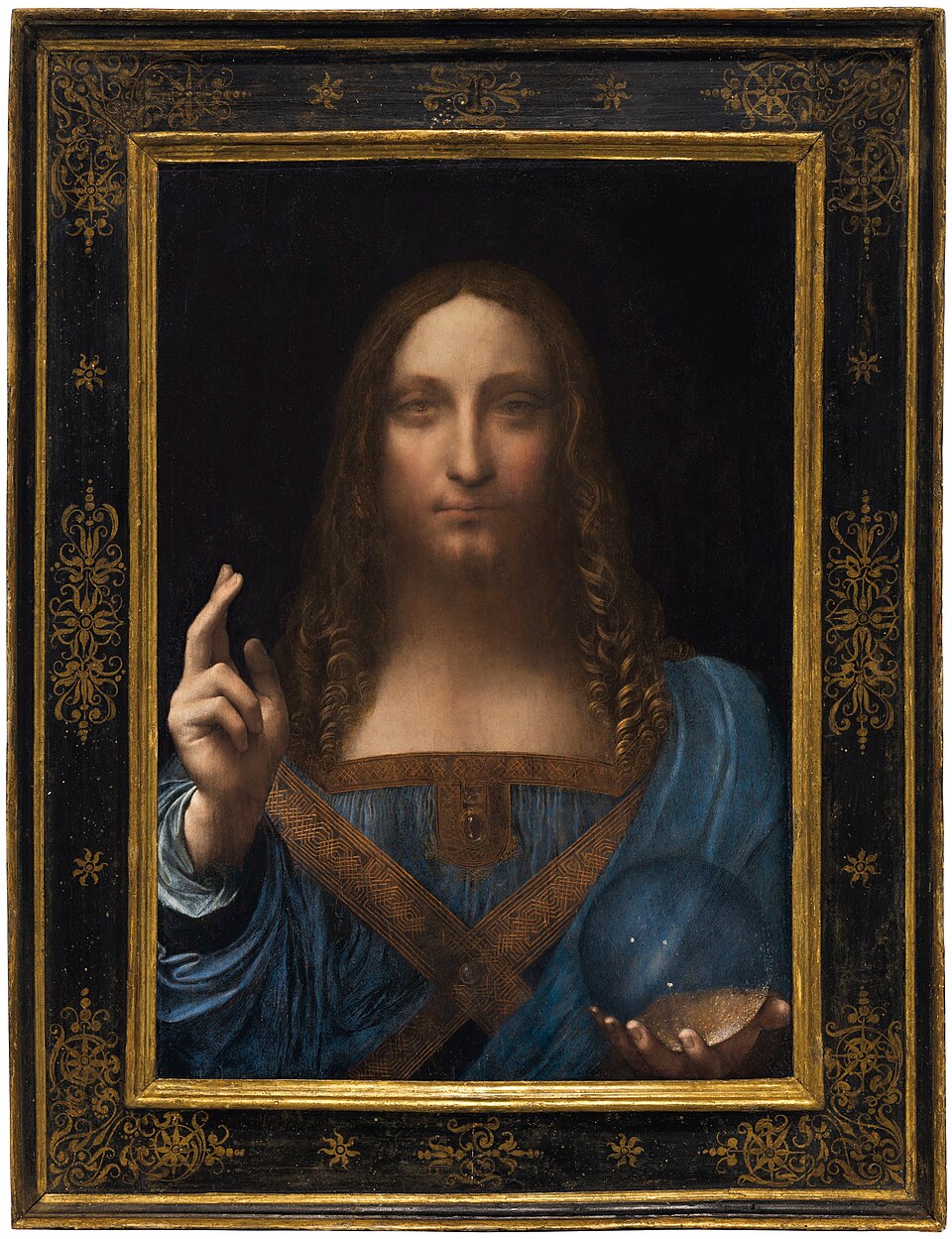
1. Salvator Mundi — Leonardo da Vinci (attrib.): $450.3 million (2017)
The absolute record belongs to Salvator Mundi, a portrait of a blessing Christ attributed to Leonardo da Vinci, sold at Christie's New York on November 15, 2017. The painting, rediscovered in the 2000s beneath several layers of overpaint, was restored and authenticated by the National Gallery in London. Its attribution remains debated among specialists — some see Leonardo's own hand, others the work of students from his workshop. The presumed buyer is Saudi Crown Prince Mohammed bin Salman, who planned to display it at the Louvre Abu Dhabi. The painting has never been publicly exhibited since.
2. Interchange — Willem de Kooning: $300 million (2015)
Sold in a private transaction in 2015 by American billionaire David Geffen to hedge fund manager Kenneth C. Griffin, Interchange (1955) by the American abstract expressionist Willem de Kooning is the most expensive private sale in history. The painting is displayed at the Art Institute of Chicago.
3. Les Femmes d'Alger (Version O) — Pablo Picasso: $179.4 million (2015)
This late Picasso variation on Eugène Delacroix's painting was sold at Christie's New York in May 2015, setting the world auction record at the time. The buyer remains anonymous. The work belongs to the Women of Algiers series that Picasso painted as a tribute to Matisse following the latter's death.
4. Nu couché — Amedeo Modigliani: $170.4 million (2015)
Modigliani's Nu couché, sold at Christie's New York in November 2015, was acquired by Liu Yiqian, a Chinese billionaire collector, who reportedly paid with his American Express card — accumulating enough air miles for several trips around the world. The anecdote made headlines worldwide.
5. Shot Sage Blue Marilyn — Andy Warhol: $195 million (2022)
In May 2022, this monumental Warhol silkscreen of Marilyn Monroe sold at Christie's for $195 million, setting a record for a twentieth-century work. The piece belonged to the 1964 Shot Marilyns series, made the year after the actress's death. The buyer was Larry Gagosian, the New York gallerist.
6. Card Players — Paul Cézanne: $259 million (2011)
This version of Cézanne's Card Players was purchased in a private sale by Qatar in 2011 for an estimated $250–259 million. It was then the most expensive painting ever sold. Qatar acquired it to enrich its national collections.
7. Number 17A — Jackson Pollock: $200 million (2015)
Sold in a private transaction to Kenneth C. Griffin in 2015 at the same time as Interchange, this Pollock illustrates the growing dominance of American abstract expressionism on the global art market.
8. Le Rêve — Pablo Picasso: $155 million (2013)
Le Rêve (1932), a portrait of Marie-Thérèse Walter, was sold by collector Steve Wynn to Steven A. Cohen for $155 million in 2013, after an eventful history: Wynn had accidentally put his elbow through the canvas in 2006 just as he was about to sell it for $139 million — the repair and later resale ended up netting him considerably more.
9. Portrait of Adele Bloch-Bauer II — Gustav Klimt: $150 million (2006)
This second portrait of the Viennese patron by Klimt was sold in 2006 for $150 million at Christie's. The first version of the portrait, returned to the family after a lengthy dispute with the Austrian state, had sold the same year for $135 million.
10. Orange, Red, Yellow — Mark Rothko: $86.9 million (2012)
This large abstract painting by Rothko, sold at Christie's New York in 2012, illustrates the growing interest of collectors in postwar American abstract expressionism. Rothko's paintings regularly achieve record prices at auction.
Why these astronomical prices?
These records are explained by a convergence of factors. Absolute scarcity first: there cannot be two original Salvator Mundis. Guaranteed authenticity next: to reach these prices, a painting must be accompanied by impeccable documentation. The artist's reputation: records are always set by universally recognised names. And finally, competition between wealthy buyers — private collectors, sovereign wealth funds, nation-states — which turns the great auction sales into battles of ego as much as commercial transactions.
These prices have little to do with the intrinsic "artistic value" of the works. They reflect the state of the global art market at a given moment, the available fortunes, and the psychology of buyers who see these acquisitions as status symbols as much as investments.

