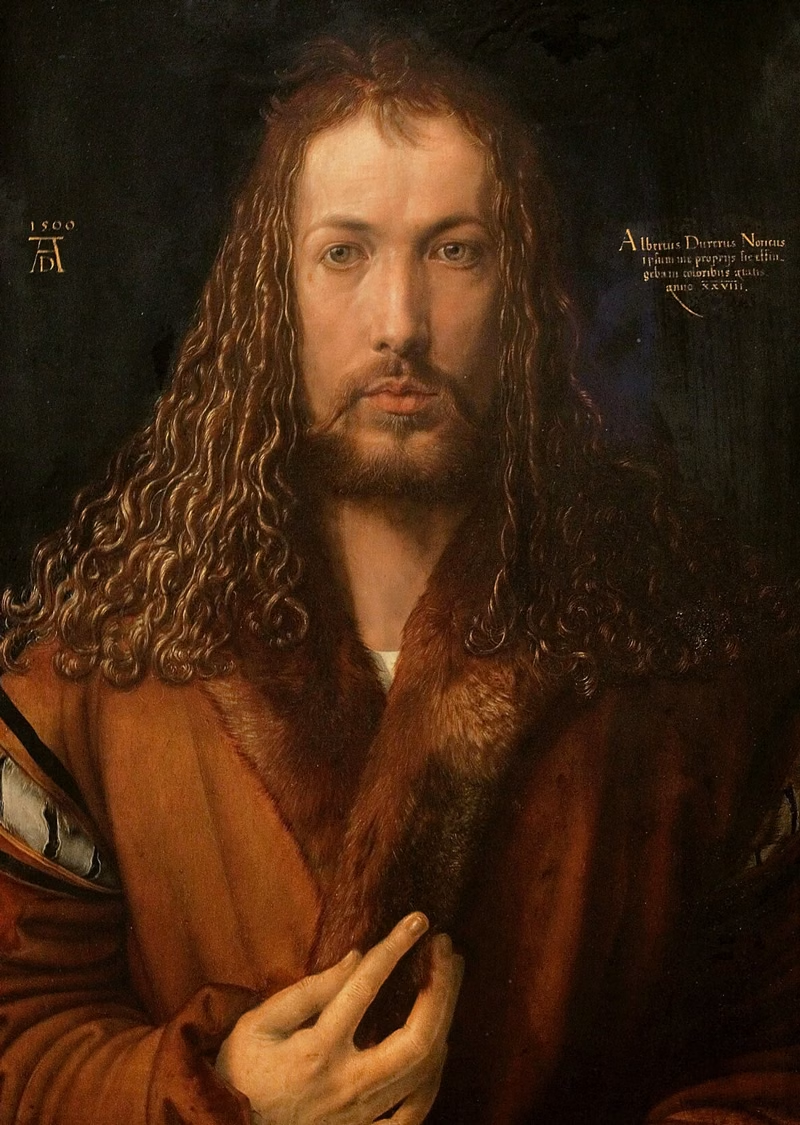
Albrecht Dürer is the most important figure of the German Renaissance and one of the greatest artists in the entire history of European art. Painter, engraver, draughtsman, theorist, mathematician: like Leonardo da Vinci, whom he admired and with whom he shared many traits, Dürer was a universal man, thirsting to understand and master every domain of visual knowledge. His contribution to the art of printmaking — in woodcut and copperplate — is without equal in history: he raised these techniques to a level of complexity, precision and expressive power that has never been surpassed. And his self-portraits, of stunning introspection and formal mastery, transformed the genre of portraiture for ever by asserting the dignity and singularity of the artist.
Nuremberg: A Formation in the Craftsman's Tradition
Albrecht Dürer was born on 21 May 1471 in Nuremberg, one of the most prosperous and cultivated free cities of the Empire, into a family of craftsmen of Hungarian origin. His father, Albrecht Dürer the Elder, was a goldsmith by trade — skilled, precise, exacting. This training in the working of precious materials, in infinitely careful detail and rigour of line, would be present throughout the son's work.
Albrecht was the third of eighteen children in the family to have survived childhood. His father taught him goldsmithing from the age of ten, but quickly recognised that drawing was his son's overriding passion. At fifteen, in 1486, he entered as an apprentice the workshop of Michael Wolgemut, the leading painter of Nuremberg and director of an important book illustration atelier. It was there that he was initiated into woodcut, a technique that would dominate much of his production.
In 1490, after four years of apprenticeship, Dürer set off on his Wanderjahre — the traditional journeyman's travel in the German crafts. He travelled along the Rhine, staying in Colmar (where he hoped to meet the engraver Martin Schongauer, who had died a few months before his arrival), Basel and Strasbourg. In 1494 he returned to Nuremberg and married Agnes Frey, daughter of a merchant, a marriage arranged by both families. That same year he left for Italy.
The First Italian Journey and the Discovery of the Renaissance
In 1494–95, Dürer made a first journey to northern Italy — Venice principally — which overwhelmed him. He discovered the work of Mantegna, several of whose compositions he copied, and came into contact with Venetian colourisim and the theories of perspective and proportion that had structured Italian artistic thinking since Alberti. The confrontation between his Northern Gothic training and the humanist ideals of the Italian Renaissance was the founding shock of his career: he would spend the rest of his life trying to reconcile these two worlds, to transfer to the German context the intellectual and formal conquests of Italy.
Back in Nuremberg, he opened his own workshop and began publishing his first great series of prints. The Apocalypse (1498), a series of fifteen large woodcuts illustrating the Book of Revelation, was his first major public success. The violence and dramatic power of these images — the Four Horsemen, the Woman of the Apocalypse, the captive Babylon — have no equivalent in contemporary Germanic art and reveal at once an artist capable of giving visual form to the eschatological tensions of his age.
Master of the Print
Dürer's contribution to the art of printmaking is fundamental and unique in history. He raised two techniques — woodcut and copperplate engraving (intaglio) — to levels of excellence that set the standards for all subsequent production.
His great woodcuts — The Apocalypse, The Large Passion, The Life of the Virgin, The Small Passion — combine a mastery of line, depth of blacks and narrative legibility that had never been attained in this technique. Woodcut had traditionally been a popular and relatively crude technique; Dürer made it a noble art.
His copperplate engravings reach even greater subtlety and complexity. Knight, Death and the Devil (1513), Saint Jerome in His Study (1514) and Melencolia I (1514) — known as the three Meisterstiche (master engravings) — are three of the most commented and admired works in the entire history of art. Melencolia I in particular — a winged figure, brooding and weighed down, surrounded by instruments of measurement and knowledge, in an atmosphere of strange and melancholy light — is a meditation of a depth and symbolic complexity that has not yet been fully deciphered.
Self-Portraits and the Question of the Artist's Dignity
Dürer produced a series of self-portraits that represent a revolution in the history of the genre. At a time when the artist was still often considered a craftsman, he depicted himself with a dignity, self-awareness and psychological depth that explicitly claimed his place among illustrious men.
The Self-Portrait of 1498 (Museo del Prado, Madrid) shows him as an elegant gentleman, leather gloves and refined clothing, with a window landscape in the background — like the Venetian portraits he had seen in Venice. The Self-Portrait of 1500 (Alte Pinakothek, Munich) is the most striking and most discussed: Dürer shows himself full face, in strict frontal position, with long curling hair and the blessing hand of the Christ Pantocrator of Byzantine icons. It is a barely veiled assertion that the creative artist is the image of God the Creator — theological and artistic audacity without precedent.
The Second Italian Journey and Friendship with Giants
In 1505–07, Dürer returned to Italy — Venice principally — for a longer and more fruitful stay. He met Giovanni Bellini, the old master of Venetian painting, who showed him genuine esteem. For the German merchant community in Venice he produced his large altarpiece known as The Feast of the Rose Garlands (1506, Národní Galerie, Prague), in which he attempted to fuse the rigour of Northern draughtsmanship with the richness of Venetian colourisim. He also met Raphael, with whom he exchanged drawings and mutual admiration.
Back in Nuremberg, he devoted himself increasingly to theory and published several treatises: A Manual of Measurement (1525), on fortification (1527), and his great treatise Four Books on Human Proportion (published posthumously in 1528), which attempted to codify mathematically the ideal proportions of the human body — a Cézannian project avant la lettre.
He died in Nuremberg on 6 April 1528, aged fifty-six, on his return from a journey to the Netherlands to observe a beached whale. His friend Melanchthon noted that his body already seemed to have been dead for some time — exhausted by a life of relentless work and thought.