A painting within a painting: the painter on stage
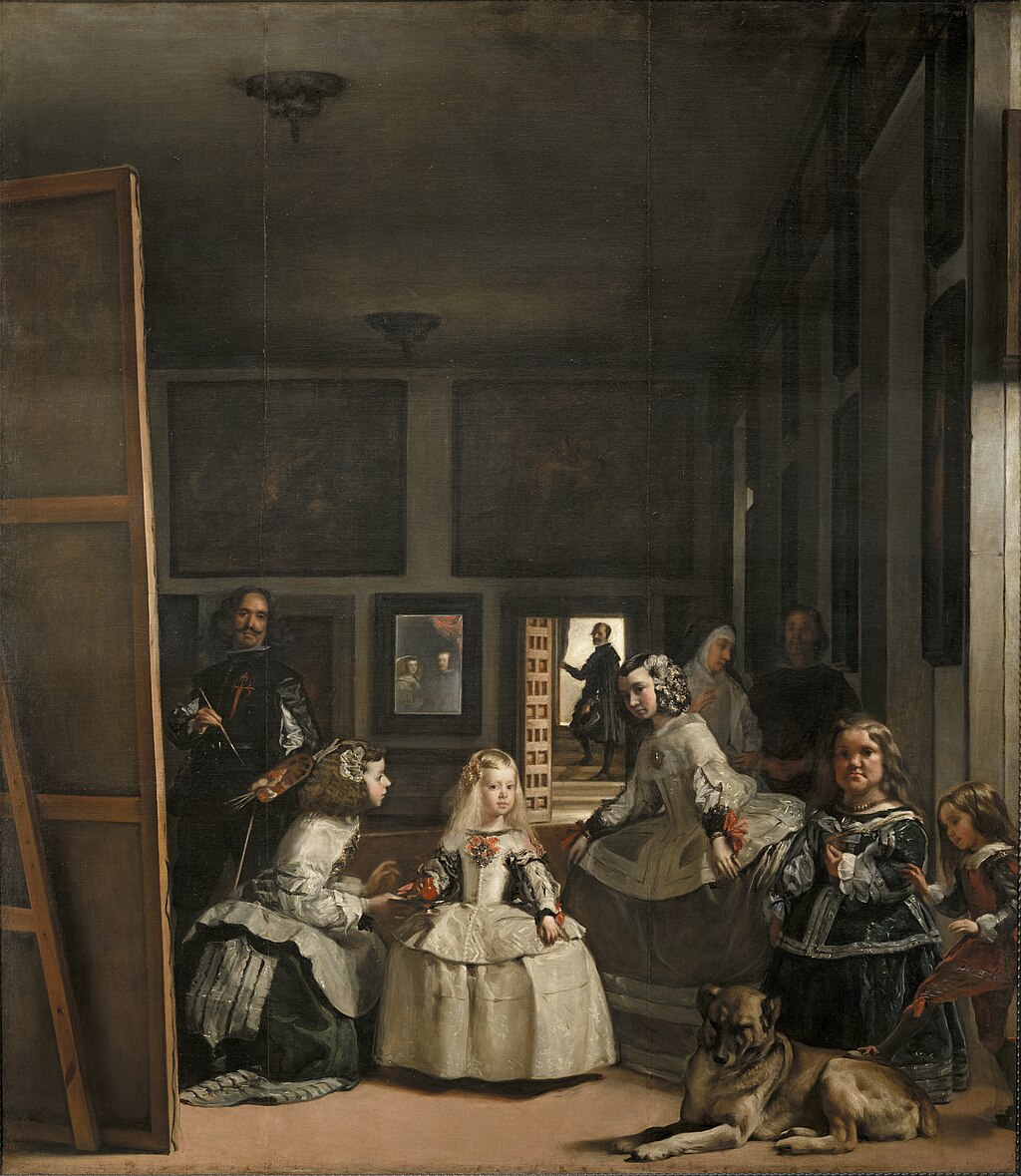
The first thing any viewer notices in Las Meninas is the presence of the painter himself. On the left, a tall man with brush in hand stands before a large canvas whose back faces us — looking directly at us. It is Diego Velázquez, then First Painter to the Chamber of King Philip IV of Spain. This self-representation is anything but incidental: Velázquez was using it to claim the noble status of painting, at a time when artists were regarded as craftsmen. His red cross of the Order of Santiago — painted, according to some historians, after his death on the king's instruction — confirms this drive for social elevation.
But whom exactly is he painting? That is where the enigma begins. The great canvas whose back we see might be Las Meninas itself — which would create a dizzying mise en abyme. Or it might be a portrait of the king and queen, whose faces appear in the mirror at the back.
The mirror: keystone of the picture
At the back of the room, slightly off-centre to the right, a mirror reflects two half-length figures: King Philip IV and Queen Mariana of Austria. Yet these two people appear nowhere else in the painting. Where are they? The logical answer is that they are standing where we are — in front of the picture, outside the frame.
This arrangement creates a vertiginous system of gazes. Velázquez looks towards us — that is, towards the king. The Infanta looks towards us — that is, towards her parents. We look at the picture — and find ourselves in the king's place. The mirror makes the viewer a participant in the scene.
Who are the figures in Las Meninas?
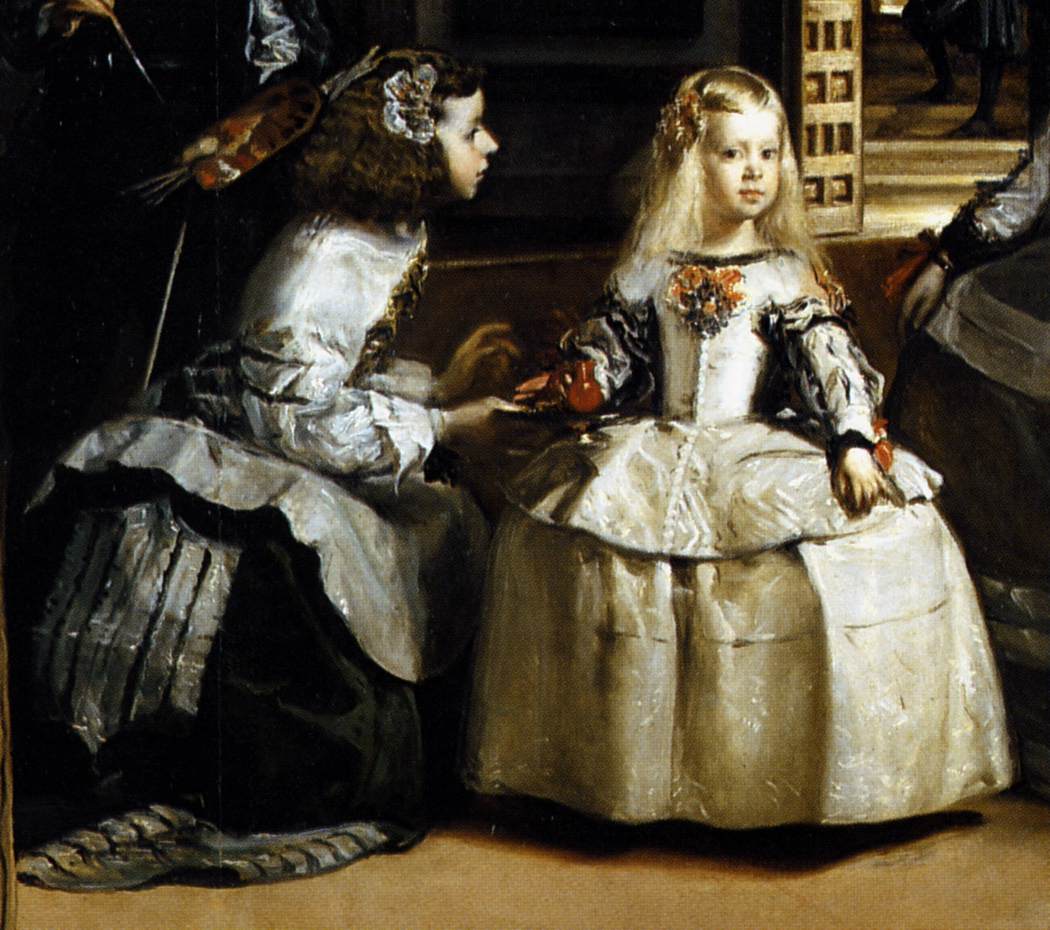
Eleven figures populate this scene set in a workroom of the Alcázar palace in Madrid. The Infanta Margarita Teresa, the king's five-year-old daughter, holds the luminous centre of the picture. On either side, two meninas (Portuguese ladies-in-waiting): Isabel de Velasco on the left, proffering a vase, and María Agustina Sarmiento on the right, kneeling towards her. Behind them, a duenna and a bodyguard. At the far right, two dwarfs — Mari Bárbola and Nicolás Pertusato, who is nudging the dog lying in the foreground.
In the background, an open doorway frames José Nieto, the queen's chamberlain, who stands silhouetted in the light of a corridor. His presence creates a third space — between the enclosed room and a luminous elsewhere — deepening the picture's spatial complexity still further.
Light as a narrative instrument
Velázquez's mastery of light in Las Meninas is among the most admired aspects by painters who have studied the work. He uses lateral light entering through windows on the right side of the picture, which illuminates each group of figures differently. The Infanta receives the most direct light, emphasising her centrality. The figures in the background are progressively absorbed by shadow.
This organisation of light creates a visual hierarchy without inscription — a staging of power through luminosity rather than positioning. Velázquez does not place the king at the centre; he places the light where the king's gaze should fall.
Foucault and classical representation
In 1966, the philosopher Michel Foucault opened his major work The Order of Things with a long and meticulous analysis of Las Meninas. For him, the painting is the pictorial manifesto of classical representation: it shows how seventeenth-century painting attempts to represent representation itself, by including the viewer, the viewed and the viewing in a system that no longer has a stable centre.
The invisible king in the mirror, the absence of the canvas Velázquez is painting, the painter's direct gaze at the viewer: all of this, according to Foucault, expresses the aporia of classical representation — its impossibility of grasping itself. The painting becomes a philosophical document as much as an artistic one.
Picasso face to face with Las Meninas: 58 variations
The influence of Las Meninas on art history is immense. The most striking example is Picasso, who devoted an entire series of 58 paintings to reinterpreting the work between August and December 1957. Fragmenting the figures into Cubist planes, redistributing the light, altering proportions, Picasso sought through practice to understand what Velázquez had achieved. These variations are today displayed at the Museu Picasso in Barcelona in a dedicated room.
Francis Bacon, Salvador Dalí, Joel Meyerowitz in photography, and dozens of other artists have in turn proposed their own readings. Las Meninas has become a matrix: a formal device that each generation reinterprets in the light of its own questions about the gaze, power and representation.
A painting in its time: the court of Philip IV
To fully grasp Las Meninas, one must recall the context in which Velázquez was painting: the court of Philip IV of Spain, one of the most formal and hierarchical in Europe. Court etiquette there was absolute. The proximity to the Infanta, the crossed gazes between a servant and the royal family, the presence of the painter in a court scene — all of this was codified to the millimetre. That Velázquez managed to slip a philosophical enquiry into the nature of his own art into this context is a political feat as much as an artistic one.