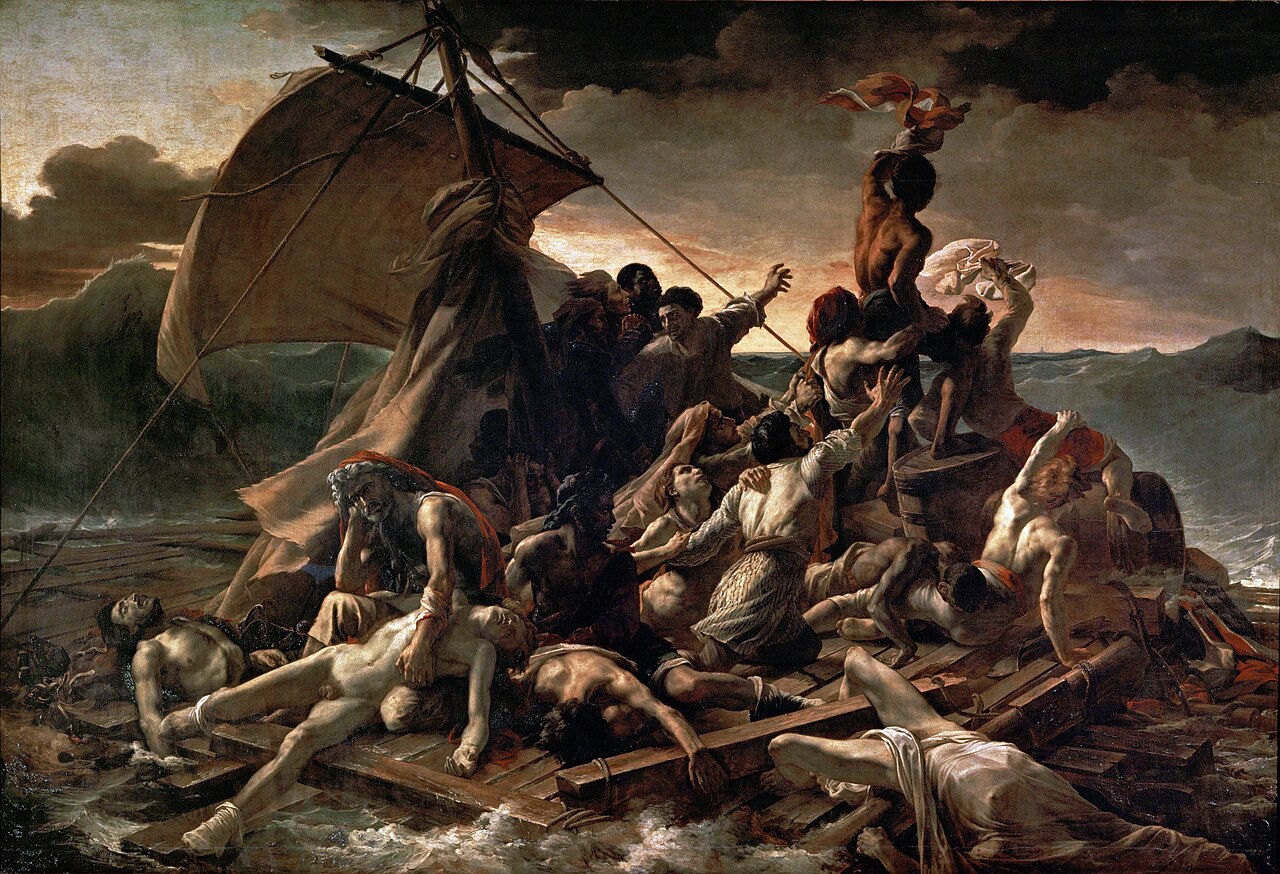
The wreck of the Méduse: a national scandal
On 2 July 1816, the French frigate Méduse ran aground on a sandbank off Mauritania, en route to Senegal. The captain, Hugues Duroy de Chaumareys — an aristocrat with no seafaring experience, appointed by the restored monarchy of Louis XVIII through favouritism — abandoned 147 passengers and crew on a makeshift raft twenty metres long. The lifeboats, reserved for officers and wealthy passengers, quickly pulled away, cutting the ropes that connected them to the raft.
What followed was thirteen days of hell: violence among the castaways, cannibalism to survive, madness and despair. When a ship finally sighted the raft on 17 July, only 15 survivors remained from the original 147. The affair broke in the newspapers and became a symbol of the incompetence and nepotism of the Restoration. Louis XVIII's government tried to bury the scandal. Géricault decided to paint it.
A year's preparation: Géricault's method
Géricault did not improvise. Over eighteen months he conducted a thorough investigation into the disaster. He met and questioned two survivors — the surgeon Jean-Baptiste Savigny and the geographic engineer Alexandre Corréard — who would themselves publish a damning account of the shipwreck. He visited Parisian hospitals to study the bodies of the sick and dying, bringing amputated limbs and severed heads back to his studio to paint flesh with unprecedented anatomical exactness.
He had a near-life-size model of the raft built in his studio to understand its geometry and movement. He made dozens of preparatory studies, searching for the precise moment to depict: the horror of the first nights? The desolate calm? The mutiny? He finally settled on the instant when the Argus, the rescue ship, is spotted on the horizon — a moment of extreme tension between nascent hope and death already installed.
The pyramidal composition: a rhetoric of despair
The picture's composition is a masterpiece of dramatic construction. The eye enters from the lower left corner, where the dead and dying lie — faces pressed to the floor or trailing in the water. It climbs along bodies that grow progressively more active, more upright, towards the apex of the pyramid: a Black man standing — Géricault deliberately placed him at the summit, an anti-slavery gesture before its time — waving a red cloth towards the distance.
This ascending pyramid from despair to hope structures the entire picture. It pulls the eye upward and to the right, towards a horizon heavy with dark clouds but pierced by a livid light. The rescue ship is so distant it can barely be seen — perhaps too far, perhaps it will not come.
The scandal at the 1819 Salon
When Géricault exhibited The Raft of the Medusa at the Paris Salon in August 1819, the effect was immediate and violent. The subject was as political as it was artistic: everyone knew the wreck was the fault of a captain appointed through favouritism, that survivors had been abandoned by royalist officers, and that the government had tried to suppress the affair. To paint this scene in monumental format at an official Salon was to display a political accusation in a room guarded by the king's own officials.
The jury could not reject the painting without causing an even greater scandal. It accepted it but awarded it a consolation medal. The press divided violently: royalists denounced the picture as seditious and ugly; liberals hailed it as courageous and new. Géricault did not sell the canvas. He took it on tour to London in 1820, where it met with great public success.
The artistic legacy: the birth of Romanticism
The young Eugène Delacroix, who had posed as a model for one of the foreground figures, immediately understood what Géricault had accomplished. The Raft of the Medusa broke with two centuries of classical history painting: it chose a contemporary and sordid subject rather than a noble mythological scene, painted suffering and deformed bodies rather than idealised heroes, and transformed the classical composition into an emotional machine.
Géricault died in 1824, aged 32, from the effects of a fall from a horse. He would not live to measure the full extent of his influence. But this painting, on display at the Louvre since 1824, changed the course of French painting — and with it, that of European Romanticism as a whole.