Florence, les Médicis et le néoplatonisme
Pour comprendre La Naissance de Vénus, il faut comprendre la Florence des Médicis à la fin du XVe siècle. Laurent de Médicis a fait de sa cour le foyer d'un renouveau intellectuel et artistique sans précédent, centré sur la redécouverte de la philosophie grecque et notamment du néoplatonisme. Marsile Ficin, philosophe et traducteur de Platon, y développe l'idée d'une Vénus céleste — Venus Coelestis — symbole de la beauté divine et de l'amour spirituel, distincte de la Vénus terrestre, incarnation du désir charnel.
C'est dans ce contexte qu'il faut lire le tableau de Botticelli. La déesse qui surgit des eaux n'est pas simplement une figure érotique — c'est l'incarnation visible de la beauté idéale, pont entre le monde divin et le monde humain. Sa nudité n'est pas vulgaire mais sacrée : elle symbolise la pureté de l'âme non encore recouverte par la matière.
La composition : lecture et symbolisme
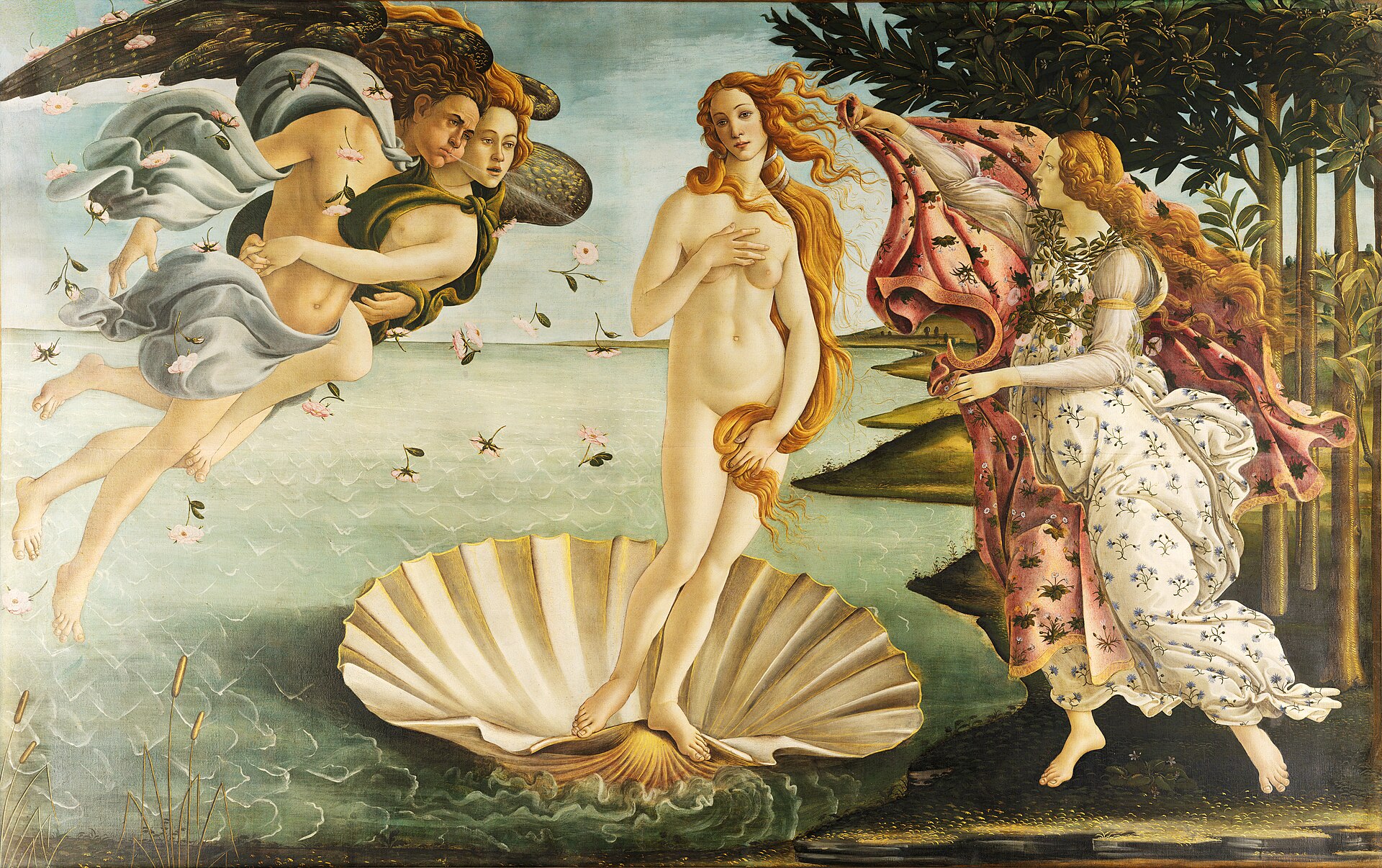
La scène s'organise autour d'un axe central : Vénus debout sur sa coquille, dans la pose pudique dite Venus Pudica empruntée à la sculpture antique. À sa gauche, Zéphyr — dieu du vent de l'Ouest — enlace une figure féminine, peut-être Chloris ou la nymphe des vents Aura, et tous deux soufflent vers la déesse. Des roses, symbole de Vénus et de l'amour, voltigent dans leur souffle.
À droite, l'une des Grâces ou une nymphe s'approche d'un manteau fleuri pour couvrir Vénus. Ce manteau orné de fleurs de printemps est identique à celui que porte une des Grâces dans Le Printemps — autre grand tableau de Botticelli, peint presque au même moment. Les deux œuvres semblent former un diptyque thématique sur le cycle de la beauté et de l'amour.
La technique : tempera et lignes de grâce
Botticelli choisit pour ce tableau la tempera — pigments liés à de l'œuf — sur toile de lin enduite, un support inhabituel pour l'époque où le panneau de bois restait la norme. Ce choix lui permet des couleurs d'une luminosité particulière et des lignes d'une précision extrême. La chevelure de Vénus, portée par le vent en sinuosités complexes, est l'un des exemples les plus admirés de virtuosité linéaire de toute la Renaissance.
La silhouette de Vénus elle-même révèle une liberté par rapport aux canons anatomiques stricts : son cou est légèrement allongé, son épaule gauche descend plus bas qu'en réalité, sa taille est affinée. Ces déformations ne sont pas des maladresses mais des choix délibérés pour accentuer la grâce du mouvement et la douceur des courbes — ce que l'on appelle la grazia botticellienne.
Qui est le modèle de Vénus ?
La tradition, solidement ancrée dans la culture populaire, veut que le modèle de Vénus soit Simonetta Vespucci, jeune beauté florentine célébrée par les poètes et aimée — à distance — par Julien de Médicis, frère de Laurent. Elle est morte de tuberculose à 23 ans en 1476, soit plusieurs années avant que Botticelli ne peigne ce tableau. La distance temporelle n'invalide pas l'hypothèse : Botticelli aurait gardé en mémoire ou utilisé des études antérieures pour construire ce visage idéal.
Cette identification n'est cependant pas prouvée documentairement. Elle appartient au domaine de la tradition florentine, colportée par des chroniqueurs de l'époque et magnifiée par les siècles suivants. Ce qui est certain, c'est que Botticelli recherchait un type féminin idéal — ni portrait, ni allégorie pure — qui incarnerait la beauté néoplatonicienne sans se réduire à un individu particulier.
L'influence de La Naissance de Vénus
Redécouverte au XIXe siècle — le tableau avait été à peu près oublié pendant trois siècles — La Naissance de Vénus est devenue l'une des images les plus reproduites de l'histoire de l'art occidental. Les préraphaélites anglais, notamment Dante Gabriel Rossetti et Edward Burne-Jones, en font une référence fondatrice pour leur propre quête de la beauté médiévale et renaissante.
Au XXe et XXIe siècles, le tableau a été décliné en publicité, mode, cinéma, musique et art contemporain à des milliers d'exemplaires. Sa silhouette est instantanément reconnaissable — et c'est précisément cette reconnaissance qui l'a transformée en icône culturelle dépassant largement le monde de l'art. De Warhol à la culture numérique, la pose de Vénus sur sa coquille est devenue un signe universel de féminité et de beauté idéale.
La Naissance de Vénus aux Offices : une expérience unique
Exposée à la Galerie des Offices de Florence depuis le XVIIe siècle, La Naissance de Vénus se trouve dans la salle 10-14 du musée, où elle fait face au Printemps du même Botticelli. Voir ces deux œuvres ensemble, dans leurs vraies dimensions et leur vraie lumière, est une expérience que les reproductions ne peuvent pas transmettre : la transparence des voiles, le modelé de la peau, la complexité des chevelures, tout cela n'existe vraiment que devant l'original.