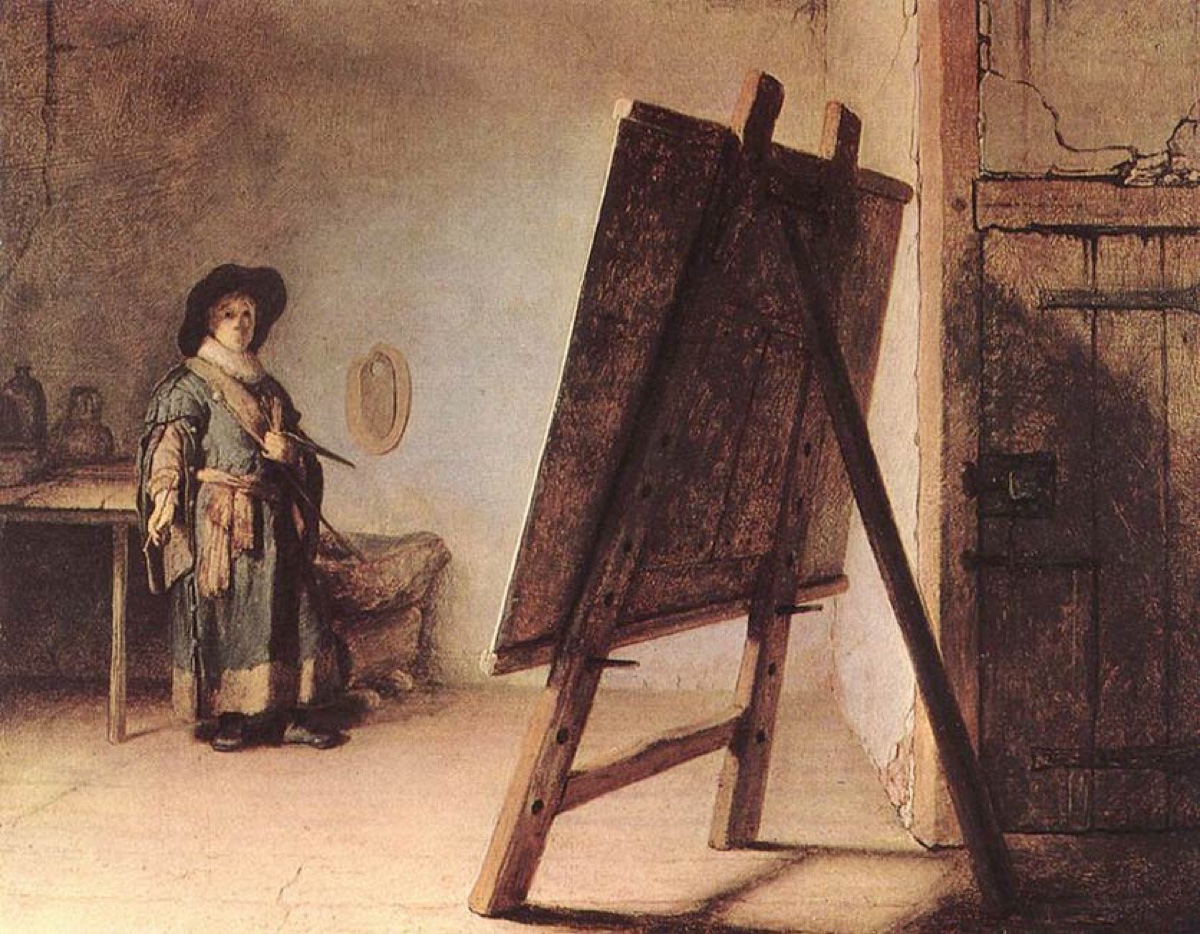
Self-portrait with easel
Artwork by Rembrandt • 1628
🖼️ Reproduce this artwork — 📗 Book on Rembrandt on Amazon
About this artwork - painting analysis
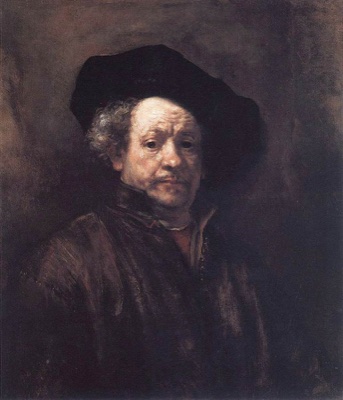
At only twenty-two years old, Rembrandt affirms himself as an autonomous artist with Self-Portrait with Easel, one of his earliest declarations as such. Painted in 1628 in Leiden, this small canvas – barely 25 by 32 centimeters – reveals the young painter in the intimacy of his studio, dressed in a theatrical costume with silky reflections, wearing a wide-brimmed hat and holding palette and brushes. The central element of the composition is none other than the easel itself, monumentalized by an audacious perspective that makes it dominate the pictorial space. This staging powerfully affirms the dignity of the artistic profession, an essential claim in Dutch Golden Age society, which was still marked by a hierarchy of trades.
The chromatic palette concentrates on earthy tones – warm browns, golden ochres, and subtle grays – that already announce Rembrandt's mastery of chiaroscuro, characteristic of his style. The light, diffuse and natural, bathes the walls of the spartan studio where a few objects – an oval frame, simple furnishings – suffice to suggest the work environment. This economy of means reveals the influence of Caravaggio and the Utrecht school, while testifying to a personal search for the representation of space and human presence. The brushwork, already assured, alternates smooth areas and impasto that structure the volumes with remarkable freedom for so young an artist.
Held at the Museum of Fine Arts in Boston, this painting belongs to the long series of self-portraits – nearly a hundred – through which Rembrandt explored his own face and questioned his identity as an artist. This youthful work marks a turning point: it does not simply show a face but proclaims a social and intellectual status. By representing himself in his studio, Rembrandt places painting among the liberal arts and asserts himself as a creator rather than a mere craftsman, a revolutionary stance that would durably influence the modern conception of the artist in Europe.
If you appreciate "Self-portrait with easel" and other paintings by Rembrandt, we offer you 10% off the purchase of an art poster from our partner europosters with the promo code GRANDSPEINTRES10.
Image license: faithful photographic reproduction of a two-dimensional public domain work of art.