
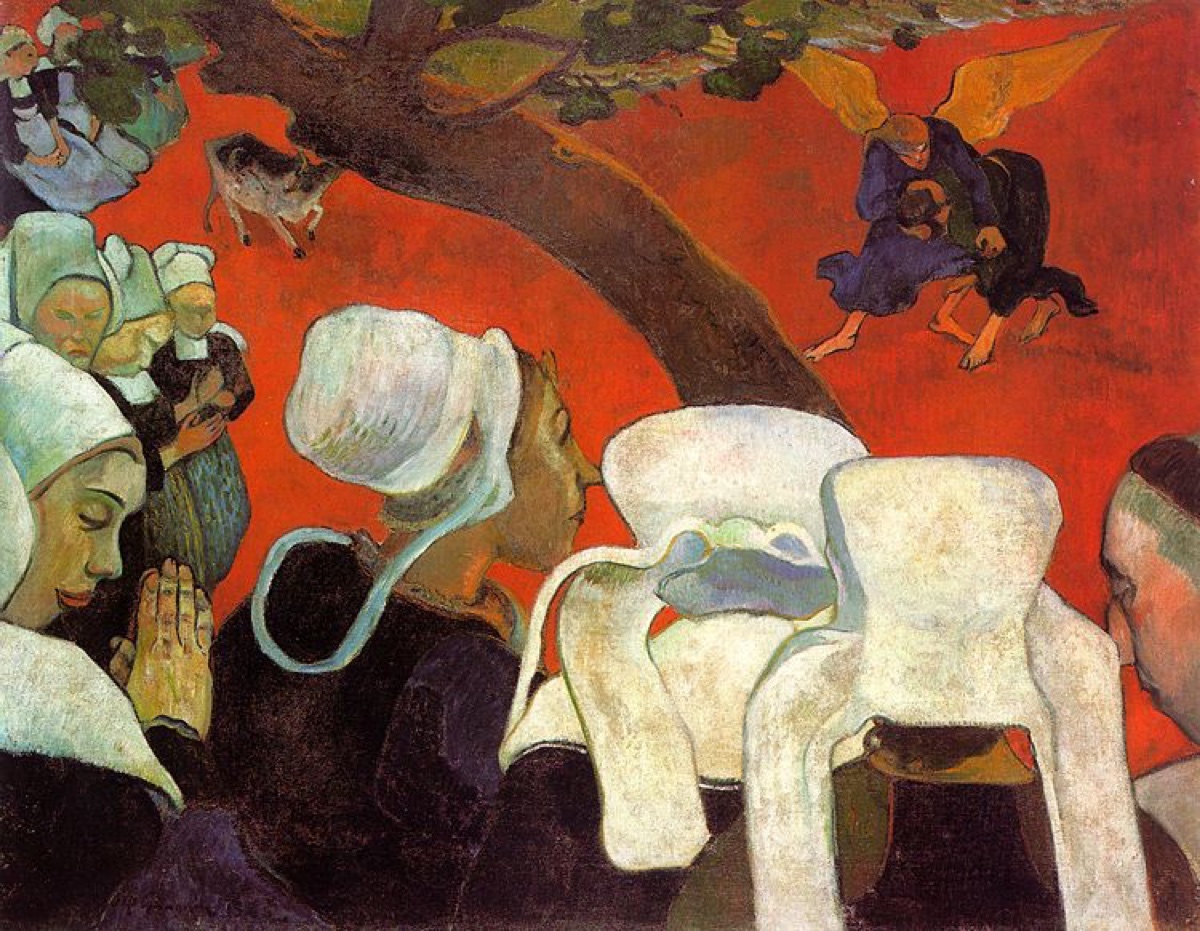
Vision After the Sermon
Artwork by Paul Gauguin • 1888
🖼️ Reproduce this artwork — 📗 Book on Paul Gauguin on Amazon
About this artwork - painting analysis
Paul Gauguin disrupts the conventions of religious painting with Vision After the Sermon, a manifesto canvas created in 1888 during his stay in Pont-Aven in Brittany. The artist transposes a biblical episode – Jacob's struggle with the angel – into the imagination of a group of devout Breton women leaving Sunday mass. This bold fusion between reality and spiritual vision marks a decisive break with Impressionism and academic naturalism.
The composition immediately strikes with its incandescent chromaticism and radical spatiality. An intense vermillion red, almost unreal, fills the background and unifies the scene in a visionary atmosphere. In the foreground, peasant women wearing their imposing traditional white headdresses cluster on the left, while the biblical struggle unfolds in an undefined space, separated by the bold diagonal of a tree trunk cutting across the canvas. This division creates a symbolic fracture between the earthly world of the faithful and the supernatural realm of their inner contemplation. The horizontal format of 73 x 92 centimeters amplifies this compositional tension, while the flat areas of pure colors – brilliant whites, deep blues, dense blacks – testify to a revolutionary formal simplification.
Gauguin develops here the foundations of Synthetism, a movement that rejects faithful rendering of nature in favor of symbolic and decorative expression. Influenced by Japanese prints, Breton popular imagery, and medieval stained glass, he abandons traditional perspective and modeling in favor of forms outlined by dark contours and bold chromatic harmonies. This technique, called Cloisonnism, directly inspires the Nabis movement and foreshadows the Fauvist research of the early twentieth century.
Held at the National Galleries of Scotland in Edinburgh, this seminal work embodies Gauguin's spiritualist and primitivist turn, as he sought in rural Brittany a primitive authenticity removed from Parisian modernity. Vision After the Sermon remains an essential milestone in the emergence of modern art, freeing color from any descriptive function to make it a vector of pure emotion.
If you appreciate "Vision After the Sermon" and other paintings by Paul Gauguin, we offer you 10% off the purchase of an art poster from our partner europosters with the promo code GRANDSPEINTRES10.
Image license: faithful photographic reproduction of a two-dimensional public domain work of art.


