
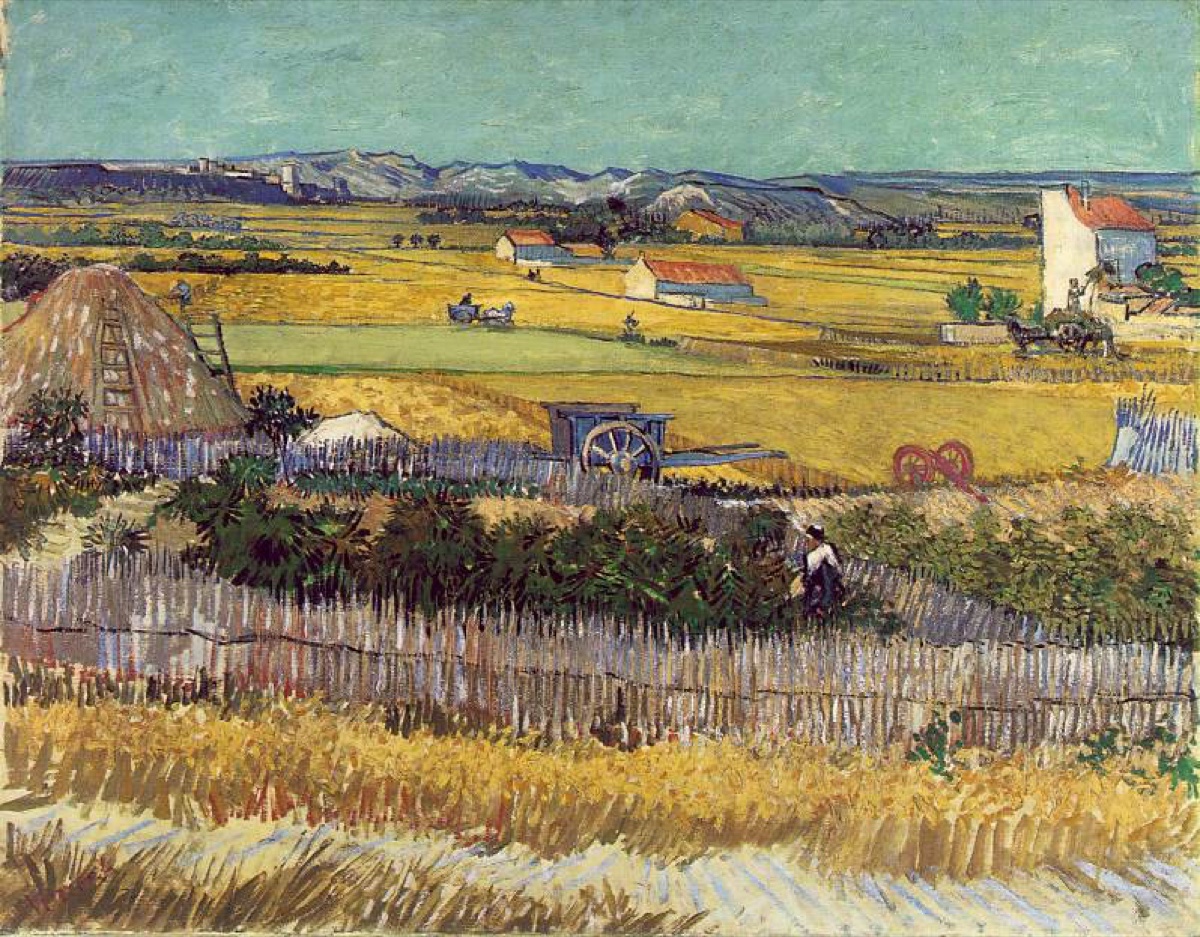
The Plain of the Crau with the Ruins of Montmajour
Artwork by Vincent Van Gogh • 1888
🖼️ Reproduce this artwork — 📗 Book on Vincent Van Gogh on Amazon
About this artwork - painting analysis
Painted during the summer of 1888, The Plain of the Crau with the Ruins of Montmajour bears witness to Vincent Van Gogh's amazement at the Provençal landscapes. Having settled in Arles just a few months earlier, the Dutch artist discovers this vast agricultural expanse, which he compares to the plains of his native country, while celebrating the intense luminosity of southern France. This canvas captures a rural panorama teeming with activity, where golden wheat fields unfold, enclosed vegetable gardens, farms with orange-tiled roofs and, on the horizon, the remains of Montmajour abbey standing out against bluish hills.
The composition reveals a bold structuring of space, organized in successive horizontal bands that guide the viewer's eye from the foreground to distant mountains. Van Gogh favours a striking palette dominated by the luminous yellows of the harvest, contrasting with the deep greens of market gardens and the turquoise blue of the Provençal sky. His characteristic brushwork – sometimes in tight hatching, sometimes in vibrant flat areas – animates every section of the painting with a particular energy. Short, directional brushstrokes evoke the texture of ploughed fields, the density of hedgerows, the imperceptible movement of the summer air. This Post-Impressionist technique conveys not only visible reality, but also the painter's physical and emotional sensations when confronted with the subject.
Created at the height of his Arles period, this work perfectly illustrates Van Gogh's ambition to create modern art rooted in rural life and the labour of the earth. The artist makes numerous excursions into the Crau, fascinated by this agricultural territory which he documents with an almost topographical precision while infusing it with his Expressionist vision. Held at the National Gallery in London, this major work embodies the successful synthesis between naturalistic observation and subjective transcription, foreshadowing the chromatic and gestural boldness that would profoundly mark twentieth-century art.
If you appreciate "The Plain of the Crau with the Ruins of Montmajour" and other paintings by Vincent Van Gogh, we offer you 10% off the purchase of an art poster from our partner europosters with the promo code GRANDSPEINTRES10.
Image license: faithful photographic reproduction of a two-dimensional public domain work of art.
Livres recommandés sur Vincent Van Gogh
Sélection de livres de référence disponibles sur Amazon

Van Gogh. L'Œuvre complète - Peinture
Ingo F. Walther, Rainer Metzger (Taschen)
19,00 € Voir sur Amazon →
Van Gogh - Biographie
David Haziot
10,90 € Voir sur Amazon →
Van Gogh. Tout l'œuvre peint
Ingo F. Walther, Rainer Metzger (Taschen)
48,62 € Voir sur Amazon →
Vincent Van Gogh, les dernières lettres
Emmanuel Coquery
14,54 € Voir sur Amazon →


