
The Flayed Ox
Artwork by Rembrandt • 1655
🖼️ Reproduce this artwork — 📗 Book on Rembrandt on Amazon
About this artwork - painting analysis
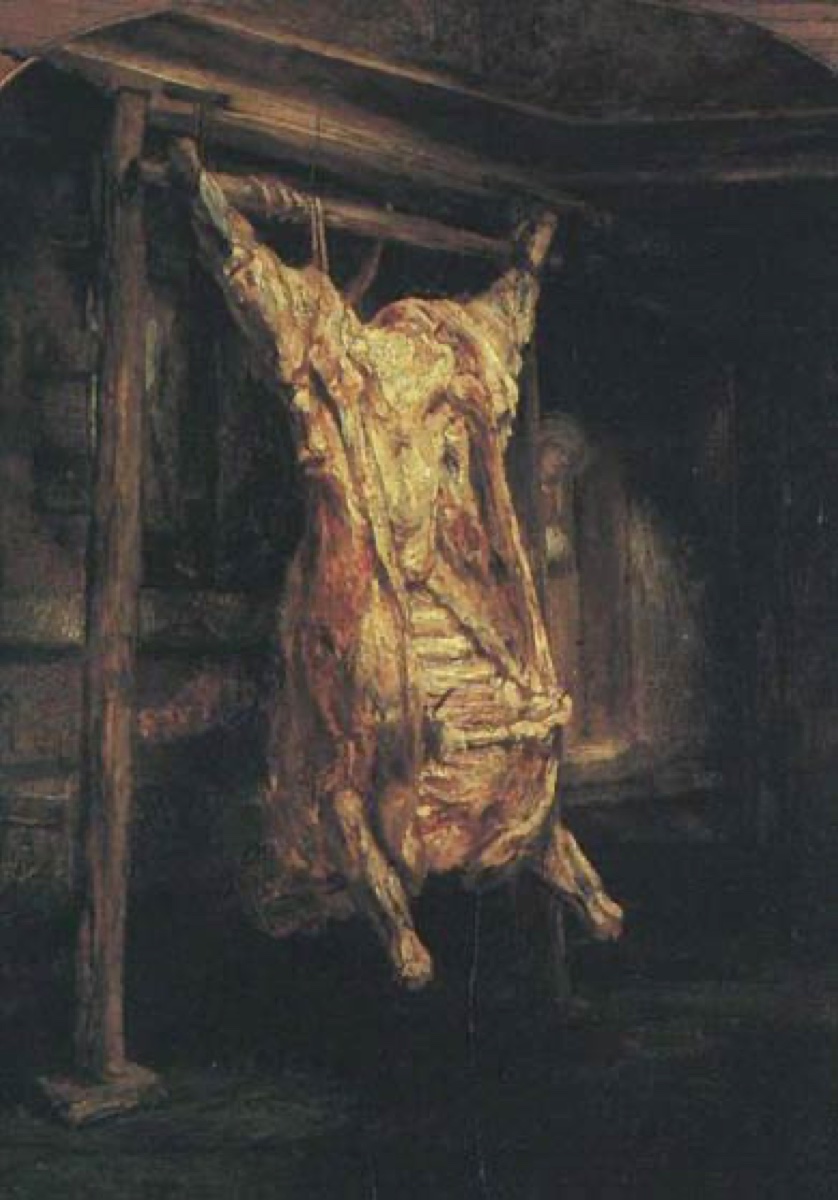
Dark, carnal, and captivating, Rembrandt's Slaughtered Ox, painted in 1655, stands as one of the most radical and unsettling still lifes of the Dutch Golden Age. At the heart of a shadowy interior, a butchered ox carcass hangs from a wooden bar, its open flesh exposed in an almost anatomical rawness, glistening with blood. The flayed animal, suspended by its hind legs, reveals its ribs, muscles, and fatty tissues in a symphony of yellows, ochres, and deep reds. In the darkness of the background, one can barely make out a female silhouette, probably a servant, observing the scene with discretion.
Rembrandt's technical virtuosity shines through in his treatment of this organic matter. The Dutch master applies paint in thick, nervous brushstrokes, creating textures that give the flesh an almost tactile presence. His chromatic palette, dominated by deep browns and velvety shadows, makes the carcass burst forth in a golden light that sculpts every fold of meat. This approach to chiaroscuro, characteristic of the Baroque style, transforms a trivial subject into a visual meditation of rare intensity. The painter's fascination with light contrasts and textures finds here one of its most audacious achievements.
Far from being a simple butcher's study, this work belongs to the Flemish and Dutch tradition of vanitas paintings, reminding us of mortality and the carnal condition of human existence. Housed in the Louvre Museum in Paris, this masterpiece has fascinated many modern artists, from Soutine to Bacon, who recognized in it an unflinching exploration of living matter. Through its brutal realism and metaphysical dimension, The Slaughtered Ox transcends the genre of still life to become a pictorial meditation on life, death, and beauty in abjection.
If you appreciate "The Flayed Ox" and other paintings by Rembrandt, we offer you 10% off the purchase of an art poster from our partner europosters with the promo code GRANDSPEINTRES10.
Image license: faithful photographic reproduction of a two-dimensional public domain work of art.


