


House in Provence
Artwork by Paul Cézanne • 1884
🖼️ Reproduce this artwork — 📗 Book on Paul Cézanne on Amazon
About this artwork - painting analysis
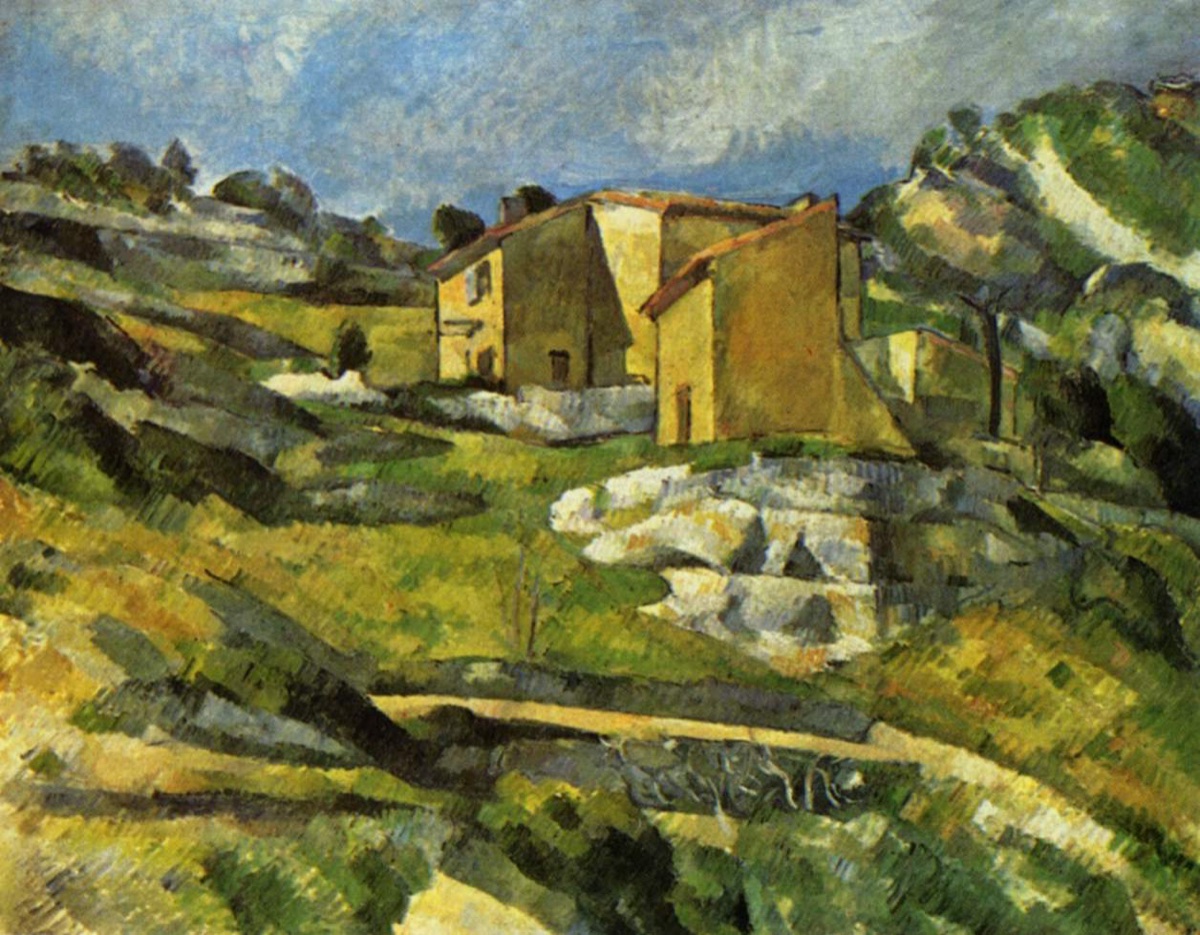
Paul Cézanne painted House in Provence in 1884, while staying in his native region, around Aix-en-Provence. This canvas bears witness to his visceral attachment to the Mediterranean landscape and his stubborn quest to convey the solidity and permanence of nature. At the center of the composition stands a cluster of buildings with ochre-yellow walls, bathed in intense southern light. These architectural volumes, set on uneven terrain scattered with white rocks, assert themselves as the true protagonists of the painting. The geometric construction of the facades, underscored by roofs in russet tones, dialogues with the undulations of the terrain and surrounding vegetation.
The color palette reveals all of Cézanne's sensitivity to Provençal harmonies: the deep yellows of the walls contrast with the nuanced greens of the vegetation, while the luminous whites of the limestone rocks structure the foreground. The sky, treated in blue-grey tones, brings a touch of freshness to the whole. The brushwork, characteristic of the Aix master's artistic maturity, proceeds through successive planes and constructive touches that simultaneously shape form and space. This technique, which fragments the surface to better reconstitute visual totality, foreshadows the plastic upheavals of the early twentieth century.
This period marks a decisive turning point in Cézanne's evolution, as he gradually distances himself from Impressionism to develop a personal pictorial language. Unlike the Impressionists who privilege the ephemeral, he seeks the permanent structure beneath changing appearances. The rigorous composition of House in Provence, with its oblique lines that punctuate space and its volumes treated as natural architectures, illustrates this ambition to reveal the framework of the visible world.
Held at the National Gallery of Art in Washington, this work embodies the Cézannian synthesis between sensitive observation and intellectual construction. It prefigures Cubist research and durably influences modern art, making Cézanne the spiritual father of twentieth-century avant-gardes.
If you appreciate "House in Provence" and other paintings by Paul Cézanne, we offer you 10% off the purchase of an art poster from our partner europosters with the promo code GRANDSPEINTRES10.
Image license: faithful photographic reproduction of a two-dimensional public domain work of art.
Livres recommandés sur Paul Cézanne
Sélection de livres de référence disponibles sur Amazon


