
The Massacre of the Innocents
Artwork by Peter Paul Rubens • 1621
🖼️ Reproduce this artwork — 📗 Book on Peter Paul Rubens on Amazon
About this artwork - painting analysis
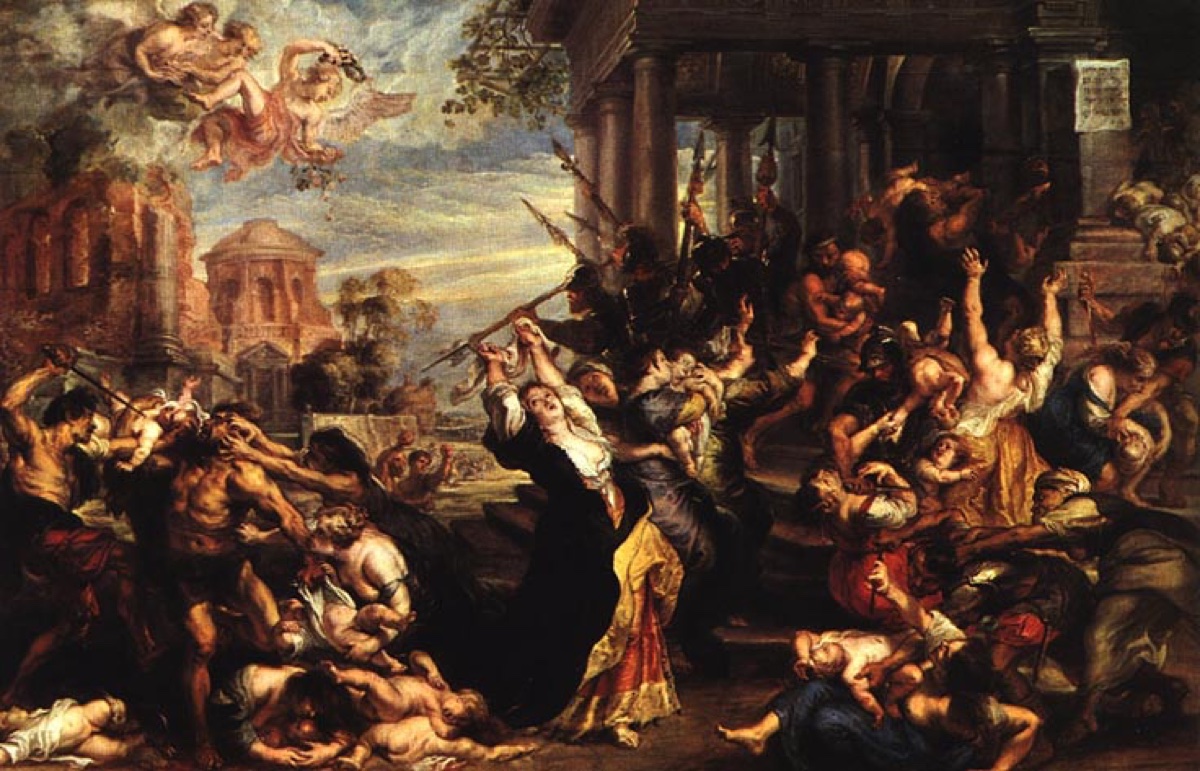
Commissioned by the Duke of Bavaria Maximilian I to adorn his Munich residence, "The Massacre of the Innocents" by Peter Paul Rubens stands as one of the most powerful and dramatic achievements of the Flemish master. Painted in 1621, this monumental canvas illustrates the biblical episode in which King Herod orders the execution of all newborns in Bethlehem, hoping thereby to eliminate the Christ Child. Rubens deploys his full genius here to represent violence and chaos: a dense crowd of soldiers, grief-stricken mothers, and martyred children occupies nearly the entire pictorial space, creating a sensation of suffocation and tragic urgency.
The Baroque composition is characterized by a centrifugal dynamic in which bodies intertwine in a whirlwind of desperate gestures. Mothers raise their arms to heaven in supplication while executioners brandish their weapons with relentless determination. Rubens masterfully commands human anatomy, sculpting the muscular bodies of soldiers and the tender flesh of victims with a precision inherited from his Italian sojourn and his thorough study of Michelangelo. The chromatic palette opposes warm tones – ochres, blood reds, and golds – against deep shadows, accentuating the contrast between the divine light emanating from the upper left corner, where celestial figures appear, and the earthly darkness of the massacre.
This work testifies to the pinnacle of Flemish Baroque, a movement that privileges emotional intensity, theatrical movement, and decorative profusion. Rubens applies his virtuoso technique in service of dramatic narrative: energetic brushstrokes and generous pictorial matter infuse the scene with an almost palpable vitality. The artist succeeds in reconciling anatomical realism and pathetic expression, transforming an atrocious subject into a visually gripping spectacle.
Preserved at the Alte Pinakothek in Munich, this version of the Massacre of the Innocents remains a brilliant demonstration of Rubens's talent for conveying human violence without ever sacrificing formal beauty, thereby establishing a major reference point for future generations of European Baroque painters.
If you appreciate "The Massacre of the Innocents" and other paintings by Peter Paul Rubens, we offer you 10% off the purchase of an art poster from our partner europosters with the promo code GRANDSPEINTRES10.
Image license: faithful photographic reproduction of a two-dimensional public domain work of art.


